The Platform
Ports, Power, and the Rising Competition in the Horn of Africa
03.09.2026
Strategic ports in the Horn of Africa have become focal points of global power competition over critical Red Sea trade routes.
Strategic competition along the Red Sea and the Gulf of Aden has intensified in recent years, turning the Horn of Africa into a central arena of global maritime geopolitics. At the heart of this competition lies the Bab-el-Mandeb Strait, one of the world’s most critical chokepoints. The narrow waterway connects the Indian Ocean to the Mediterranean through the Suez Canal and carries vast volumes of global commerce, including energy supplies and manufactured goods. Because of this geographic reality, control over access to the region’s ports has become a priority not only for nearby states but also for major powers far beyond the region.
Djibouti offers perhaps the clearest example of how geography can reshape a nation’s strategic importance. The small state sits directly along the Bab-el-Mandeb corridor and today hosts an extraordinary concentration of foreign military installations. The United States operates Camp Lemonnier there, its only permanent military base on the African continent. China, France, Japan, and Italy also maintain facilities in Djibouti, each reflecting its own strategic interests in protecting shipping lanes and maintaining a presence along one of the world’s busiest maritime corridors. The density of these installations illustrates the growing weight attached to the security of the Red Sea and the surrounding sea lanes.
Meanwhile, attention has increasingly turned toward Somaliland’s Port of Berbera. Foreign investment has transformed Berbera from a modest coastal facility into a port with expanding commercial capacity and growing logistical significance along the Gulf of Aden. In Washington, policy discussions have occasionally highlighted Berbera’s potential strategic utility. Across the region, other actors are also strengthening their footholds. Turkey maintains a large military training base in Mogadishu, while the United Arab Emirates has invested heavily in port infrastructure in Berbera and Bosaso. At the same time, instability linked to Houthi activity along Yemen’s Red Sea coastline has amplified security concerns throughout the maritime corridor.
Within this broader geopolitical landscape, Israel’s recognition of Somaliland can be interpreted as part of a larger pattern in which diplomacy intersects with maritime strategy. Rather than standing as a purely political gesture, the move reflects the growing strategic importance of the Horn of Africa itself, a region where infrastructure development, military positioning, and diplomatic alignment increasingly converge around some of the world’s most important shipping routes.
Taken together, these developments demonstrate that ports such as Djibouti and Berbera are no longer peripheral trade outposts. They have become pivotal nodes in a competitive maritime order in which regional rivalries and global power calculations intersect, reshaping both the political landscape of the Horn of Africa and the broader security architecture of the Red Sea–Gulf of Aden corridor.
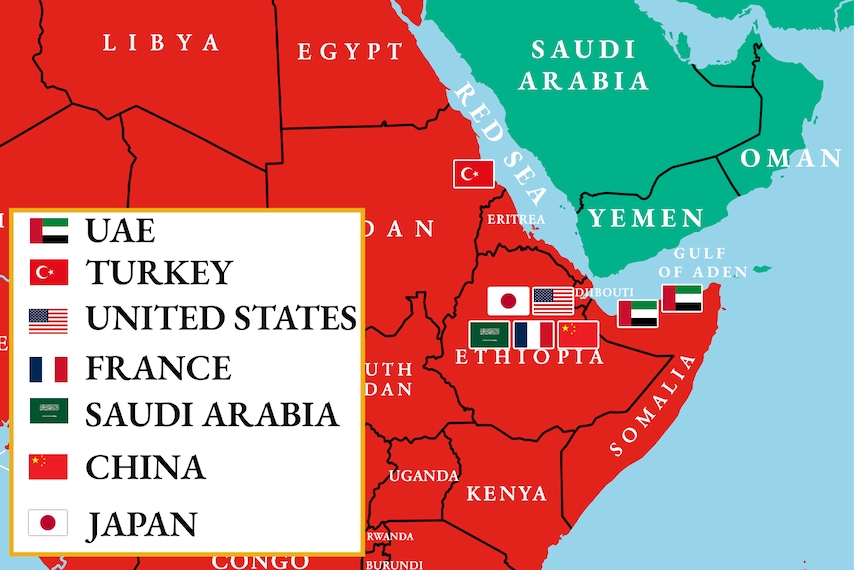
Understanding the current geopolitical contest over strategic maritime ports requires placing recent developments within a longer historical context marked by regional fragmentation, external military presence, and competing foreign interests. The Horn of Africa, which includes Djibouti, Somalia and Somaliland, Ethiopia, Eritrea, and nearby Yemen, sits at the junction of the Red Sea, the Gulf of Aden, and the Indian Ocean. Nearly a third of global maritime trade moves through routes connected to the Suez Canal, many of which pass directly through this region. For global commerce and for national security planners alike, the Horn of Africa occupies a location that is difficult to ignore.
Djibouti: An Epicenter of Military Competition
Djibouti is a small state, but its location along the Bab-el-Mandeb Strait has allowed it to play an outsized role in international security. Since gaining independence from France in 1977, the country has leveraged its strategic geography by hosting foreign military bases, transforming what might otherwise have remained a peripheral economy into a focal point for global power projection. France retained a military presence as a legacy of its colonial history. After the attacks of September 11, 2001, the United States established Camp Lemonnier in 2002, which became the cornerstone of American counterterrorism operations across East Africa and the Arabian Peninsula.
During the 2010s, Djibouti attracted additional foreign bases. China opened its first overseas military facility near the Chinese-operated Port of Doraleh in 2017, enhancing Beijing’s ability to project naval power into the Indian Ocean while protecting its maritime trade routes. Japan established its first long-term overseas Self-Defense Force base in 2011, focusing on protecting commercial shipping and supporting anti-piracy missions. Italy followed with a logistics and support facility in 2013. Smaller contingents and logistical hubs operated by countries such as Germany and Spain further contribute to what has become one of the most concentrated military environments anywhere in the world.
Somalia, Somaliland, and Regional Bases
Somalia’s prolonged civil war, which began in 1991, fractured the country into competing political entities. Following the collapse of the Somali state, the northern regions declared themselves the Republic of Somaliland, a political entity that has operated with relative stability but has struggled for international recognition. Israel has recently emerged as the first state to formally recognize Somaliland.
Elsewhere in Somalia, regional authorities have also become focal points for foreign engagement. Turkey established a large military training base in Mogadishu in 2017 as part of an expanding security partnership with the Somali federal government. At the same time, the United Arab Emirates secured rights to develop and operate facilities at the Port of Berbera beginning in 2016. These developments included expanded naval and air infrastructure that supported logistics and operations connected to the war in Yemen. Across the Gulf of Aden, the UAE also invested in Bosaso in Puntland, creating a logistical hub that reinforced its strategic triangle of influence across the southern Red Sea and the Gulf of Aden.
The Yemen Factor and Regional Power Dynamics
The conflict in Yemen, which began in 2014 when the Houthis captured the capital city of Sanaa, has profoundly reshaped the strategic environment of the wider region. The war emerged from decades of political fragmentation under President Ali Abdullah Saleh, whose shifting alliances weakened central authority. When Saleh’s alliance with the Houthis collapsed in 2017, he was killed, leaving the Houthis in consolidated control of northern Yemen.
In 2015, a Saudi-led coalition intervened to restore the internationally recognized government of President Abdrabbuh Mansur Hadi and to counter what Riyadh perceived as expanding Iranian influence through the Houthis. Although the United Arab Emirates initially joined the coalition, differences in strategic priorities soon emerged. Abu Dhabi began supporting the Southern Transitional Council, a separatist movement that eventually seized much of southern Yemen, including several strategic coastal areas.
By late 2025, UAE-backed forces controlled most of southern Yemen. This shift created tensions with Saudi Arabia and prompted a partial withdrawal of Saudi troops. The fragmentation that followed reflected broader changes in Gulf strategy. Saudi Arabia pursued a more cautious approach focused on containing Houthi influence, while the UAE invested in local proxies to secure key coastal regions. The resulting dual system of authority weakened coordinated operations against the Houthis and further complicated the regional security landscape.
Beyond Yemen itself, the war has destabilized vital maritime corridors. Houthi attacks on shipping in the Red Sea and the Bab-el-Mandeb Strait have forced many vessels to reroute around the Cape of Good Hope, dramatically increasing shipping costs and transit times. For ports in the Horn of Africa such as Berbera, Bosaso, and Djibouti, these disruptions have heightened both strategic risk and strategic opportunity.
Yemen’s war demonstrates how internal fragmentation, external intervention, and proxy competition can ripple outward across an entire region. Local ports and coastal infrastructure have become nodes within a much larger geopolitical contest.
Historically, the international military presence in the Horn of Africa grew out of anti-piracy patrols and counterterrorism missions. Over time, however, it has evolved into a broader competition for influence. Western powers, including the United States, France, Italy, and Japan, operate alongside rising actors such as China and Turkey, as well as Gulf states like the United Arab Emirates and Saudi Arabia. Each pursues overlapping objectives that combine commercial access, maritime security, and geopolitical positioning.
At the same time, internal political dynamics within Somalia and Somaliland intersect with these external rivalries. Strategic ports such as Berbera and Djibouti are therefore not simply economic assets. They have become instruments of power and leverage within an increasingly multipolar regional order.
Port-Centered Power Projection
Recent developments illustrate how geopolitical competition is increasingly organized around maritime infrastructure. Israel’s recognition of Somaliland, the United Arab Emirates’ investments in Berbera and Bosaso, and Turkey’s expanding influence through Mogadishu all reflect a shift in strategic competition channeled through ports rather than through traditional military deployments alone.
In Somaliland, diplomatic recognition and infrastructure development have become closely intertwined. Israel’s recognition of Somaliland in late 2025 links political engagement directly to access to the Port of Berbera. Located near the Bab-el-Mandeb Strait, Berbera offers strategic depth in an era when Red Sea shipping has become increasingly vulnerable to disruption.
At the same time, the United Arab Emirates has consolidated its presence through long-term port agreements in both Berbera and Bosaso. Through the state-linked logistics firm DP World, these ports serve both economic and strategic purposes. They provide logistical access, facilitate security cooperation, and extend Emirati influence across key maritime routes. UAE port diplomacy reflects a broader pattern in which Gulf states project power through infrastructure partnerships and economic agreements rather than solely through military deployments.
Turkey’s involvement in Somalia offers a somewhat different model. By managing Mogadishu Port and operating a large military training base, Ankara has pursued a strategy that integrates port access with state-building and security reform. This approach has strengthened Turkey’s political leverage within Somalia while positioning it as a counterweight to Gulf influence in northern Somali territories.
These overlapping strategies reveal how competition in the Horn of Africa increasingly operates through maritime infrastructure. Ports such as Berbera, Bosaso, and Mogadishu have become focal points where diplomatic recognition, commercial investment, and military cooperation converge.
Why Port Competition in the Horn Matters
The Horn of Africa has emerged as a central arena for geopolitical rivalry largely because of the strategic importance of its maritime corridors. Ports such as Djibouti, Berbera, Bosaso, and Mogadishu now function as instruments of power projection, linking regional rivalries, global security concerns, and local political dynamics.
External actors, including Israel, the United Arab Emirates, and Turkey, use these ports to secure trade routes, extend influence, and gain operational depth without direct entanglement in Middle Eastern conflicts. For local authorities, these partnerships provide opportunities for economic development and political leverage. Yet they also risk deepening fragmentation by aligning different regions with competing external patrons.
The growing militarization of strategic ports increases the possibility that they could become flashpoints in broader conflicts. At the same time, these investments bring infrastructure development, commercial activity, and enhanced maritime security.
In the end, strategic maritime ports in the Horn of Africa have become central points of regional and global interest. Djibouti and Berbera are no longer simply trading hubs. They are arenas where local actors and global powers intersect, shaping political influence, security priorities, and economic opportunity. How these ports are developed, managed, and contested will continue to shape the stability of the Horn of Africa and the security of the maritime routes that connect the region to the wider world.
Mohamed Nouh Rakaab is a researcher, political analyst, and community development specialist focused on governance, state-building, and political stability in fragile contexts across the Horn of Africa.