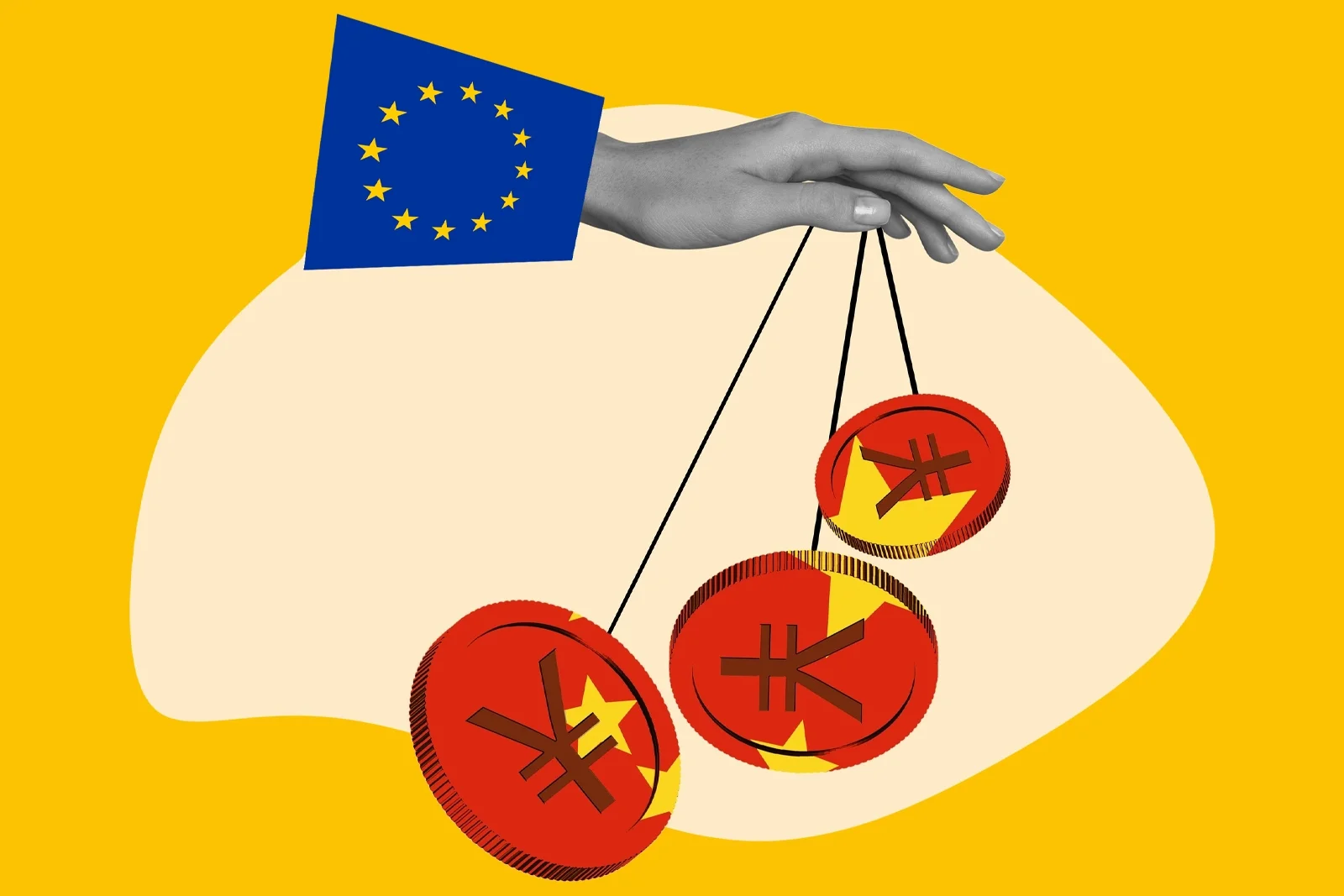

After Years of De-Risking Talk, Europe Faces a China Test
October is shaping up to be a consequential test of whether the European Union is willing to defend its industries against China’s trade practices—or merely continue talking about doing so.
The EU’s next round of trade talks with China will no longer be framed as another attempt to improve market access. Instead, it will measure whether Brussels can turn years of concern over widening imbalances, subsidized competition, and economic dependence into concrete action.
EU Trade Commissioner Maroš Šefčovič has reportedly warned that Beijing must deliver “tangible results” by October or face pressure for tougher measures. The demand establishes a clear political deadline ahead of his planned trip to China and a mid-October summit of EU leaders.
Speaking in Berlin earlier this month, Šefčovič said, “What we definitely need to bring back are clear pointers, the sense of travel where we are going, to have a couple of pilot schemes where I can prove for a certain group of products that this consultation, this cooperation works and that we believe we can develop the mechanics further to address this issue.”
European Commission President Ursula von der Leyen reinforced that warning this week. In her State of the Union address, she said the EU would use every available means to reduce its “unsustainable” trade deficit with China. Speaking to members of the European Parliament on September 16, she said it was in both sides’ interest to find a solution.
“Let me be clear: We will use all the tools at our disposal to rebalance our relationship,” she said.
The political groundwork was laid in June, when Šefčovič and Chinese Commerce Minister Wang Wentao held the first meeting of the EU-China Trade and Investment Consultations in Brussels. Both sides agreed that greater market access could “contribute to the balancing of the trade relationship.” They also acknowledged the need to strengthen the EU-China Export Control Dialogue and pursue further measures to maintain the stability of global industrial supply chains.
The numbers explain the urgency.
China’s trade surplus with the EU reached €360.6 billion in 2025, up 15 percent from the previous year, and widened by another 9 percent during the first half of 2026.
Three priorities have emerged for the October talks: curbing the surge in Chinese exports, removing barriers confronting European companies in China, and securing more predictable access to critical supplies such as rare earths and legacy chips. Chinese exports of machinery, batteries, electric and hybrid vehicles, chemicals, plastics, and textiles have all risen sharply. European officials argue that much of this growth is driven by excess industrial capacity and extensive state support.
The consequences are increasingly visible across European industry, with electric vehicles providing the clearest example. Chinese car sales in the EU rose by 63 percent in the first half of 2026, reaching nearly 549,000 vehicles and approaching 10 percent of the market. European manufacturers are being asked to compete not only on price, but also against supply chains and production systems that Brussels itself says benefit from substantial government backing.
Such concerns have already prompted the bloc to impose countervailing duties and scrutinize Chinese investment more closely, including JD.com’s proposed €2.2 billion takeover of the German electronics retailer Ceconomy.
The EU is now signaling that its response could extend beyond tariffs and investigations. Proposed public-procurement rules would give European authorities greater latitude to favor domestic goods and services. They would also place more weight on quality, sustainability, and local supply chains instead of awarding contracts principally on the basis of cost.
Public procurement represents roughly 15 percent of EU GDP. Properly designed, the rules could become a powerful industrial-policy instrument, particularly in sectors where subsidized Chinese companies have made rapid inroads.
The same debate extends into less obvious markets. A February 2026 Fraunhofer IIS study found that about 90 percent of e-cigarettes imported into the EU come from China. It estimated that irregular trade accounts for roughly 48 percent of Europe’s e-cigarette market, worth €6.6 billion, and identified Luxembourg, Germany, Belgium, and the Netherlands as key European “gateway countries.”
The study warned that legal retailers complying with taxes and product regulations face a substantial price disadvantage against irregular imports. It is a reminder that weak enforcement can become an industrial-competitiveness problem as well as a regulatory one.
That is one reason the October talks matter far beyond the immediate trade deficit. After years of invoking de-risking, strategic autonomy, and reduced dependence on China, the EU must show what those ideas mean in practice.
The economic relationship is too important for easy decoupling. China is the EU’s third-largest trading partner in goods and services, after the U.S. and the United Kingdom, and its second-largest partner in goods alone, behind the U.S. Bilateral trade in goods reached €732 billion in 2024, a decline of 1.6 percent from 2023.
Yet scale does not eliminate the need for reciprocity. For Brussels, securing a level playing field and addressing persistent asymmetries have become central priorities. EU officials have repeatedly raised concerns about structural imbalances in the Chinese economy, particularly industrial policies that provide broad support to manufacturers and contribute to excess capacity. The effects are not confined to Europe; they spill into global markets and affect a wide range of World Trade Organization members.
Šefčovič has acknowledged that one visit will not rebalance the relationship. He wants, however, to prove that the process can begin.
“It’s very clear that if we will not be able to demonstrate that this way works there will be huge political pressure to look for other solutions because it would be detrimental to the future of the European economy,” he said in Berlin.
The commissioner also told Euronews that the EU is seeking to finalize a “diversification instrument” designed with China in mind. The instrument would give Brussels another means of reducing vulnerabilities in strategically important supply chains.
If Beijing offers meaningful concessions on market access, export pressure, and critical supplies, October could mark the beginning of a more balanced relationship. If it does not, demands for stronger European trade defenses will intensify.
Either way, the talks will force Brussels to answer a question European manufacturers have posed for years: When Chinese competition threatens European production, how far is the EU prepared to go to defend its own market?