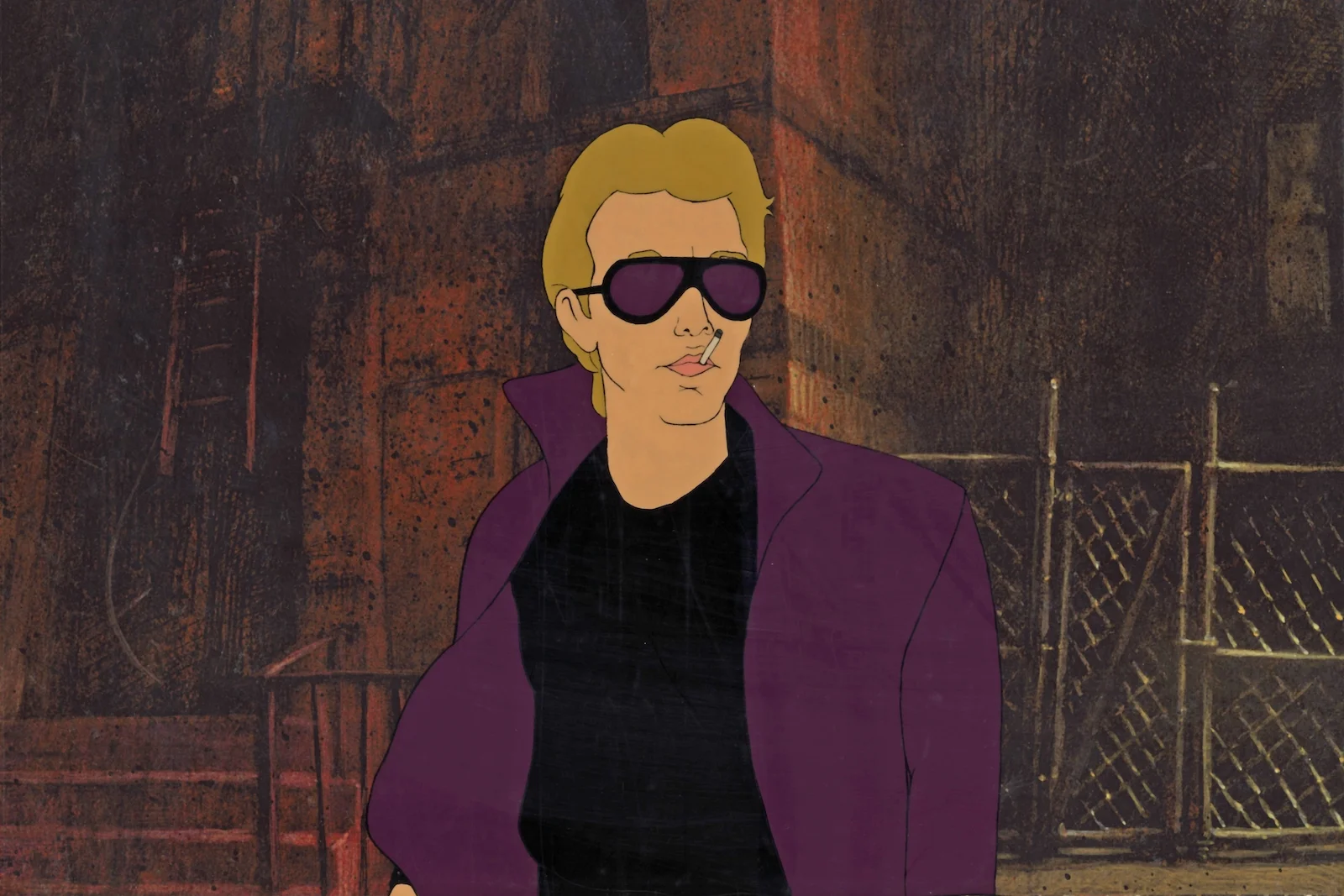

Will’s Core Canon: The Beautiful, Experimental and Visceral Nature of Ralph Bakshi’s ‘American Pop’
Welcome to Will’s Core Canon, a series covering some of my all-time favorite movies and why they work. This series seeks to go beyond surface-level analysis to strike at the core of why these films resonated the way they did.
It pisses me off the extent to which we still think of animation as being “just for kids.” Maybe it’s because starting in childhood, we’re inundated with cartoon characters like Mickey Mouse and the Looney Tunes being promoted for children’s consumption almost exclusively. It feels like every decade, there’s a new addition to the pantheon of children’s cartoon characters that capture the zeitgeist, from The Flintstones to Scooby-Doo, Transformers to SpongeBob, Adventure Time to Bluey, just to name a few.
I’m of a generation that was introduced to The Simpsons when I was very young precisely because it was seen as a cartoon, and therefore safe for kids to watch. And even though plenty of cartoons with a more mature bent did emerge in the groundbreaking wake of The Simpsons, animation just isn’t something taken that seriously by most grown-ups. There hasn’t been an animated movie nominated for the Academy Award for Best Picture in over 16 years at this point. Animation feels dominated by the likes of the Minions or the formerly-niche anime becoming increasingly mainstream.
All of which brings me to filmmaker Ralph Bakshi.
Bakshi started his career at television animation studio Terrytoons, best known for Mighty Mouse. He then emerged with his controversial but hugely successful feature-length debut, Fritz the Cat, in 1972. The film was the first animated film to receive an X rating, and for good reason: it depicts the titular Fritz doing drugs, getting drunk, having sex, cursing, and monologuing to the audience about what he sees as the ills of modern society. Basically, it was everything you didn’t want your kid watching. But the film, based on the subversive underground comics of Robert Crumb, caught on with the counterculture, allowing Bakshi a blank check of sorts to pursue other projects, including the semi-autobiographical Heavy Traffic (1973) and the controversial racial satire Coonskin (1975).
Already established, Bakshi made his two most ambitious projects up to that point, both of which were successful. The first was Wizards (1977), a fantasy sci-fi tale where fairies, elves, and wizards battle an evil wizard who has his troops hyped up on rediscovered Nazi propaganda footage. But he one-upped himself with its follow-up, a formidable animated adaptation of J.R.R. Tolkien’s epic The Lord of the Rings in 1978, featuring rotoscoping and new techniques to adequately depict the sprawling world of Middle-earth.
In this era, Disney animation was really the only other game in town, but Bakshi distinguished himself by telling mature stories that were not necessarily kid-friendly, but were nevertheless embraced by mainstream audiences. And none of his films better encapsulate that than the one I consider his masterpiece, his magnum opus: 1981’s American Pop.
I had already seen Fritz the Cat and his take on The Lord of the Rings by the time of the annual James River Film Festival, held in my hometown of Richmond, VA, in 2015. That year, after a screening of The Lord of the Rings, there would be a Skyped-in appearance by Bakshi himself in between the films. It’s hard to imagine now in a world where it feels like Zoom and other remote videoconferencing platforms rule our lives in the post-COVID era, but getting a filmmaker too advanced in age to travel to appear remotely felt downright novel at the time.
When it was my turn to ask a question, I asked Bakshi about why he wasn’t involved in the sequel to Fritz the Cat. With his trademark Brooklyn accent with a hint of a slight lisp, he was blunt when he said that The Nine Lives of Fritz the Cat was, in his words, “a piece of a gah-bage.” He gave a long answer, but the Skype glitched as he was giving it, leading me to smile and nod along while I didn’t have any clue what he was actually saying. After that, the screening of Wizards really impressed me. I had never seen it before; it felt weird, subversive, uniquely of its era, yet capable of resonating decades after its release.
Because of this screening and my fleeting interaction with Bakshi over glitchy Skype, I felt compelled to go deeper into Bakshi’s filmography, and American Pop was one of the first entries I watched. It pains me to say it now considering how highly I regard the film now, but the first time I saw it, it didn’t necessarily click for me. I thought I enjoyed it overall, but found it a little confusing and perhaps lacking focus. Yet every subsequent time I’ve seen it has endeared me to it even more. I notice little details and motifs every time I watch it now, making me even more hyperaware of its inherent brilliance.
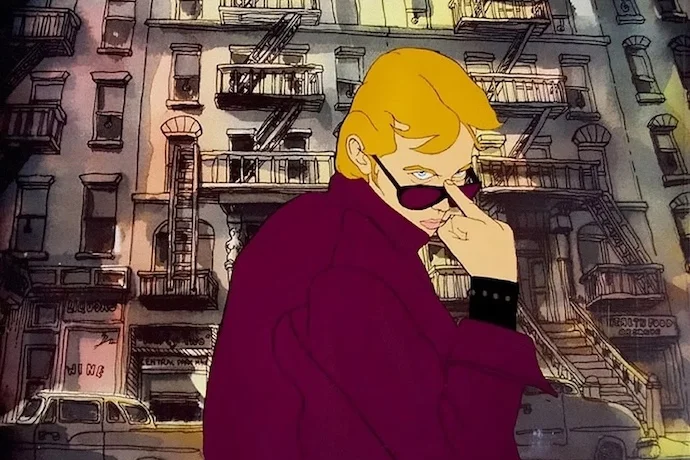 I think the first time I watched it, I was perhaps alienated because it’s not a traditional movie with a traditional narrative. It also includes everything from live-action footage to still paintings to the rotoscoping Bakshi utilized on The Lord of the Rings, which gives the animation a beautiful, almost handmade quality. It can be stunningly gorgeous at times and uniquely grotesque at others. But such is its charm, ultimately. It balances these in a hugely effective and meaningful way, along with a soundtrack that represents nearly a century of American popular music from wildly different genres.
The film’s plot follows four generations of musicians from the Belinsky family, as each of them interacts with and plays the music associated with their respective eras. It starts with Zalmie (voiced by Jeffrey Lippa), who emigrates with his mother from Imperial Russia at the turn of the 20th century. After settling in New York, Zalmie is recruited to work at a burlesque house, eventually becoming a performer in his own right upon entering adolescence after the death of his mother in a factory fire. His singing career is ended by a bullet grazing his throat when he is performing for the troops during World War I. He marries a fellow performer and has a son, Benny (voiced by Rick Singer).
Benny witnesses the death of his mother in a mafia bombing, doubling down on his passion for piano before marrying a mob boss’s daughter and enlisting in World War II. In one of the film’s best sequences, he plays piano in bombed-out ruins, alerting a Nazi soldier to his presence. First-time viewers might think the soldier would take pity on Benny for playing a German song he seems to like and connect with, but alas, the soldier unceremoniously shoots and kills Benny. Such is the way of war.
Benny’s son Tony (voiced by Ron Thompson) grows up as the son from a previous marriage, resented by the rest of his immediate family as they watch his grandfather Zalmie testify against the mob on television. Tony decides to move out west, and has a one-night stand with a pretty blonde waitress at a diner. Soon enough, he’s in San Francisco, recruited to join the psychedelic rock revolution in a band that is reminiscent of Jefferson Airplane as he sports a look that reminds one of Jim Morrison. That’s not the only thing he shares in common with the late Doors frontman, as Tony and the band’s lead singer, Frankie Hart (voiced by Mews Small), begin experimenting with heroin. It is the drug that eventually takes Frankie’s life in a fatal overdose.
While performing on tour in the Midwest, Tony stumbles onto the young son he conceived with the waitress, Pete (also voiced by Ron Thompson). Tony and Pete move to New York, where Tony becomes a drug dealer in order to pay the bills. Tony abandons Pete, and Pete grows up to take on the family business, selling drugs to musicians until he tells them one day that he’s written songs and wants to perform them. The movie ends with Pete performing in a major stadium arena, fulfilling his family’s destiny by becoming a rock-and-roll star.
The narrative, while important, takes a backseat to the visuals. It’s the type of story that could only work on film. The movie thrives on unexpected visuals, still drawings, matte paintings, brief moments between characters, and the fluid movement of the revolutionary rotoscoping method. Even live-action archival clips can be briefly incorporated. The music is another reason it feels perfectly suited to the medium: it provides a crucial element as we hear big band and jazz standards make way for the more familiar rock songs from the second half of the 20th century. The music helps tell the story, powerful in its own right but useful in conveying the themes and tones of the movie.
The synthesis of this feels like the scene of an animated Jimi Hendrix rocking out on his guitar, playing “Purple Haze.” It has no plot relevance beyond evoking the era, yet feels like a summation of the entire film: the power of animation meets the power of music. Only Bakshi could have pulled off such a thing, and I’d be hard-pressed to recall anything that felt as personal or visceral in American animation that I’ve personally seen in years.
American Pop should’ve been a bigger deal. It was well-received by critics, but wasn’t a box-office sensation in the slightest. By the early 1980s, it felt like maybe Bakshi’s moment was over. He kept plugging along, making projects like the underwhelming 1950s period piece Hey Good Lookin’ (1982). He returned to rotoscoping with a fantasy epic called Fire and Ice (1983), his collaboration with his close friend, the renowned fantasy artist Frank Frazetta. But it was the failure of his live-action/animation hybrid Cool World (1992), intended to be “Roger Rabbit, but for grown-ups” and starring the likes of Kim Basinger and a young Brad Pitt in one of his earliest roles, that forced Bakshi to no longer work on full-length animated movies. He instead pivoted to a short-lived television series, the occasional animated short film, and one live-action made-for-TV movie. Bakshi, now 87, is fully retired and currently living in New Mexico with his wife of almost six decades, Liz.
I had probably seen American Pop half a dozen times before, and I particularly loved introducing friends to it. The most recent time I watched it was on Turner Classic Movies over the summer, when it was selected by Better Things creator and actress Pamela Adlon, who claimed it was her favorite movie ever. I watched it with my dad, who had never seen it before. And it feels like a movie meant to be watched with your dad: the generational through-line is one of the film’s strongest elements. I also recently learned that the title itself is a double entendre: American “pop” as in popular music, but also “pop” as a nickname for one’s father. Regardless, if you have never seen this one, I hope I’ve successfully made the case for it as a must-see classic, the embodiment of some of the best of animation as a medium from one of its most distinctive auteurs.