
Afghanistan’s Armed Resistance Is Spreading. Can It Challenge the Taliban?
Armed resistance to Taliban rule is becoming more geographically dispersed and politically diverse, with new groups joining established opposition movements and former Afghan security personnel taking a more visible role. Yet the growing number of claimed attacks does not, by itself, establish that the Taliban’s hold on power is seriously threatened.
After the Taliban returned to power in August 2021, armed opposition remained fragmented and concentrated largely in northern and northeastern Afghanistan. The National Resistance Front (NRF) and Afghanistan Freedom Front (AFF) were its most prominent organizations, carrying out intermittent ambushes and targeted operations. During 2026, the landscape appears to have broadened. Resistance groups have reported attacks on Taliban installations and personnel in Badakhshan, Nuristan, Baghlan, Takhar, Panjshir, Kapisa, Kabul, and parts of southern and western Afghanistan.
Three organizations remain especially prominent. The NRF, led by Ahmad Massoud and predominantly Tajik in composition, has claimed operations in Panjshir, Herat, Baghlan, Parwan, Kapisa, Kunduz, Kabul, and Badakhshan. The AFF, led by Yasin Zia, a former chief of the Afghan Army’s general staff, also draws heavily from Tajik communities and former security personnel. Its reported activity is concentrated in Badakhshan, Takhar, and Nuristan, although it has also claimed attacks in Baghlan, Kapisa, Kabul, Kunar, and Sar-e Pol.
The Afghanistan United Front (AUF), led by Lt. Gen. Sami Sadat, a former commander of the Afghan Army’s 215 Corps, represents a different constituency. Described as predominantly Pashtun, it began its armed campaign in August 2026 and claims a presence in Helmand, Kandahar, Nimroz, Ghor, Badghis, and Faryab. Its emergence points to a broader role for Pashtun opponents of Taliban rule and for veterans of the former republic’s security forces.
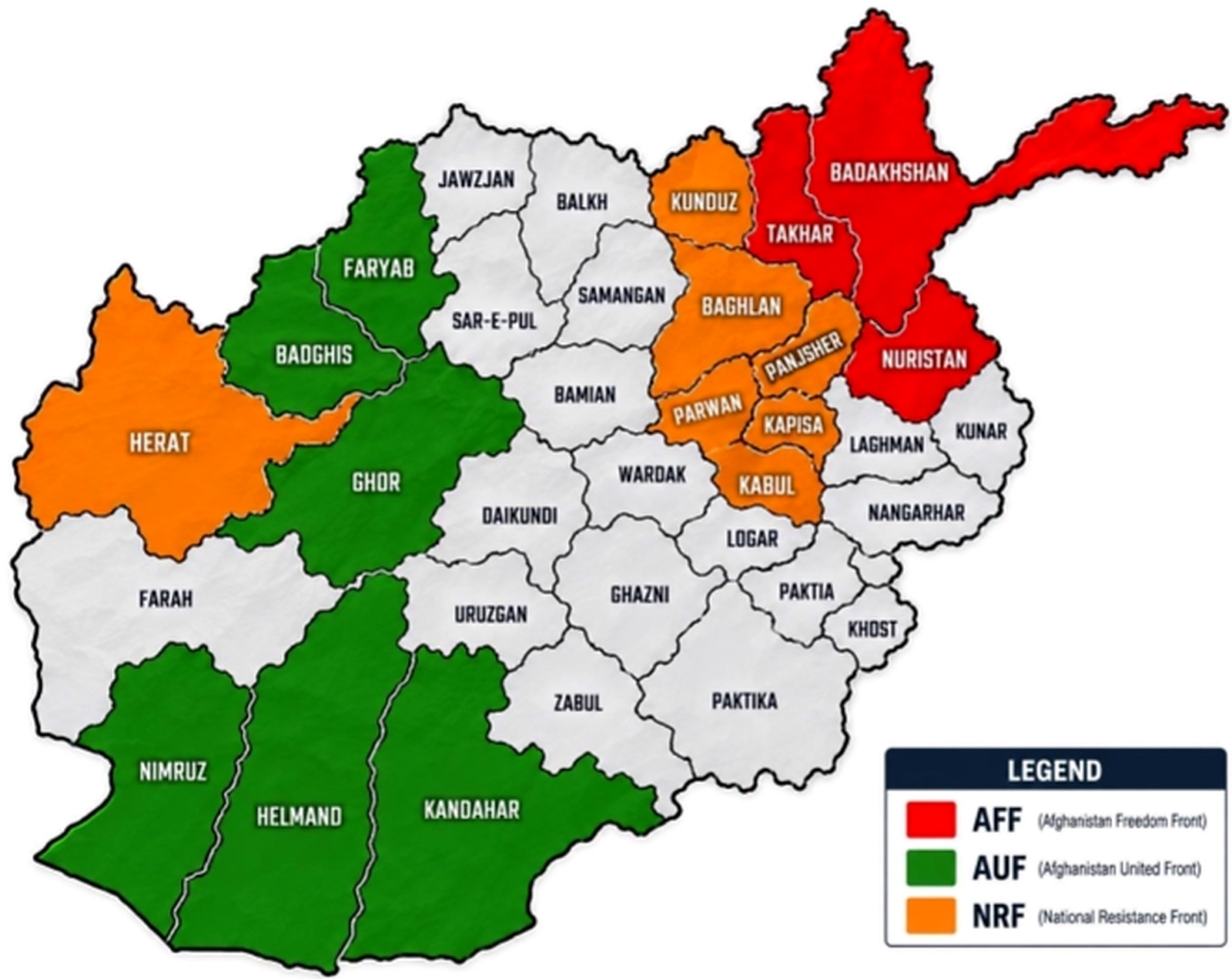
Other formations have entered the picture. The Afghan Green Trend, led by former Vice President and intelligence chief Amrullah Saleh, is associated with northern provinces and supply routes. Its armed wing claims to have conducted seven attacks since August 8 across Parwan, Takhar, Laghman, Baghlan, Panjshir, Badakhshan, and Kapisa, killing 14 Taliban members. Those casualty figures are the organization’s claims, not independently established totals.
In Badakhshan, a local group known as Sepahiyan-e Mihan, or the Homeland Soldiers Front, is led by Qayyum Malang, a former Afghan Army commando who previously served with an NRF unit associated with Khalid Amiri. On July 17, the group reportedly entered the Yaftal-e Sufla district center, disarmed Taliban personnel, and raised its flag. The episode was presented by resistance supporters as a rare loss of a district center by the Taliban, although the seizure was brief and its broader military significance remains uncertain.
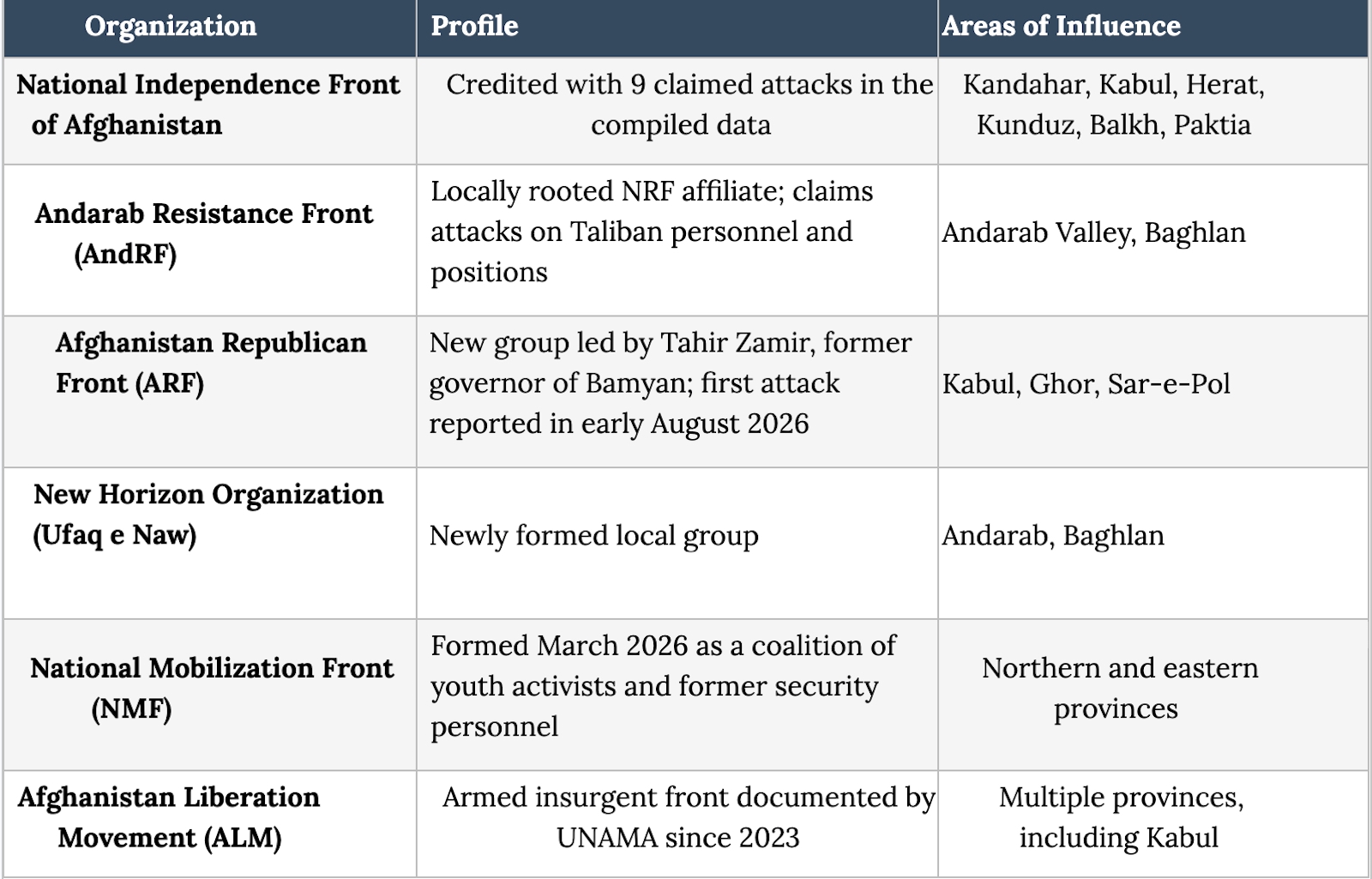
The aggregate figures suggest a busier insurgent landscape. Between August and September 2026, resistance organizations claimed 119 attacks across 26 provinces, resulting in 256 Taliban deaths and 256 injuries. These numbers are derived from opposition claims and should not be treated as independently verified casualty counts. The AUF claimed 59 attacks; the AFF, 29; the NRF, 11; the National Independence Front of Afghanistan, nine; the Afghan Green Trend, seven; the New Horizon Organization, two; and the Afghan Republican Front, two.
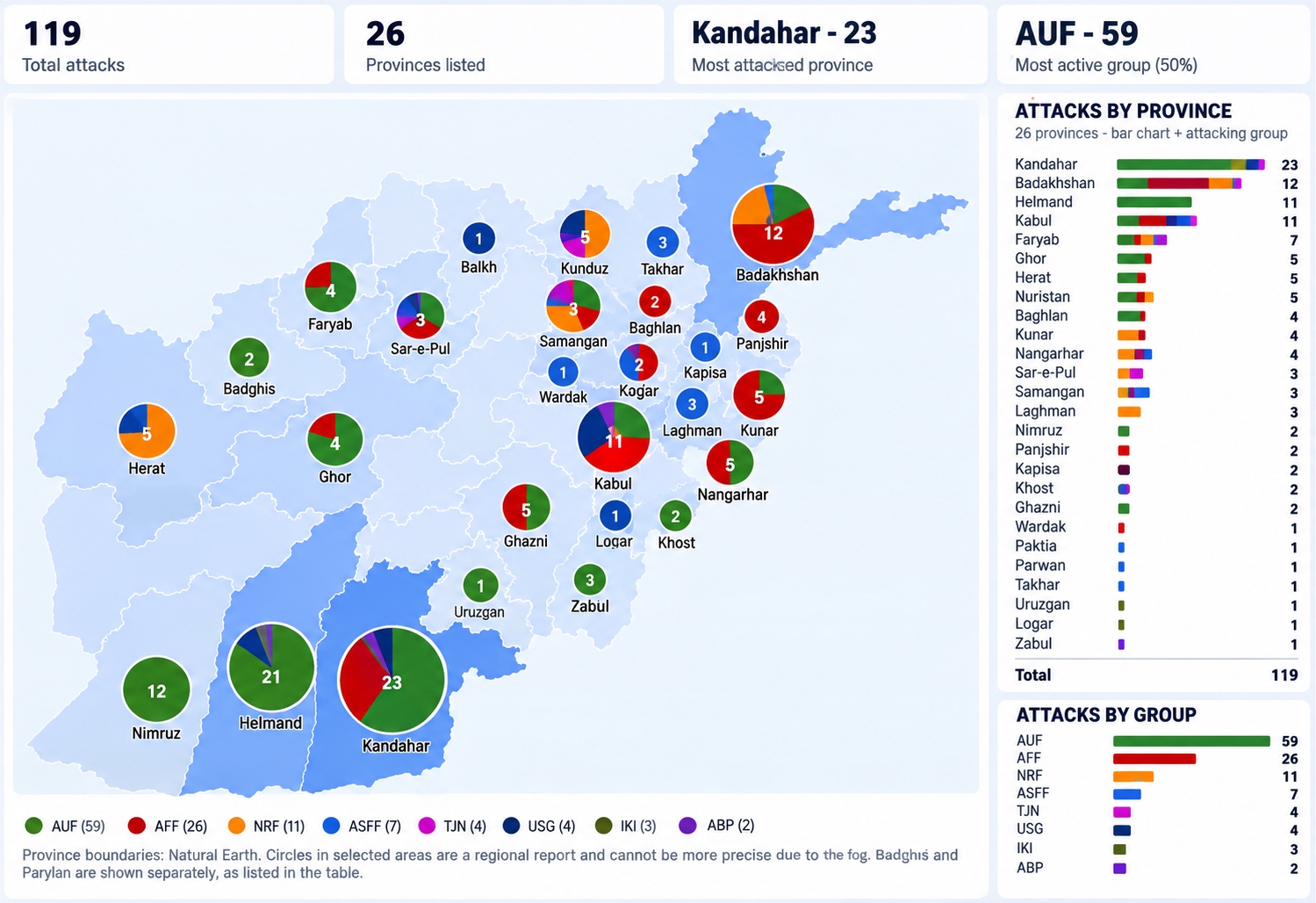
The reported operations stretched across Afghanistan’s north, northeast, center, east, south, and west, including Badakhshan, Baghlan, Kabul, Kandahar, and Helmand. The geographic spread is notable, but a claim of activity in a province is not necessarily evidence of sustained territorial control or an enduring local support network.
Smaller formations have contributed to the wider pattern. On September 5, the Andarab Resistance Front, an NRF affiliate active in Baghlan’s Andarab Valley, claimed a joint attack with the newly formed New Horizon Organization that killed three Taliban members and wounded three others. The Afghan Republican Front, which reported its first attack in early August, claimed a grenade assault on a Taliban checkpoint in Kabul’s 13th district on September 4 and announced another attack in Ghor on September 12.
Malang’s Homeland Soldiers Front reported no attacks in September. Afghan media accounts said a senior Taliban delegation traveled to Badakhshan to persuade him to abandon the insurgency, but that he rejected the overture. These reports have not been independently corroborated in the material reviewed for this article.
The NRF, meanwhile, reported fewer operations in September. One possible explanation is the loss of senior commander Hasib Panjshiri, who was killed by the Taliban in northern Salang, Parwan province, on August 19. On September 4, the NRF named Commander Mukhtar Shoresh as his replacement. Later that month, it appointed former parliamentarian Saleh Mohammad Registani as general operational commander. The movement also released a video in which Registani announced his return to Afghanistan to fight the Taliban. The connection between these leadership changes and the decline in reported attacks remains an inference rather than an established fact.
Several claimed attacks have targeted provincial authorities and government compounds. In Firozkoh, Ghor province, the AUF said it carried out an explosion at the Taliban governor’s office compound. Resistance accounts alleged that one bodyguard was killed and eight Taliban personnel were wounded. The whereabouts of Governor Hayatullah Mubarak during the incident were unclear. In Faizabad, Badakhshan, the AFF claimed a rocket attack on the governor’s office followed by a clash with its guards; it said four Taliban personnel were killed and five wounded, and that a nearby vehicle was destroyed.
The expansion of armed opposition reflects more than military organization. It also takes place against a background of disputes over political exclusion, representation, and the treatment of those who served the former Afghan government. Under Supreme Leader Hibatullah Akhundzada, authority has become concentrated among the Taliban’s Kandahar-centered leadership. Critics argue that this arrangement leaves Tajiks, Uzbeks, Hazaras, and other communities with little meaningful influence over senior appointments and national decision-making.
Ethnic representation is a particularly contentious issue. The original analysis describes the Taliban’s senior leadership and cabinet as overwhelmingly Pashtun and notes the absence of women and Hazaras from its cabinet. Precise percentages and cabinet counts require up-to-date, independently sourced verification, but the underlying concern about exclusion is central to the resistance groups’ political narrative. In northern and northeastern provinces, where local networks have historically exercised significant influence, the loss of representation has intensified longstanding grievances.
The treatment of former government officials and security personnel has been another source of anger. Despite announcing a general amnesty after taking power, the Taliban have been accused of reprisals against members of the previous administration and Afghan National Defense and Security Forces. A United Nations Assistance Mission in Afghanistan report covering August 15, 2021, through June 30, 2023, documented at least 218 extrajudicial killings, 424 arbitrary arrests and detentions, 144 cases of torture or ill-treatment, and 14 enforced disappearances involving former officials or security personnel.
The source material also cites subsequent reports of killings, arrests, and torture in 2025 and the first half of 2026. The figures and reporting periods need clearer attribution before publication, but they indicate the continuing allegations of reprisals despite the amnesty. For former soldiers, police officers, and intelligence personnel, the resulting insecurity can make armed resistance both a political choice and a means of protection.
Those veterans bring military training, operational experience, knowledge of the terrain, and established networks that can strengthen insurgent organizations. Their involvement also helps explain why new groups have appeared beyond the opposition’s original strongholds. Yet fragmentation remains a central weakness: the proliferation of fronts does not demonstrate unity of command, a shared political program, or the ability to hold territory.
The rise in claimed attacks should therefore be understood as evidence of a more complicated security environment, not proof that the Taliban face imminent defeat. Islamic State Khorasan Province presents a separate, ideologically distinct threat, and its activities should not be conflated with those of anti-Taliban resistance fronts. What has changed in 2026 is the apparent breadth of armed opposition. Whether that breadth develops into a durable challenge to Taliban rule remains an open question.