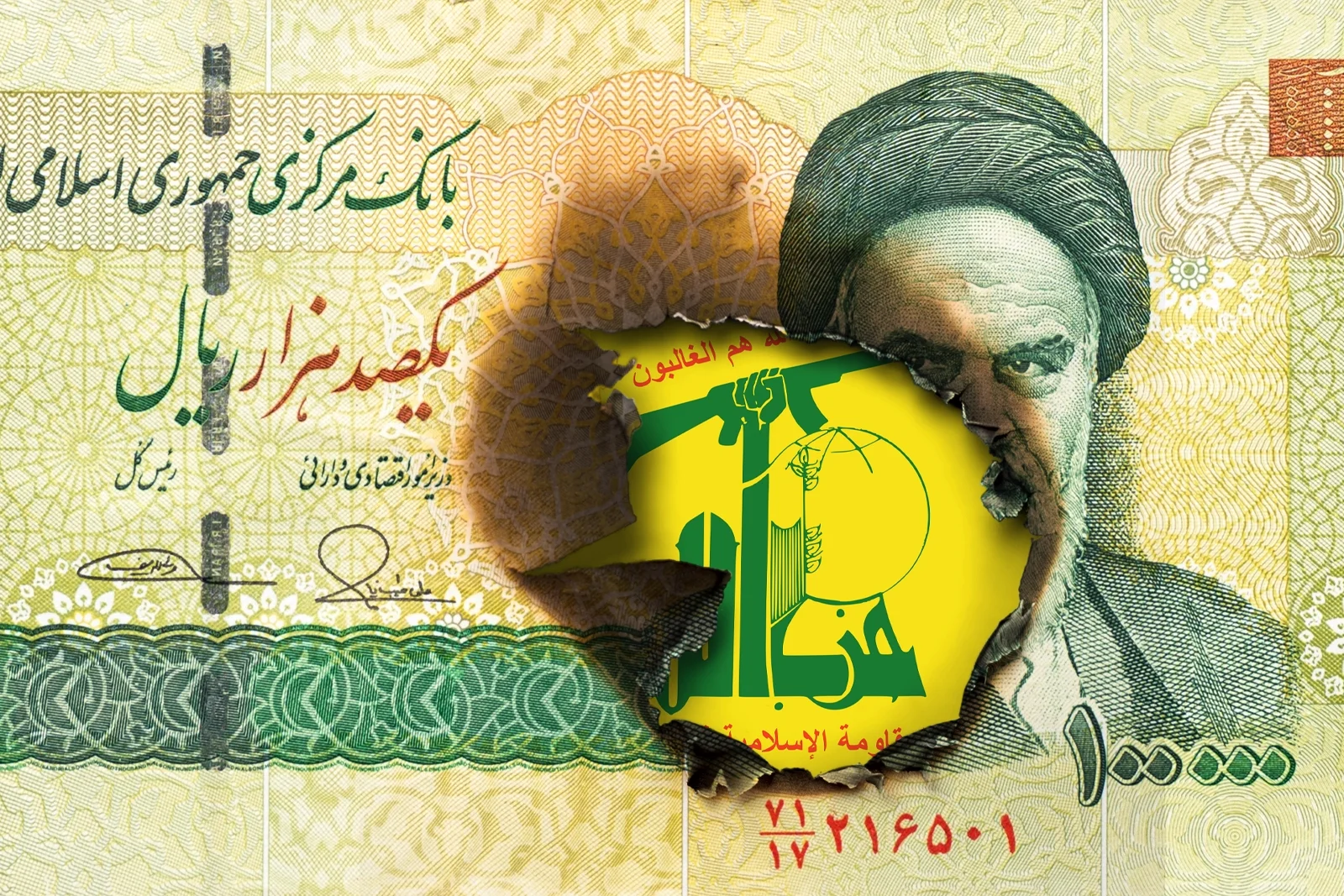

The Price of Keeping Hezbollah Alive
On November 10, the free-market dollar in Tehran traded at roughly 2.65 million rials. That figure is more than a measure of Iran’s economic distress. It is also a warning about the mounting cost of the Islamic Republic’s foreign commitments. Hezbollah has never been financially self-sufficient. Its fighters, social services, and the patronage networks that sustain its influence in Lebanon’s Shiite communities have long depended on Iranian funding. In 2026, however, moving that money from Iran to Lebanon has become more difficult than ever, even as Tehran turns to stablecoins, gold, and whatever dollars it can still mobilize.
The problem is not simply the collapsing rial. Iran’s remaining hard-currency reserves and other assets are increasingly difficult to access and transfer. As financial restrictions tighten, the money sustaining Hezbollah becomes slower to arrive, more expensive to move, and potentially scarcer. For Lebanon and its international partners, that creates an opportunity.
The U.S. Treasury Department reported that Iran transferred more than $1 billion to Hezbollah during the first ten months of 2025, much of it through Lebanese money exchangers. In August, the department sanctioned ten individuals involved in a courier network that moved up to hundreds of millions of dollars on commercial flights connecting Lebanon, Turkey, the United Arab Emirates, and Iran. Operating outside the formal banking system, the network was linked to Iran’s Islamic Revolutionary Guard Corps-Quds Force. Washington also redesignated Hezbollah under sanctions authorities relating to its service to the Iranian regime under Quds Force command.
Iran still possesses dollars, gold, and other assets, but sanctions and disruptions to its oil-export revenues have made those resources increasingly difficult to mobilize. Stablecoins and informal financial networks offer alternatives, yet they face growing scrutiny. Tehran has consequently become more dependent on physical cash transfers and intermediaries whose services carry substantial costs.
Recent reports illustrate those constraints. In October, sources told Reuters that Hezbollah had received approximately $200 million from Iran to assist displaced Lebanese families, alongside reports of additional funding for rearmament, including explosives and attack drones. U.S. officials disputed Tehran’s ability to provide such assistance, underscoring the uncertainty surrounding Hezbollah’s finances. According to Reuters, intermediaries facilitating the reported $200 million transfer charged fees of roughly 20 percent, four times the normal rate.
Lebanon’s tighter airport controls have also complicated the movement of cash, encouraging greater reliance on smaller transfers, jewelry, and hawala networks. Every additional restriction pushes Hezbollah’s financing farther from conventional banking and toward arrangements that are more cumbersome, expensive, and vulnerable to disruption. Physical couriers can be intercepted. Cryptocurrency transactions can be traced, and associated intermediaries can be sanctioned. Neither offers the comparatively straightforward financial access Hezbollah once enjoyed.
The consequences extend well beyond weapons procurement. Hezbollah has reportedly operated on a monthly budget of approximately $50 million, much of it supplied by Iran, to cover fighter salaries, military operations, and other organizational expenses. Financial pressure threatens the broader system of social assistance and political patronage that has helped sustain the group’s influence for decades.
Among the most immediate pressures are payments to fighters, compensation for families whose homes have been destroyed or remain inaccessible, and the financial assistance that reinforces Hezbollah’s standing in southern Lebanon. Some housing and reconstruction payments have already faced delays or reductions, while families desperate for immediate relief have reportedly sold compensation checks at a discount.
Hezbollah can continue promising assistance, but promises become less persuasive when payments arrive late or fail to cover mounting expenses. The organization’s political strength rests partly on its reputation as a provider of services where the Lebanese state has often struggled to deliver. As its financial capacity deteriorates, that reputation becomes harder to maintain.
This is not merely a question of political loyalty. It is a question of resources. Every dollar Iran must devote to domestic obligations, from government payrolls and essential imports to deteriorating water and electricity infrastructure, is a dollar potentially unavailable for foreign commitments. A government struggling to meet the needs of its own population will eventually confront difficult decisions about which external priorities it can continue financing. Hezbollah is among the most expensive of those commitments.
Lebanon and its Western and Arab partners have three practical ways to exploit these vulnerabilities without waiting for Hezbollah’s financial network to collapse entirely.
The first is more aggressive enforcement against cash couriers, illicit exchange operations, and financial intermediaries facilitating prohibited transactions. Airports, land borders, and exchange houses connected to regional trading centers remain important conduits for Iranian funds. The August 2026 sanctions provide a foundation for closer scrutiny of suspicious transfers, including those involving smaller quantities of cash, jewelry, or digital assets.
Cooperation with Turkish and Emirati authorities would be particularly valuable, given the commercial and financial connections running through both countries. A courier network capable of moving hundreds of millions of dollars does not become irrelevant because individual transfers grow smaller or pass temporarily through cryptocurrency. Those adaptations can create additional opportunities for financial investigators to identify and disrupt the network.
The second priority is sustained support for the Lebanese Armed Forces, tied to measurable results. The military has sought roughly $3 billion over five years to strengthen its capabilities and advance the Lebanese state’s control over weapons and security. Existing international assistance provides a starting point. The European Peace Facility approved a €100 million package in June, while Germany and the United States have provided additional forms of military and logistical support.
That assistance should remain linked to demonstrable progress in border security, deployment in southern Lebanon, and the gradual replacement of Hezbollah’s independent security structures with legitimate state institutions.
A military capable of paying its soldiers, securing communities, and supporting reconstruction offers more than an alternative source of security. It can also strengthen public confidence in the Lebanese state at a moment when Hezbollah’s ability to finance its own patronage system is under increasing strain.
The third priority is reconstruction assistance that reaches Lebanese communities without reinforcing Hezbollah’s political and financial networks.
This contest will be decided in practical terms: who provides temporary housing, who selects contractors, who determines which families receive assistance, and who ultimately receives political credit for rebuilding shattered communities. Institutions associated with Hezbollah and its political ally Amal, including the Council for South Lebanon, already exercise influence over public spending and reconstruction priorities.
International donors and the Lebanese government can reduce the risk of political capture by screening contractors’ beneficial ownership, directing assistance through accountable state institutions such as the Council for Development and Reconstruction, and requiring independent financial audits. Companies linked to Hezbollah’s military infrastructure should not be allowed to benefit from contracts intended to restore civilian life.
Reconstruction that demonstrably improves living conditions through legitimate public institutions would challenge Hezbollah’s claim that it alone can rebuild communities devastated by war. It would also give the Lebanese state an opportunity to establish a more credible presence in areas where its authority has historically been limited.
Meanwhile, Iran’s economic pressures continue to intensify. The rial’s collapse, soaring inflation, water shortages, and deteriorating infrastructure reflect decades of economic mismanagement, compounded by sanctions, conflict, and the substantial resources devoted to the Revolutionary Guard and its regional allies.
Iran’s remaining foreign assets may provide some financial breathing room, but accessing and transferring them has become increasingly difficult. The longer domestic pressures persist, the harder it becomes for Tehran to sustain its external commitments at previous levels.
Hezbollah nevertheless remains a formidable organization. It retains armed fighters, weapons stockpiles, political influence, and an established constituency. Financial pressure alone will not eliminate those advantages, nor will it automatically produce a stronger Lebanese state.
But Hezbollah’s military and political infrastructure requires sustained financing, and much of that support ultimately depends on an Iranian government facing profound economic constraints. The channels connecting Tehran to Lebanon are increasingly expensive, exposed, and difficult to maintain.
That is the opportunity Lebanon and its international partners should recognize. Financial enforcement, a more capable national military, and reconstruction assistance insulated from Hezbollah’s political networks could gradually weaken the organization’s dependence-based influence while strengthening legitimate state institutions.
Iran’s economic difficulties will not dismantle Hezbollah on their own. But they may create an opening that Lebanon cannot afford to squander.