
Russia’s African Ambitions Have a Gateway in Libya
In September 2026, two Russian cargo ships carrying military equipment arrived at the Libyan port of Tobruk under naval escort. Their voyage was hardly a secret. Western intelligence agencies had been monitoring the shipment, and the movement of Russian military equipment across European waters was closely watched. Yet the ships reached their destination without being stopped.
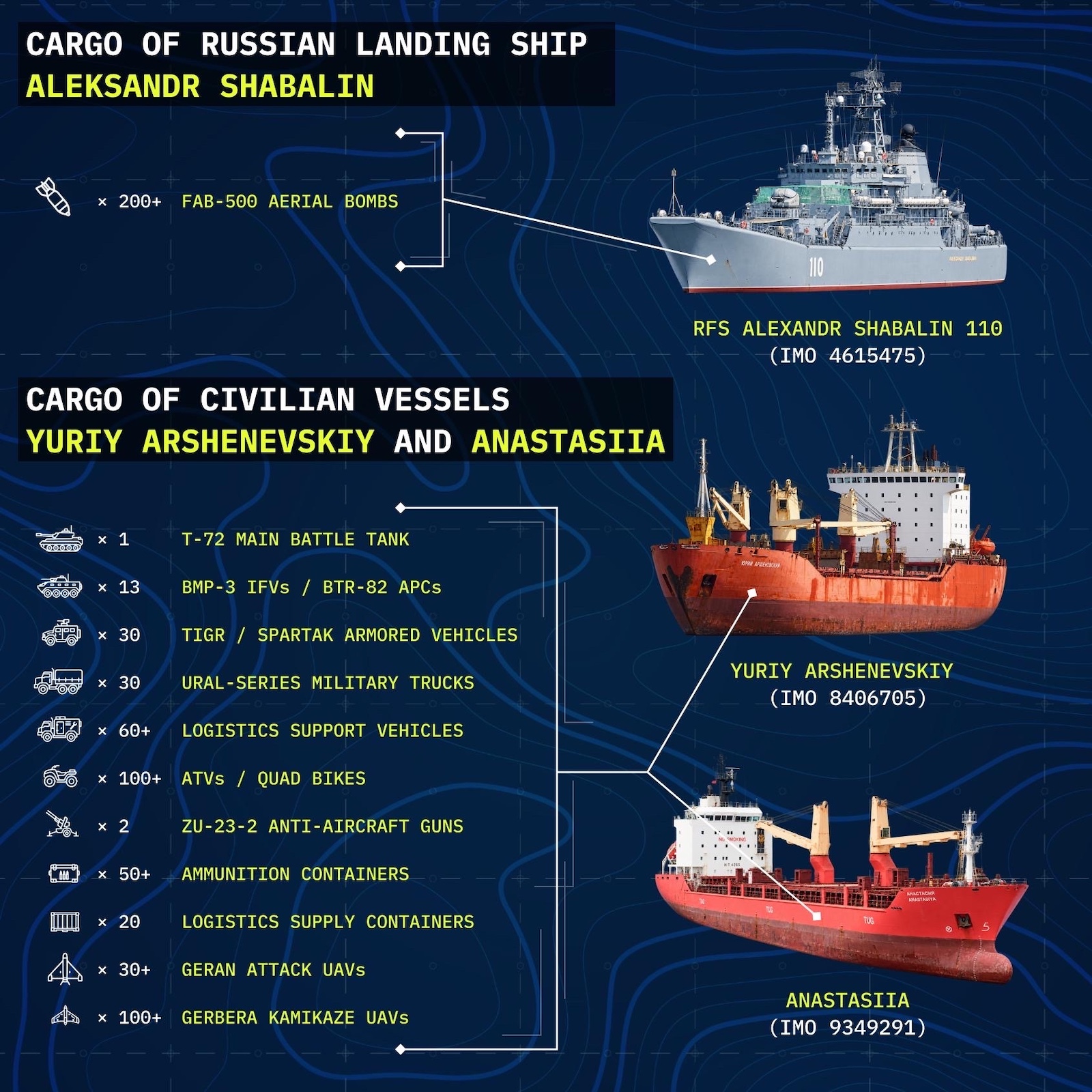
On August 26, the Anastasiia (IMO 9349291) and the Yuriy Arshenevskiy (IMO 8406705) departed from the Baltiysk naval base in Russia’s Kaliningrad region. Less than three weeks later, on September 14, both vessels entered Tobruk, a strategically important Mediterranean port controlled by Khalifa Haftar’s Libyan National Army.
In apparent defiance of a United Nations arms embargo, Russia delivered at least 370 pieces of military equipment to Libya, reportedly including unmanned aerial vehicles (UAVs), armored combat vehicles, Ural military trucks, all-terrain vehicles, and even a tank, along with as many as 100 containers of ammunition and other military supplies. These figures may represent only a portion of the shipment visible to intelligence analysts.
The presence of a Russian naval escort, the large amphibious landing ship Alexander Shabalin, underscored the importance Moscow attached to the operation and complicated the prospect of any outside intervention. The voyage was further obscured by periods during which automatic identification system (AIS) transmissions were reportedly disabled, raising questions about compliance with international maritime safety regulations.
 Despite the apparent violations of international restrictions, and despite one of the cargo vessels already being subject to U.S. sanctions, the international community proved unable to prevent the shipment. The episode illustrates a growing disconnect between the rules that ostensibly govern international security and the willingness or ability of governments to enforce them. Unless Western policymakers confront that disconnect, Russia will have little reason to reconsider its expanding military ambitions in Africa.
The delivery of military equipment to Tobruk appears to violate the UN arms embargo on Libya, established under Security Council Resolution 1970 in 2011. That may explain why the Anastasiia and the Yuriy Arshenevskiy reportedly listed the Egyptian port of Suez as their destination rather than Libya. The equipment was subsequently unloaded at a military facility near Tobruk, where convoys were assembled to transport the cargo farther inland.
Of particular interest among the reported shipments of armored vehicles and military trucks were Geran and Gerbera drones. The presence of Russian Geran drones was reportedly documented in Mali in July. Evidence of Gerbera drones operating on the African continent, however, has been more elusive. Their relatively small size and weight make them particularly difficult to monitor when transported alongside other military equipment.
The broader security implications extend beyond Africa. The Spanish newspaper El Mundo, citing U.S. intelligence, recently reported concerns that Russia was preparing possible drone attacks against Spain, France, or Italy involving commercial maritime vessels. Italian Defense Minister Guido Crosetto publicly denied the report. Although the allegations remain disputed, they underscore growing European concerns about the security implications of Russia’s military and commercial maritime activities.
The Anastasiia has been subject to U.S. sanctions since May 2022, reportedly in connection with commercial dealings involving Iran. Its continued participation in Russian military logistics illustrates the limitations of sanctions imposed on individual vessels when those restrictions are not accompanied by effective enforcement mechanisms. The Yuriy Arshenevskiy, meanwhile, has reportedly avoided comparable restrictions despite its apparent involvement in transporting Russian military cargo.
Washington and its European partners should also examine the individuals and commercial entities responsible for facilitating these shipments. Maritime personnel records and employment histories may offer useful avenues for investigating the networks that sustain Russian military logistics. Where sufficient evidence exists, sanctions could extend beyond the vessels themselves to their owners, operators, and other individuals knowingly facilitating prohibited transactions. Such measures, however, must be grounded in independently corroborated evidence of wrongdoing rather than mere association with sanctioned vessels.
 The September shipment was hardly an isolated incident. Over the past two and a half years, Tobruk has emerged as one of Russia’s most important maritime gateways to Africa. From eastern Libya, military equipment can be distributed to Russia’s Africa Corps, both within Libya itself and across the Sahel, where Moscow has increasingly sought to establish itself as an influential security partner.
In the spring of 2024, Russian amphibious vessels were still transporting military equipment to Tobruk from Tartus, Syria. Aging commercial ships operating under foreign flags were also reportedly being used to sustain these shipments, sometimes with their tracking systems disabled.
One such vessel, the Cameroon-flagged Barbaros, was intercepted and inspected by the European Union’s Operation IRINI. The 115 Russian trucks discovered aboard were classified as dual-use equipment, allowing the vessel to continue its journey. Other shipments reportedly proceeded without inspection, illustrating the limitations of the operation’s jurisdiction and enforcement powers.
As Russia’s military position in Syria became increasingly uncertain, Moscow adapted its logistical arrangements. Instead of relying as heavily on its Syrian facilities, Russia began dispatching shipments directly from the Baltic Sea aboard Russian-flagged commercial vessels accompanied by naval escorts.
In January 2026, the sanctioned vessel Mys Zhelaniya reportedly arrived in Tobruk accompanied by the Russian destroyer Severomorsk. September brought the arrival of the Anastasiia and the Yuriy Arshenevskiy. By mid-October, observers had reportedly identified four cargo vessels, including the Anastasiia, being loaded with military equipment near Baltiysk. Their intended destinations have not been independently established, although Tobruk remains a plausible possibility given Russia’s recent shipping patterns.
What makes these developments particularly troubling is not the absence of international restrictions but their apparent ineffectiveness. The UN arms embargo remains formally in place, yet the UN Panel of Experts has repeatedly documented shortcomings in its enforcement. Russia’s veto power on the Security Council further complicates efforts to strengthen international restrictions against activities in which Moscow itself is implicated.
Operation IRINI, launched in 2020 to help enforce the UN arms embargo on Libya, has faced significant operational and legal constraints. The expiration in May 2026 of the Security Council authorization permitting certain maritime inspections reportedly deprived the operation of a critical enforcement mechanism. Without comparable authority to conduct compulsory inspections, intelligence gathering and reporting risk becoming substitutes for meaningful intervention.
Sanctions against individual vessels are similarly limited in their effectiveness. Russian-flagged ships can operate with domestic insurance and classification services while relying on ports in countries willing to maintain commercial relations with Moscow. Conventional maritime enforcement mechanisms become considerably less effective when the government responsible for overseeing a vessel has little incentive to investigate its activities.
The use of naval escorts presents an even more difficult challenge. A military escort is not inherently unlawful, and attempting to intercept a commercial vessel protected by a Russian warship could provoke a direct confrontation with Moscow. Few Western governments are prepared to assume that risk, particularly given the already elevated tensions between Russia and NATO.
Russia is exploiting the considerable distance between what Western governments are legally empowered to do and what they are politically prepared to do. Closing that gap does not necessarily require military intervention. It requires a more coordinated approach to the economic, diplomatic, and commercial networks underpinning Moscow’s African ambitions.
The United States possesses considerable leverage in this regard. An obvious starting point would be a comprehensive examination of the sanctions framework governing Russian military shipments. While the Anastasiia has reportedly been under sanctions since May 2022, the Yuriy Arshenevskiy appears to have escaped similar restrictions.
Washington should investigate whether the vessel, its owners and operators, and the commercial intermediaries facilitating its voyages meet the criteria for designation under existing sanctions authorities. Where the evidence warrants it, restrictions should be extended to the broader network responsible for organizing and sustaining these shipments.
A second approach would involve increasing the financial costs associated with transporting Russian military equipment. Existing U.S. sanctions authorities concerning Libya could potentially be used against entities involved in embargo violations in eastern Libya, including those facilitating prohibited military shipments through Tobruk. Additional restrictions could target banks and companies in third countries that knowingly assist such transactions, where the relevant legal criteria are met.
Diplomatic pressure is equally important. Washington maintains relationships with Haftar, Egypt, and the United Arab Emirates, all of whom have varying degrees of influence over developments in eastern Libya. The United States could make efforts to curtail Russia’s military presence in Tobruk a more prominent component of its diplomatic engagement with these partners.
U.S. reconnaissance aircraft are reportedly already monitoring Russian activities around Tobruk. Intelligence gathered through such operations should, where appropriate, be shared more extensively with European allies and the UN Panel of Experts. Better intelligence coordination would help establish a stronger evidentiary foundation for sanctions and diplomatic action.
European governments and other international partners can complement these measures by systematically documenting suspected arms embargo violations, coordinating sanctions designations using vessels’ unique IMO identification numbers, restricting access to port services where legally permissible, and publicly exposing the networks responsible for illicit military shipments.
None of these measures, taken individually, will necessarily halt Russia’s military expansion in Africa. Collectively, however, they could make that expansion considerably more expensive, politically complicated, and difficult to sustain.
The danger is not simply that Russia is arming Libya. It is that Moscow is demonstrating how readily international restrictions can be circumvented when the governments responsible for enforcing them are divided, constrained, or unwilling to act. Every shipment that reaches Tobruk without meaningful consequences reinforces that lesson.
The West need not risk a naval confrontation with Russia to demonstrate that international rules still matter. But it must do more than watch those rules being broken.
Editor’s note: The author is an open-source intelligence (OSINT) researcher whose work focuses on Russian military activities, illicit networks, and alleged violations of international law.