
After the Doha Airstrikes, Can the Gulf Trust Washington?
On August 2, 1990, Saddam Hussein’s sudden invasion of Kuwait jolted the Gulf out of complacency. What followed was not only a war but a reordering of regional security. Monarchies that already sensed their vulnerability were forced to confront how quickly a neighbor’s ambitions could upend their safety—and their sovereignty.
That shock nudged the Gulf toward tighter defense cooperation and a firm alignment with the United States. Washington’s coalition liberated Kuwait, and the region grew more hospitable to American basing and logistics. U.S. troops, weapons systems, and infrastructure expanded across the peninsula, and for decades, the Gulf monarchies outsourced much of their security to a superpower that promised to deter existential threats. The United States became the ultimate guarantor—the strategic umbrella under which small but wealthy states could concentrate on economic development while outsourcing much of their defense.
Fast-forward to 2025. The Middle East is mired in instability. The Gaza war has dragged on into a third year, producing one of the era’s worst humanitarian crises. A brief, bruising Iran–Israel war laid bare the fragility of the regional architecture—and the limits of Washington’s influence when allies move at cross-purposes.
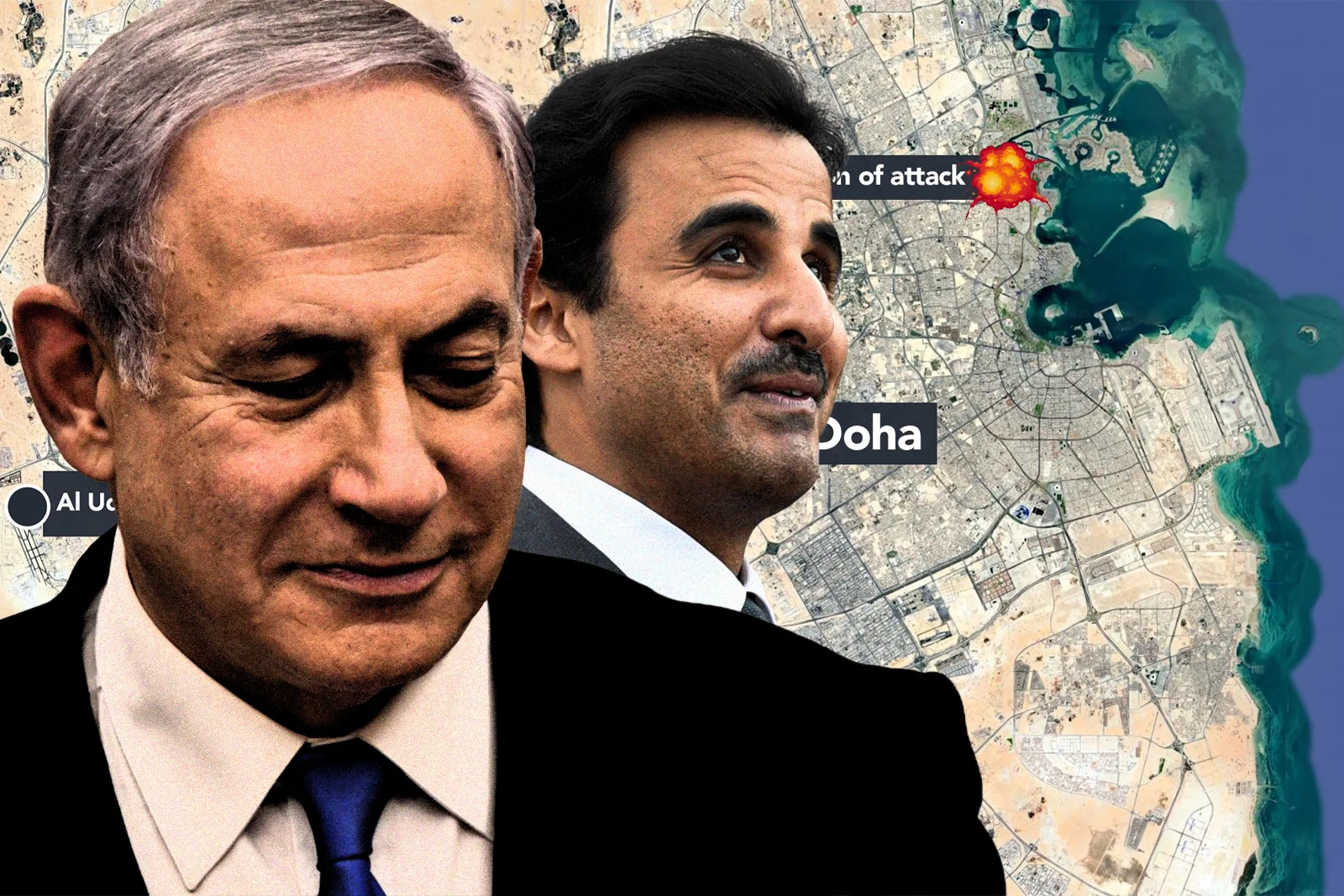
Into this volatile landscape came Israel’s September 9 strike in Doha—apparently a failed attempt to assassinate Hamas leaders. The attack was a reckless breach of Qatar’s sovereignty and a strategic gamble with consequences far beyond a single night’s explosions. It targeted a state that has long served as mediator between Israel and Hamas and is designated by Washington as a Major Non-NATO Ally.
The episode recalls Israel’s earlier pre-emptive strikes on Iran while Tehran and Washington haggled over a nuclear deal. Then, as now, Israel acted despite American awareness of its plans. This time, Hamas leaders were in Doha to weigh U.S. cease-fire proposals—ironically, within the very capital that had hosted the mediation from the start. Qatar also hosts Al Udeid Air Base, the region’s largest U.S. installation, where U.S. Central Command oversees operations and airspace.
According to Al Jazeera, a White House official acknowledged that Washington “was informed of the operation targeting Hamas officials in Qatar.” The admission fueled outrage and immediate doubts about the reliability of American assurances to its Gulf partners. If the United States knew, why didn’t it prevent an ally from striking in the backyard of another ally—especially one facilitating U.S. diplomacy?
The White House’s messaging did little to steady nerves. Officials said the strike was “against U.S. interests,” and the press secretary relayed President Trump’s view of Qatar as a “strong ally and friend.” She added that the president had assured Qatari leaders such an episode would not recur and that Doha had been warned by special envoy Steve Witkoff. Within hours, Qatar’s Foreign Ministry flatly contradicted that account. “The statements being circulated that the State of Qatar was pre-informed of the attack are completely false. The call that was received from an American official came during the sound of the explosions that resulted from the Israeli attack in Doha.”
Trump then took to Truth Social, writing that the U.S. military notified the White House that “Israel was attacking Hamas, which, very unfortunately, was located in a section of Doha,” and adding that by the time he learned of it, “it was too late to stop the attack.” He emphasized that the decision belonged to Prime Minister Benjamin Netanyahu, not to him—language that reads as both exculpation and a hint that Washington may have been kept at arm’s length until the last minute.
Whether the administration was blindsided or merely equivocal, the larger question is unavoidable: Will Israel’s military adventurism come at the expense of American diplomatic and strategic interests in the Gulf? At what point does an “ironclad” bond begin to bend?
The days ahead will show whether this was a passing embarrassment or the start of a deeper fracture in U.S.–Israel relations. For now, the divergence in public accounts has pushed Washington into damage-control mode. America’s closest regional ally has undercut U.S. credibility and placed vital Gulf partnerships at risk.
The regional response was swift—and unusually unified. Saudi Arabia called the strike “an unacceptable violation of sovereignty” and warned of “serious consequences.” The United Arab Emirates, typically careful to harmonize with Washington, went further, labeling the attack treacherous. Turkey, increasingly outspoken since the Gaza war began, condemned the airstrikes as proof of Israel’s war-mongering and state terrorism. This chorus was more than anger; it was a signal that Israel is no longer seen as untouchable—and that Washington is not the unerring guarantor of stability.
For Qatar specifically, the strike risks crippling its value as an honest broker. Doha has hosted and facilitated negotiations on everything from hostage releases to Gaza cease-fire frameworks. If mediators cannot guarantee physical safety on their own soil, the incentives to keep talks alive diminish—and the roster of states willing to assume that risk shrinks. A chill on shuttle diplomacy will not only slow humanitarian arrangements, but it will also embolden spoilers who benefit from the stalemate.
Gulf capitals have options, though none are cost-free. They can double down on U.S. security ties but demand clearer vetoes over cross-border operations that endanger them; they can widen hedging strategies toward Europe and Asia; they can accelerate intra-Gulf defense coordination on missile defense and air policing; and they can tighten de-confliction hotlines with Israel and Iran alike. Each step moves the region away from a model of dependence toward one of conditional partnership—cooperation premised on mutual restraint.
The strike also fits a broader pattern. Since Hamas’s October 7, 2023 attack, Israel has steadily expanded military operations beyond Gaza—hitting targets in Syria, Lebanon, Iran, Yemen, and now Qatar. This posture exhibits a willingness to disregard borders and norms. History suggests where unchecked ambition can lead. Just as expansionist gambles in the 1930s pushed Europe toward catastrophe, Israel’s escalating regional campaign risks widening today’s conflicts into a more general confrontation across the region.
The burden now falls squarely on Washington to recalibrate. Rebuilding trust with Gulf partners will take more than sympathetic statements. It requires enforceable guardrails on Israeli operations that jeopardize U.S. objectives, a concerted push to end the devastation in Gaza, and a regional strategy that elevates de-escalation over tactical surprise. Without concrete steps, Israel will continue to act with impunity, and international law will remain a bystander.
The wider international community cannot duck this problem, either. The normalization of pre-emptive strikes—often justified by speculation rather than verifiable threat—shrinks the space for diplomacy, magnifies the risk of miscalculation, and erodes the last restraints embedded in international law. As “pre-emption” becomes habit, smaller states are left at the mercy of the powerful and the proximate.
Will Israel’s airstrikes on Doha become a watershed for the Middle East? After Saddam’s 1990 invasion, the region’s security map was redrawn. Once again, the Middle East stands at a crossroads. Lenin’s line comes to mind: “There are decades where nothing happens; and there are weeks where decades happen.” The bombing of Doha may prove to be one of those weeks.
If Gulf governments use this moment to reconsider their dependence on Washington—diversifying partners, tightening regional crisis-management mechanisms, and insisting on red lines that allies respect—this attack may be remembered not merely as a reckless escalation but as the spark that forced a strategic reset.