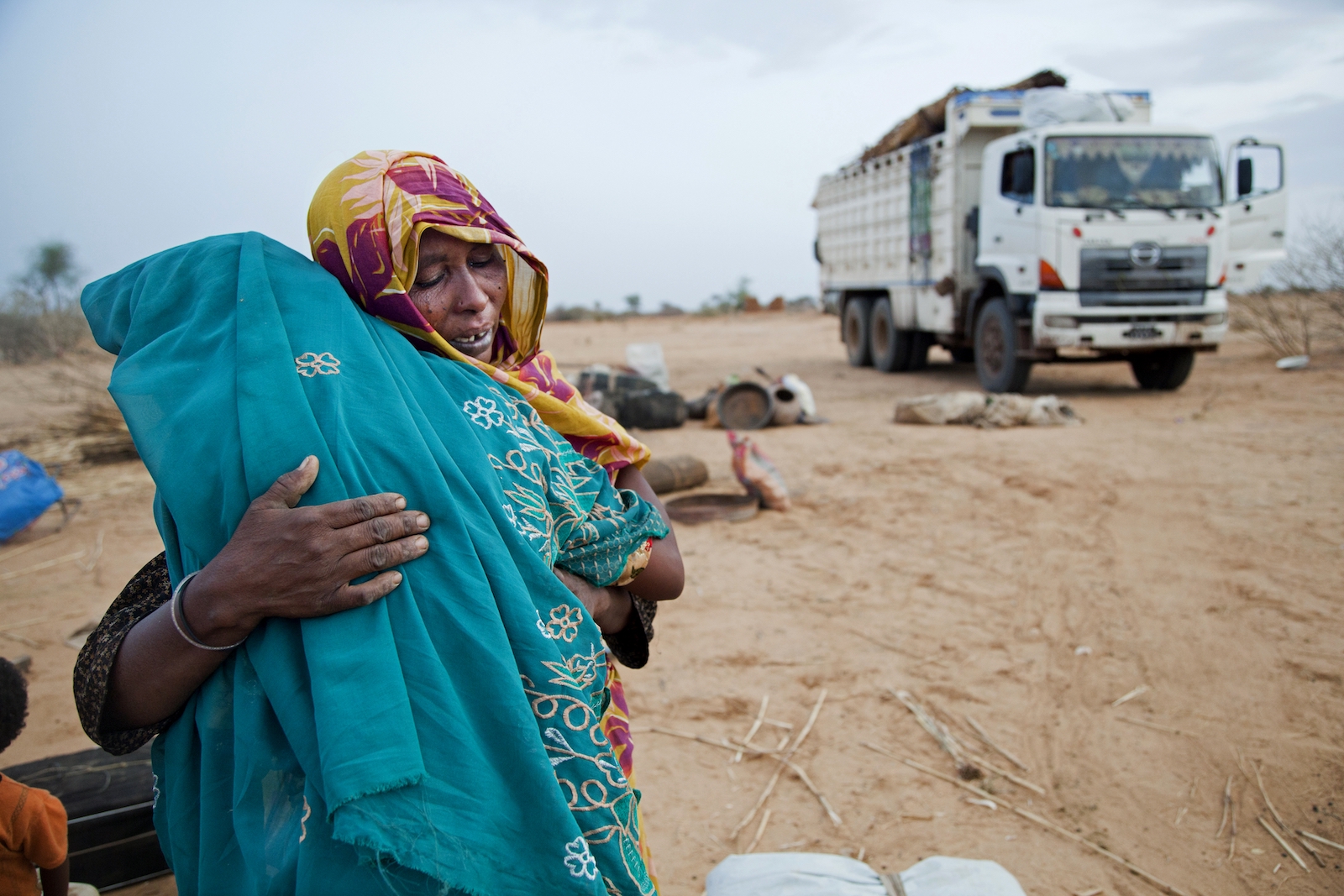

As Sudan Falls Apart, Its Ambassador Pleads for Europe’s Help.
Sudan’s ambassador to the European Union has issued an unusually blunt appeal to Brussels, warning that his country’s war is sliding into an even darker phase and that European policy risks making a catastrophic situation worse.
Speaking at Press Club Brussels Europe, Ambassador Abdelbagi Kabeir said Sudan has been “ravaged by a brutal war” that has destroyed infrastructure, emptied cities, and pushed millions toward famine. He framed the conflict—now in its third year—as both a humanitarian cataclysm and a diplomatic failure, and urged the EU to move from punitive measures to what he called “constructive engagement.”
“The war has led to a huge loss of human life and destruction of the infrastructure,” he told reporters. “There is now a dire humanitarian and economic situation in Sudan.” He stressed that sexual violence has been used as a weapon, that his own home had not been spared, and that “it is now time the guns were silenced.”
The envoy’s intervention comes as fresh reports of atrocities emerge from Sudan, a conflict that for long stretches has struggled to compete for attention with Ukraine and Israel’s war with Hamas in Gaza. Yet the scale is staggering: more than 150,000 people killed, according to some estimates, some 12 million forced from their homes, and an internal displacement crisis that the ambassador described as “very troubling.” He said 10.7 million people are now internally displaced, including around 3 million from Khartoum alone, with another 1.5 million scattered across neighboring countries. All of them, he added, have effectively been barred from democratic participation “for decades” and shut out of any civic role.
His remarks echoed the warning this week from UN Secretary-General António Guterres, who said the war was “spiralling out of control” and that people were dying “of malnutrition, disease and violence.” That, Kabeir suggested, is precisely why the EU should be leaning in, not tightening the screws.
Across Sudan, fighting between former allies—who rose together in a coup but later split over an internationally backed transition to civilian rule—has wrecked agriculture, severed supply lines, and turned large parts of the country into battle zones. Nearly 25 million people, about half the population, now face severe food insecurity, and more than 600,000 are already experiencing famine-level conditions, according to UN figures. The envoy conceded that Sudan “teeters on the edge of disaster.”
One of the most acute problems, he said, is no longer getting aid into Sudan but moving it inside the country. Humanitarian organizations such as Médecins Sans Frontières have remained in Sudan since the outset of the war, he noted, and food is reaching the Port of Sudan. But moving those supplies to civilians is perilous. “The problem is that this desperately needed aid and food is often just stuck there at the port,” Kabeir said. “All the necessary clearances have been completed, but the current huge challenge is how to guarantee the safety of humanitarian aid workers taking the food to targeted civilians around the country.” Looting, he added, compounds the problem: “These aid NGOs do have big, big problems.”
He credited Sudan’s neighbors—among them Eritrea, Uganda, Egypt (with some restrictions), and Chad—with opening their borders to those fleeing the war, calling this an “exemplary approach.” But he also suggested that the secondary effects of the conflict, especially mass displacement, should be a wake-up call for Europe. If the war continues to hollow out Sudan, migratory flows toward the Mediterranean will intensify, he warned, which is precisely why “the EU should double its efforts to assist in ending this brutal war.”
Kabeir reserved some of his sharpest language for the EU’s sanctions policy. On September 25, member states agreed to extend for another year the restrictive measures targeting individuals and entities accused of destabilizing Sudan and obstructing its political transition. As it stands, the regime—now extended to October 10, 2026—targets ten individuals and eight entities with EU-wide travel bans, asset freezes, and a prohibition on making funds or economic resources available to them.
To Brussels, this is leverage. To Kabeir, it is counterproductive. He called the measures “unjust” and “uncalled for,” arguing that they could obstruct efforts to find a peaceful settlement. Sudan is a largely agricultural country, he said, and at least one of the sanctioned companies is an agricultural operator. “These measures will, and do not, help create stability in Sudan and, additionally, nor will they do anything to improve relations between Sudan and the EU,” he said. “The EU could and should have chosen a different path.”
He hinted that Khartoum would pursue bilateral outreach, noting that Belgium, which currently holds the rotating EU Council presidency, “opened a door to possible action.” But he was firm on principle: “We do not accept the measures in principle and they are not legal. They are baseless and do not help the existing [Sudanese] relationship with the EU, which we hope could be better.”
From the EU’s side, officials have insisted that sanctions are precisely intended to push the warring parties toward a ceasefire and a political process. Since October 2023, the European Union has created and expanded the sanctions framework to cover individuals and entities linked to both the Sudanese Armed Forces (SAF) and the Rapid Support Forces (RSF), issuing successive listings in January, June, December, and July 2025. In an April 11 statement, the EU’s High Representative again called for “an immediate and lasting ceasefire,” pledged to use “diplomatic tools and instruments, including restrictive measures,” and stressed that any political outcome should reflect the “aspirations of the Sudanese people.”
This is where Kabeir wants to shift the conversation. Sanctions, he argued, may look principled on paper but “serve to destabilise things” in practice. What Sudan needs from Europe, he said, is not isolation but engagement—more coordination with humanitarian actors, greater attention to the security of aid routes, and more political facilitation to stop the fighting. “Instead of imposing restrictive measures, which serve to destabilise things, the EU would be better to take part in a more constructive engagement with Sudan,” he said. “We may never always see eye to eye but Sudan wants to be treated as it wants to be treated and not as EU wants to treat it.”
He also pushed back on suggestions that Sudan’s external relations—specifically with Russia—were a reason for European pressure. Ties with Moscow date to the 1960s, he said, and are “normal,” not least because Russia is a permanent member of the UN Security Council.
The ambassador’s press conference came on the heels of a separate visit to Brussels by the heads of UNHCR, UNICEF, and the World Food Programme in Sudan, who delivered the same basic message: the world’s largest humanitarian emergency is also one of its most neglected. They warned that 25.6 million people are exposed to acute hunger, that more than 10 million have been forcibly displaced inside and outside Sudan since the war began, and that famine has already been confirmed in Darfur—the first documented famine anywhere in the world since 2017. Thirteen other areas of the country are at risk.
Kabeir’s appeal was in that sense both diplomatic and urgent. He acknowledged “war fatigue” after more than two years of fighting but insisted there has been “no change of command” and that the state still seeks a way out. The choice he put before Brussels was stark: keep punishing Sudan’s fractured state and risk further collapse and migration pressures, or re-engage and help secure the aid corridors that could save millions.
“You can be very much instrumental in a partnership with us because we share so many platforms of cooperation,” he told EU policymakers. “But, to maximise any gains from such a relationship, there ought to be more constructive engagement with Sudan.”