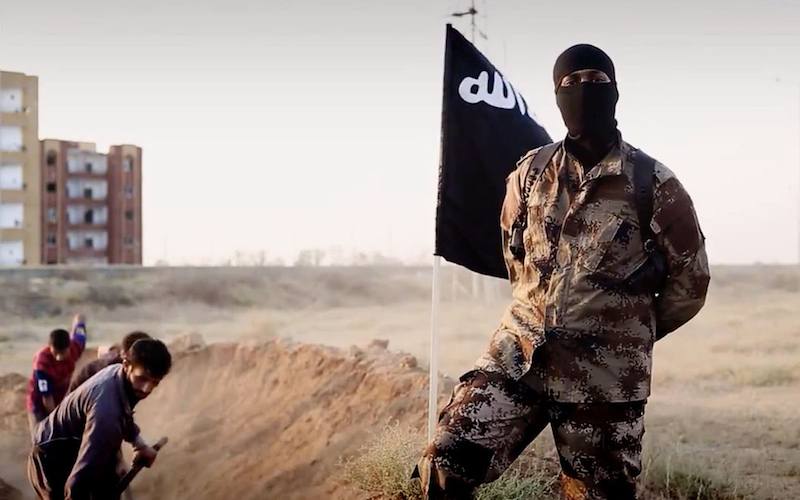

Beheadings are the Middle East’s Twisted Ice Bucket Challenge
You have seen the video countless times by now. A man steps in front of the camera, makes a speech, challenges his friends to follow him in the cause, and then…
For most of the summer, the “act” peppering our social media feeds has involved dumping a bucket of ice water over one’s head. Most people do it to raise money for charitable causes. But many do it out of sheer vanity: to look cool, to flash wealth.
While countless people have spent the summer dumping ice water over themselves, another kind of video has also been circulating online, this one from the Islamic State. These videos, too, show a man stepping in front of the camera, making a speech and then proceeding to behead another man. Many of the executioners perform with clear theatricality, as if putting on a show for the camera. Some likely do it out of vanity: to look cool. And, according to them, it is done in support of a charitable cause. That is, if you believe that massacring civilians by the thousands, destroying historical monuments on an unprecedented scale, and bringing a state to the brink of collapse count as charity.
Over the past year, the Islamic State has beheaded thousands of people: Syrian and Iraqi army soldiers, members of rival factions, Christians, Shias, and Yazidis. Virtually anyone who crosses its path risks ending up not merely shot, but beheaded or crucified.
However repugnant they are, the videos are not made solely for shock value. They help build ISIS’s reputation as the most fearsome force in the Middle East, which in turn aids the group’s efforts to conquer territory and consolidate power.
They also function as surprisingly effective propaganda and recruitment tools, drawing in young Muslims from around the world, many of them from Europe, who flock to ISIS-controlled areas believing they are helping to build a better world. A caliphate, no less.
In the shadow of U.S. airstrikes, the group also needs to show that it remains active and capable of striking back. Posting videos of victories and executions is important for financing. To keep the money flowing, the Islamic State must convince supporters that it, rather than other groups, deserves their donations. There is a market of people willing to give money to causes they believe are just. Like conventional charity donors, many want to know that their money is being used effectively and making a difference.
As a result, the Islamic State works hard to recruit new donors and retain existing ones by showing progress despite the airstrikes. This competition for funding and credibility pushes the group further into a spiral of increasingly gruesome content, leading it to release ever more violent videos and images. If anything, the Islamic State has redefined terrorist propaganda and marketing, treating brand-building with unusual seriousness and expertise.
A close-range decapitation is about as shocking, or to ISIS supporters, as reassuring, as any piece of content could be.
Despite all the Islamist chest-thumping, an important distinction must be made. Regardless of what the Islamic State claims, its interpretation of Islam is rejected by the overwhelming majority of Muslims and Islamic scholars around the world, who regard its actions as an abhorrent distortion of religious teachings.
Nor is beheading a uniquely Muslim custom. Far from it: the practice has a long and violent history across many civilizations and continents. The Assyrians frequently used it as a form of execution and intimidation. The Romans also practiced beheading widely, employing it as a standard method of capital punishment.
During the Middle Ages, beheading by the sword was common across Europe, Asia, and parts of the Americas. Japanese soldiers beheaded thousands of civilians and prisoners of war during World War II. The last execution by guillotine in France took place in 1977. More strikingly, the Bible contains more than a dozen references to beheading, though they are narrative accounts of specific events rather than divine commands.
Although most recent cases have occurred in the Middle East, beheadings by Islamist militant groups are not confined to the region. Incidents have also been documented in Nigeria, Afghanistan, Somalia, parts of Russia, Pakistan, and the Philippines.
While the beheading of Daniel Pearl in Pakistan in 2002 marked an important turning point, it was by no means the beginning. The roots of the practice in a modern jihadist context can be traced to the Soviet war in Afghanistan, waged between 1979 and 1989, when foreign mujahideen, mainly Arabs, often resorted to decapitating Soviet prisoners of war. During the Bosnian War, documented beheadings of captured Serb and Croat prisoners were carried out primarily by foreign mujahideen fighters rather than local Bosnian Muslim soldiers. These foreign volunteers, who fought alongside Bosnian government forces, came mainly from Middle Eastern and other Muslim-majority countries, with a disproportionately large number from Saudi Arabia.
The practice of beheading captives was quickly adopted by Chechen fighters during the First Chechen War (1994–1996) and, more prominently, the Second Chechen War (1999–2000), aided by the significant presence of foreign mujahideen. A small number of such killings, including the 1996 beheading of Russian soldier Yevgeny Rodionov and the execution of several Russian soldiers in Dagestan, received some attention in the Western media. However, they were largely treated as remote curiosities. It was not until after the U.S. invasion of Afghanistan in late 2001 that beheadings began to receive sustained international headline coverage.
There are only four countries in the world where, in accordance with Sharia law, beheading with a sword is considered a valid form of capital punishment: Iran, Qatar, Yemen, and Saudi Arabia. Of these, Saudi Arabia is the only one that actively carries out such executions in public. The practice is far from rare: in 2013 alone, the kingdom beheaded 79 people. The underlying reason is that Saudi Arabia’s official religious doctrine is Wahhabism, a strict and puritanical interpretation of Sunni Islam founded in the eighteenth century by the preacher Muhammad ibn Abd al-Wahhab. It demands a literal interpretation of the Quran and the Hadith, the recorded sayings and traditions of the Prophet Muhammad, as further developed and applied by Wahhabi scholars.
Wahhabis generally reject the label “Wahhabi,” preferring to describe themselves simply as Muslims who follow the purest form of Islam, based on the Quran and the example of the Prophet Muhammad and his companions. Their doctrine has historically been highly exclusivist, particularly toward other branches of Islam. This was demonstrated early in their history when, in 1802, forces of the First Saudi State under Saud bin Abdulaziz sacked the Shia holy city of Karbala in present-day Iraq. They killed thousands of inhabitants whom they did not consider true Muslims and severely damaged the shrine of Imam Husayn, one of the most sacred sites in Shia Islam.
It is no coincidence that the actions of groups such as the Islamic State, including the ethnic and religious cleansing of territories under their control, echo earlier Wahhabi practices. Reports have long pointed to significant private funding for extremist groups coming from the Gulf region, including Saudi Arabia, which is hardly surprising given the influence of its state-supported Wahhabi ideology. However, while Abd al-Wahhab’s original teachings were already radical for their time, modern iterations of the ideology have often become more extreme and politicized. Notably, Abd al-Wahhab’s iconoclastic campaigns were directed primarily against fellow Muslims, especially Shia communities, whom he accused of idolatry and polytheism, rather than against adherents of other religions.
Negative portrayals of Jews and Christians have deep roots in Islamic tradition, but they became especially prominent in modern Saudi religious education during the second half of the twentieth century. In Saudi schoolbooks, Jews and Christians were routinely depicted as inferior to Muslims and as historical enemies of Islam, and these portrayals continued into the twenty-first century.
The late historian Bernard Lewis, known for his sometimes controversial views on Islam, once said of Saudi religious influence: “Imagine that the Ku Klux Klan gets total control of the state of Texas. And the Ku Klux Klan has at its disposal all the oil rigs in Texas. And they use this money to set up a well-endowed network of colleges and schools throughout Christendom, peddling their peculiar brand of Christianity. You would then have an approximate equivalent of what has happened in the modern Muslim world.”
Members of the Saudi royal family have historically taken a notably more pragmatic and forward-looking approach to religion than the official religious establishment. However, while the Saudi state has attempted to rein in extremist elements, it has struggled to contain the spread of radical interpretations once they have gained wider influence.
Furthermore, the justification for beheadings does not come solely from Wahhabi teachings. Some scholars and militant groups have interpreted several verses in the Quran as permitting the execution of unbelievers in specific wartime contexts. In addition, the example of the Prophet Muhammad, whom Muslims regard as a role model, carries significant weight, as certain hadiths describe executions that he ordered or approved.
Following the surrender of the Jewish tribe of Banu Qurayza in Medina after the Battle of the Trench, traditional Islamic sources report that the women and children were enslaved, while the adult males were executed, with some 400 to 900 beheaded. The decision was delivered by Sa’d ibn Mu’adh, an arbitrator chosen by both sides, and approved by the Prophet Muhammad. These events are recorded in classical biographical literature, including the Sirah of Ibn Ishaq. While historians debate the exact numbers and historical details, extremists often cite this mass beheading. Most Muslim scholars, however, interpret it as a specific judgment tied to the tribal and wartime context of seventh-century Arabia rather than a general religious precedent.
Those who describe Islam as a religion of peace are right in important ways. At the same time, like many religious traditions, Islamic sources contain passages that have been interpreted in multiple ways over the centuries. Extremist groups cherry-pick certain texts and historical episodes to support their views. The material exists, and in the end, the question is one of interpretation. The Islamic State’s beheading videos make its own reading clear, but that reading is rejected by the overwhelming majority of Muslims and by mainstream Islamic institutions around the world.