Culture

Christian Solidarity With Israel After October 7
For more than three decades, Bishop Robert Stearns and Eagles’ Wings have brought Christian leaders to Israel to pray for Jerusalem, encounter the country beyond its biblical associations, and build relationships with Israelis and Jewish communities. After October 7, that familiar undertaking acquired a more immediate purpose. Visiting became a way of demonstrating that those relationships could withstand a crisis, and that expressions of solidarity would be accompanied by a willingness to listen.
This year, more than 550 Christian leaders from 51 countries joined a 10-day delegation organized by Eagles’ Wings in partnership with Israel’s Ministry of Foreign Affairs. Timed around the third anniversary of the October 7 attacks, the visit brought participants into meetings with Israeli officials, faith leaders, returned hostages, and bereaved families. They received briefings on Israel’s security challenges, but they also encountered people for whom those challenges were neither theoretical nor distant.
For many Israelis, October 7 unsettled more than their assumptions about national security. It raised painful questions about the outside world: who understood what had happened, who would remain engaged, and what support would mean once the initial expressions of sympathy faded. For Stearns and Eagles’ Wings, the attacks sharpened a conviction that has long informed their work. Relationships reveal their substance when maintaining them becomes difficult.
The connection between evangelical Christians and Israel has a much longer history. Generations of Christians have traveled to the country, studied the Bible in the places where its stories unfolded, and developed ties with Jewish communities. Eagles’ Wings has spent more than 30 years cultivating those encounters, encouraging visitors to understand Israel through the people who live there as well as through religious teaching, news coverage, and political argument.
After October 7, the human stakes of those encounters changed. Families were mourning murdered relatives, waiting for hostages, coping with displacement, caring for injured soldiers, and living with the psychological consequences of the violence and the war that followed. A visit could not undo those losses. It could, however, give people an opportunity to describe their experiences to someone prepared to hear them.
The delegation’s geographic reach also distinguished this anniversary. Participants came from Africa, Asia, Latin America, Europe, and North America. Among them were Ogiame Atuwatse III, the 21st Olu of Warri in Nigeria’s Delta State, and Olori Atuwatse III, the kingdom’s queen consort. Their presence underscored the breadth of a relationship often discussed primarily through the lens of American evangelical support for Israel.
For the Olu of Warri, the visit carried a message about healing that extended beyond the delegation’s immediate purpose. Reflecting on his time in Jerusalem, he said: “The sooner we all heal and really allow things to flow from that place, the healed heart, the world can only be a better place.”
He also drew a connection between Nigeria’s diversity and what he understood to be Jerusalem’s wider appeal: “Obviously Nigeria is a very diverse nation: there are many tribes, many cultures, a couple of religions, but sometimes people are very focused on the division. But if we all yield ourselves, we can produce a really beautiful tapestry. That’s the appeal that Jerusalem has. There is so much more that unites than divides.”
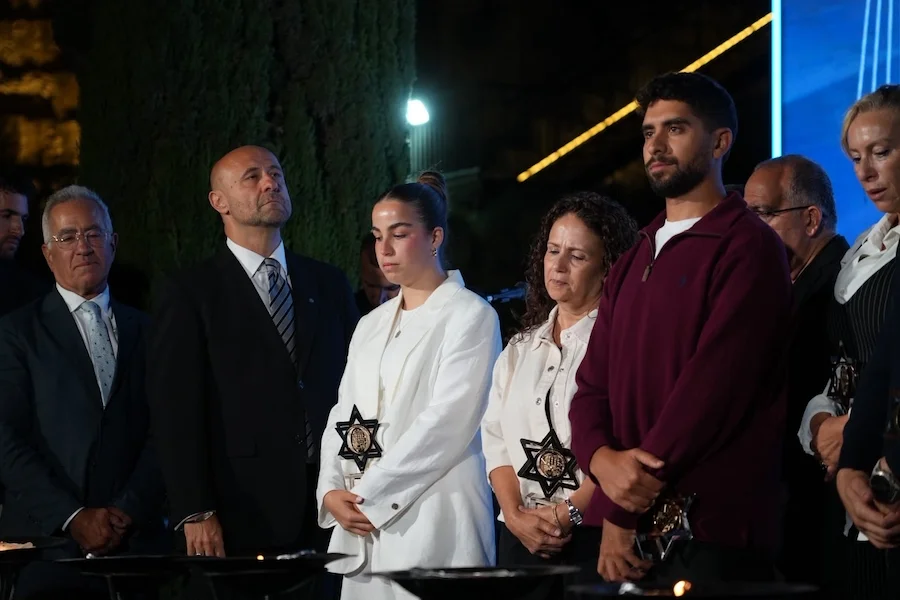
On October 7, the Eagles’ Wings delegation joined a solidarity gathering organized by Friends of Zion at Jerusalem’s Southern Wall. According to the organizers’ post-event account, more than 2,000 participants from 123 countries attended. Christian and Jewish leaders gathered alongside returned hostages, bereaved families, wounded Israelis, ambassadors, and diplomats, placing personal testimony at the center of an international commemoration.
Those who appeared onstage included Agam Berger, members of the Elkabetz family, Sagui Dekel Chen, Evyatar David, Itamar Shapira, and members of the Kupershtein family. Their presence gave the gathering a dimension that a statement of support alone could not supply. The people whose experiences had prompted the event were there to be seen and heard.
Friends of Zion also organized a 24-hour international broadcast around the commemoration, with Stearns participating. The broadcast carried the gathering to Christian audiences abroad, allowing communities unable to travel to Jerusalem to take part in its observance. For Stearns, however, the purpose of the visit extended beyond the audience for a broadcast or the number of people assembled at a ceremony.
“October 7 reminded us that genuine friendship is not measured by what we say when times are easy, but by whether we show up when times are hard. True friendship means coming close, listening, and refusing to walk away. We want Christian leaders who come to Israel to build real relationships with real people—relationships that endure long after they return home. Then they can speak not merely from information, but from personal experience, and stand with people they now know as friends.”
That emphasis on personal relationships has particular force in a debate shaped by social media, television, and polarized political narratives. A firsthand encounter cannot settle every question about Israel or its policies. Nor does meeting people affected by an attack confer comprehensive knowledge of a conflict. It can nevertheless make distant suffering more concrete and give visitors a basis for understanding experiences that otherwise reach them only through competing accounts.
The leaders who traveled to Israel also have audiences of their own. A pastor can describe a conversation to a congregation. A denominational leader can share those encounters across a larger network. Participants from Africa, Asia, or Latin America can bring what they heard into communities whose understanding of Israel may be drawn largely from international coverage. The influence of the visit therefore depends partly on how carefully they convey those experiences once they return.
For some African Christian leaders, the journey reinforced a sense of religious and personal responsibility. Dr. Emmanuel Nuhu Kure, Vision Pioneer of Throne Room Trust in Kafanchan, Kaduna State, Nigeria, described his support for Israel as an obligation rather than a passing response to suffering.
“No nation would stand by and watch its existence be continually threatened the way Israel has without proactively doing everything to protect its continued existence. I leave with a determination to pray for and stand with Israel as a duty, not out of sympathy.”
Apostle Daps Dalyop Gwom placed his experience within the Christian call to pray for Jerusalem and seek peace. His reflection connected the city’s suffering to that of his own community and framed forgiveness as a condition for healing: “To seek the peace of Jerusalem is to align my heart with God’s longing for the world. I cannot separate her streets from the streets of my own city, nor her tears from the tears of my own people. I stand with all who carry a burden for healing across borders and generations. My prayer is that forgiveness would flow like a river, and that enemies would discover they are neighbors. For where forgiveness flows, peace takes root, and where peace takes root, nations can heal.”
The African presence mattered beyond the symbolism of an international guest list. Christianity has a large and influential presence across the continent, and religious leaders can carry their accounts into churches and communities well beyond those directly represented in Jerusalem. Participants from other regions have similar opportunities. What began as a visit by several hundred people could continue through conversations among many more, although its lasting effect will depend on what those leaders actually do.
For Israel, evangelical support cannot resolve the country’s security problems or diplomatic disputes. Personal relationships do not substitute for policy, and an anniversary gathering offers no assurance that its participants will remain involved. Yet people overseas who know Israelis personally and choose to maintain those connections can offer something that governments and public statements cannot always provide: a continuing sense that someone beyond the country’s borders is paying attention.
The ceremonies made the breadth of that support visible. Their significance will be tested in the less conspicuous work that follows: keeping in touch with the people participants met, making room for their stories in congregations, and sustaining interest after the anniversary has passed. The delegation’s ambition is to turn a shared occasion into relationships that survive the return to ordinary life.
The visitors can now speak about Israel through encounters as well as through what they have read or watched. Whether those encounters deepen understanding will depend on the care, humility, and persistence they bring to that task. Three years after October 7, the promise of the journey rests in that continuing effort. Showing up mattered. Remaining present will determine how much.