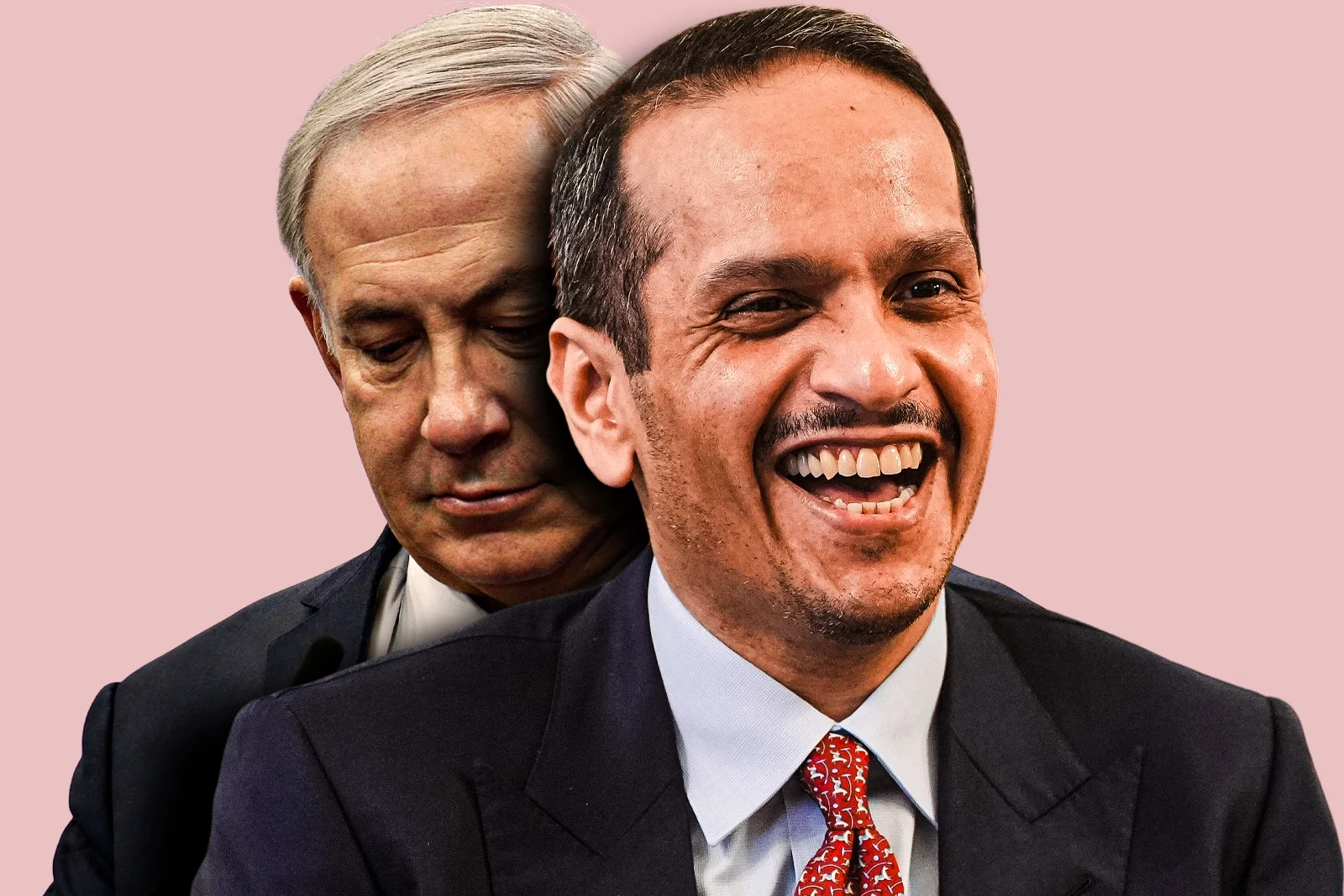

Netanyahu’s War on Qatar Is Bad for America
For years, a network of pro-Israel advocacy groups has urged Washington to regard Qatar as an adversary masquerading as a friend. Their case is familiar: a Gulf monarchy that hosts Hamas’s political leadership, finances an influential television network, and hedges its geopolitical bets. But that account leaves out much of what Qatar has actually done for the United States.
Al Udeid Air Base, outside Doha, hosts the forward headquarters of U.S. Central Command and has supported American air operations across the region for more than two decades. In 2022, Washington designated Qatar a major non-NATO ally. Administrations of both parties have described it as a strategic partner and sought its investment. That is hardly how the United States ordinarily treats an enemy.
When Kabul fell in 2021, Qatar opened its airport and territory to one of the largest evacuations in modern history. After the United States closed its embassy in Afghanistan, Doha agreed to represent American interests there, a role it continues to perform. Few governments would have volunteered for either responsibility.
Then there are the Americans who made it home. Qatari mediation helped secure the release of Americans detained in Iran in 2023, and Doha has participated in negotiations over Americans held by the Taliban. Secretary of State Marco Rubio publicly credited Qatar after George Glezmann’s release in March 2025 and Amir Amiry’s in September. Following Dennis Coyle’s release in March 2026, Rubio thanked Qatar and the United Arab Emirates, while distinguishing their contributions: the Emirates helped secure the release, and Qatar provided support and advocacy. Those distinctions matter. So does the broader record. Qatar has also hosted talks aimed at ending the fighting in eastern Congo. For the families of freed detainees, the question of whether Doha is a friend is hardly abstract.
The most serious objection is Qatar’s hosting of Hamas’s political office, and it warrants a serious answer. Hamas leaders have lived and worked in Doha, and Americans are entitled to question whether that arrangement should continue. But the office was never a secret. Qatari officials say it opened in 2012 at Washington’s request to provide an indirect channel to Hamas, an account a former Obama administration State Department official has corroborated. A Taliban office followed in 2013, based on similar reasoning, and Doha subsequently hosted talks over the American withdrawal from Afghanistan.
Israel, too, has relied on Qatar’s access. Israeli officials knew about Qatari payments into Gaza for years. The head of Mossad has dealt directly with Doha, and Qatari mediation helped produce the November 2023 agreement that freed roughly 100 hostages, including Americans. Governments can reasonably conclude that hosting Hamas carries unacceptable costs. But anyone demanding the office’s closure must explain what would replace it. Shutting down a diplomatic channel does not eliminate the need to negotiate.
In remarks reportedly made to hostage families in January 2024, Netanyahu argued that Qatar possessed leverage over Hamas and that Washington should pressure Doha to use it. That argument is not inherently unreasonable. But political incentives also deserve scrutiny. Netanyahu remains on trial on corruption charges that he denies, has sought a presidential pardon, and faces an International Criminal Court arrest warrant. The October 27 election left his political bloc short of a parliamentary majority, with the formation of the next government unresolved.
A mediator capable of ending a war can also hasten the moment when political leaders must answer difficult questions about why that war began and how it was conducted. I cannot prove that such considerations determine Netanyahu’s approach to Qatar. But American policymakers should consider the possibility before allowing Israel’s domestic political battles to dictate Washington’s relationship with Doha.
Washington has relatively few partners willing and able to maintain contact with actors American officials cannot readily meet, including Hamas, the Taliban, and, at times, Tehran. Fewer still have translated those relationships into the release of detainees and negotiated pauses in fighting. American diplomats cannot occupy every negotiating room. Qatar has been present in several that mattered. Treating it as an enemy could leave the next American detained abroad with one fewer route home.
Some of the pressure against Qatar has been organized. In September, Haaretz reported that roughly 30 communications professionals and political advisers, including a former Mossad official, launched a covert campaign targeting Doha within days of Hamas’s October 7, 2023, attack. They established a multilingual website, approached American journalists, and embraced the slogan “Hamas is ISIS.” According to the newspaper, the civilian initiative was intended to pressure Qatar into pushing Hamas to release the 251 people taken hostage. It ended without explanation after about a month. The identities of those behind it have not been established, and the reporting did not link the operation to Netanyahu’s government.
Its participants may sincerely have wanted the hostages released. There is nothing objectionable about that objective. The troubling part is the tactic: depicting the government that maintains a line to Hamas as indistinguishable from Hamas itself risks discrediting one of the very intermediaries needed to negotiate a release.
Israeli investigators have separately examined allegations that aides to Netanyahu received Qatari-linked funds in connection with a public relations effort. Netanyahu and Doha have denied wrongdoing. Those allegations raise questions about the conduct of Israeli officials, not whether Qatari mediation has helped Americans return home. Qatar conducts lobbying in Washington as well. That is why the strongest evidence for its value comes not from Doha’s claims but from what American officials have publicly acknowledged.
The longer-term political cost may fall on Israel. A February Gallup survey found that 41% of Americans sympathized more with Palestinians, compared with 36% who sympathized more with Israelis. Gallup cautioned that the difference was not statistically significant. Nevertheless, it marked the first time since the question was introduced in 2001 that Israelis had not led. In early 2023, Israelis held a 54% to 31% advantage. Among Americans ages 18 to 34, just 23% now sympathize more with Israelis, a record low. The shift began before the Gaza war, but the war has accelerated it. Today’s younger Americans will help shape U.S. policy for decades.
Israel’s security matters to American interests. That is precisely why its leaders should reckon with the damage. A government unable to bring its wars to a close gives its critics fresh ammunition, and no public relations campaign can reverse a long-running shift in public opinion. Whoever forms Israel’s next government will inherit that problem. Blaming Qatar will not solve it.
Washington should judge Qatar by what it has delivered: a critical air base, a pathway for evacuation, diplomatic representation in Kabul, and Americans returned to their families. It can and should press Doha about Hamas’s political presence and the destination of Qatari funds. But mistaking a useful intermediary for an enemy would not serve the families awaiting the next release. It would serve those who find Qatar a convenient political target.