When Worlds Collide: The Legal Maze for U.S. Troops Injured on Home Soil
If you’re serving in the U.S. military and you’re injured while in the United States, this article might help you.
In Norfolk, Virginia—home to the world’s largest naval station—the streets just outside the gate pose a quiet, measurable threat to national security. The danger isn’t hypothetical; it’s quantifiable. City data show 170 fatal and serious-injury crashes on local roads in 2024, putting thousands of service members at risk on routine commutes. For them, a simple drive can turn, in an instant, into a life-altering crisis—one that drops them into a legal labyrinth where military status tangles what would otherwise be a standard personal-injury claim.
When U.S. troops are hurt in civilian crashes on home soil, they enter a jurisdictional gray zone: military regulations on one side, civilian tort law on the other. That collision of systems imposes heavy burdens on service members, complicates both physical recovery and financial redress, and—critically—undercuts military readiness, a pillar of U.S. foreign policy and national security. Failing to provide a transparent and equitable framework isn’t merely bureaucratic sloppiness. It’s a strategic liability for an all-volunteer force.
A Jurisdictional Quagmire: Why a Civilian Accident Isn’t Simple
For civilians, the aftermath of a wreck is governed by relatively straightforward state law. For active-duty personnel, the same event triggers a maze of overlapping—and sometimes contradictory—state and federal rules that can jeopardize compensation and even careers. The problem is structural: two legal worlds, one injured person.
The Collision of Two Worlds
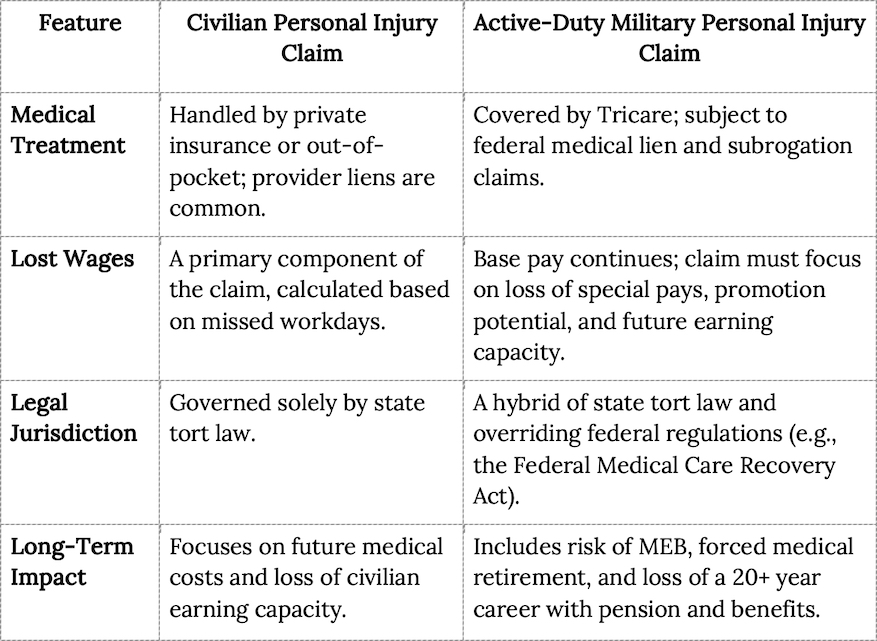
An active-duty service member injured off-base, on personal time, is plainly in a civilian context. Fault and liability fall under state tort law. But the consequences of that injury are immediately shaped by federal and military jurisprudence. The member’s status as a federal employee, mandatory reliance on Tricare for care, and the injury’s potential impact on deployability and career trajectory all inject federal interests into a state-level case. The result is a hybrid jurisdiction—confusing to civilians and even to many lawyers—that few encounter until it’s too late.
The Tricare Complication and Federal Liens
Tricare will cover necessary treatment. It also introduces a significant legal complication. Under the Federal Medical Care Recovery Act, Washington can recoup the medical costs it paid from any settlement or verdict obtained from the at-fault party’s insurer. That subrogation right effectively turns a private claim into one encumbered by a federal lien. Satisfying the government’s interest can sharply reduce a service member’s net recovery and complicate negotiations, since the injured party is bargaining not only for their own damages but also with a federal payback in the balance. The process routinely slows cases and hardens positions.
The Shadow of Sovereign Immunity
The Feres Doctrine bars suits against the Department of Defense for injuries “incident to service.” A collision with a civilian driver is not incident to service—but Feres still casts a long shadow. Its mere existence fuels a persistent misperception among some adjusters and inexperienced attorneys that service members possess narrower rights than civilians. The result can be lowball offers and avoidable legal trench warfare to secure fair compensation.
Military service scrambles the default settings of personal-injury litigation. Standard playbooks often fail.
In a typical civilian case, lost wages are a central, clean number. For active-duty members, base pay often continues during recovery. The real financial losses are subtler and potentially more significant: special-duty and hazardous-duty pay, sea pay, reenlistment bonuses, and promotion prospects that evaporate. Serious injuries can trigger a Medical Evaluation Board (MEB) and, potentially, medical discharge. The delta between a 20-year retirement and a medical retirement can total hundreds of thousands of dollars over a lifetime—losses a vanilla damages model may miss entirely.
The Imperative for Specialized Legal Counsel in Military Communities
Because state liability rules intersect with federal military regulations, a service member’s claim demands more than a generalist. In military-dense regions like Hampton Roads, that expertise is non-negotiable. The risk environment alone is elevated: in 2023, Virginia recorded more than 25,000 speed-related crashes, a significant contributor to local accidents. When the injured are military personnel, the ensuing case requires counsel who is fluent in the realities of service life and the intricacies of military law.
Firms with a long history in the region are often best equipped to handle these nuanced cases. For example, a seasoned Norfolk car accident lawyer from a firm like Montagna Law understands the unique challenges faced by active-duty clients. With over 50 years of experience serving Hampton Roads families, including countless military personnel, their attorneys are versed in the specific hurdles that can derail a service member’s case. They recognize that a claim is not just about immediate medical bills but about protecting a career, a pension, and a family’s future.
This specialization proves decisive when arguing for damages a civilian framework can obscure: losses tied to missed promotions or security-clearance issues; inability to perform military-specific duties that imperil special pays; the long-tail financial impact of a medical discharge compared with a full retirement; and careful navigation of Tricare reimbursement to maximize a client’s net recovery. Without that expertise, service members can be pushed into settlements that overlook the long-term career implications of their losses.
The Hidden Costs to U.S. Military Readiness and Foreign Policy
What happens to one injured airman or petty officer doesn’t stay personal. It radiates into force readiness.
A member mired in litigation, wrestling with medical uncertainty and financial stress, is—by definition—non-deployable. That status erodes unit cohesion and dulls the military’s ability to respond to global threats, a point underscored in work on the spy war. As Italian military unions noted after a fatal road accident, the safety and well-being of personnel during commutes directly affects on-duty effectiveness. Replicate that dysfunction across hubs like Norfolk, Fort Liberty, or Camp Pendleton, and you’re looking at measurable degradation of America’s capacity to project power.
A Policy Vacuum Demanding Action
Here, Congress has left a hole. The obstacles troops face in civilian courts mirror a broader failure to anticipate how domestic systems can have international consequences—a theme explored in discussions of how nations weaponize history. Recently, the U.S. Supreme Court signaled interest in the welfare of cadets injured during training, urging policy fixes to support rehabilitation. That logic should extend to service members injured in the civilian sphere, where protections are even murkier and the risk of injustice higher.
The Strategic Imperative of a Fair System
A clear, fair pathway to justice after a civilian accident isn’t just a matter of equity. It’s a strategic necessity. The all-volunteer force runs on trust and morale. If the system fails troops at home, recruitment and retention suffer.
Other democracies are connecting these dots. The High Court in Jammu & Kashmir has amended its rules to provide specific legal safeguards for soldiers in civil litigation, recognizing the distinctive obligations of service. The United States needs a comparable, proactive federal approach to close dangerous gaps.
Beyond the Barracks: Securing the Home Front for America’s Troops
The intersection of civilian tort law and military regulation has produced a confusing and often disadvantageous regime for troops injured on U.S. roads. That ambiguity harms families and gums up the machinery of national defense—sidelining highly trained personnel, sapping morale, and straining the covenant between the nation and those who serve. Courts can mitigate some of it, but real progress requires legislation: more explicit rules, streamlined processes, and guaranteed access to counsel with genuine military expertise. That isn’t only justice. It’s a strategy—vital to the health, welfare, and readiness of the force that secures the nation.