
The AI-Copper Rally Behind NovaRed Mining’s Critical Minerals Bet
NovaRed Mining occupies an unusually crowded intersection of contemporary market themes. The company sits at the convergence of artificial intelligence, copper supply, critical minerals policy, and North America’s growing concern with economic security. Taken individually, none of these trends is unique. Together, they help explain why a relatively small Canadian exploration company has attracted outsized attention from investors.
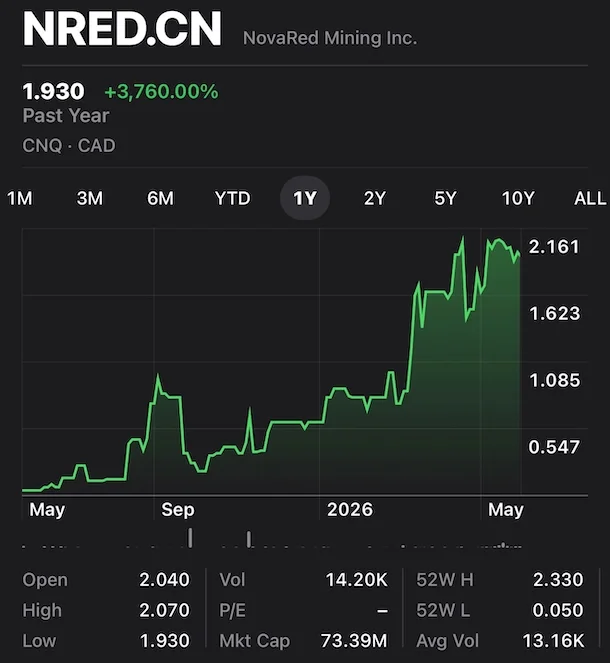
Trading on the Canadian Securities Exchange under the symbol NRED, NovaRed has experienced a remarkable rise over the past year. Market data showed the stock climbing from a 52-week low of C$0.05 to as high as C$2.33 before closing at C$1.93 on May 29. Such moves are not uncommon in the speculative corners of the mining sector. What makes NovaRed distinctive is the narrative that has emerged around it.
The company’s principal asset is the Wilmac Copper-Gold Project in British Columbia, where NovaRed holds an option to acquire a 70 percent interest. Like many junior mining firms, the company is pursuing the possibility that a promising geological concept can ultimately become a commercially viable resource. Yet over the past year, Wilmac has evolved from a relatively modest exploration project into a much larger district-scale land package.
That expansion accelerated in May when NovaRed announced the addition of the Trojan-Condor Corridor, increasing the project’s footprint to more than 16,000 hectares. The scale is notable not simply because of the acreage involved, but because it changes how the project is perceived. Large land packages provide room for multiple exploration targets and, perhaps more importantly, allow investors to imagine a broader geological system rather than a single prospect.
Wilmac is situated within British Columbia’s Quesnel porphyry belt, a region known for significant copper mineralization and established mining activity. The company is careful to note that nearby deposits offer no guarantee of success at Wilmac itself. Exploration history is filled with examples of promising geology that failed to produce economic results. Nevertheless, location remains one of the first factors investors consider when evaluating an early-stage mining project, and Wilmac’s position within a recognized mining district provides an important part of its investment thesis.
 The project’s technical work has gradually added substance to that story. NovaRed has undertaken geophysical surveys across several target areas, using a combination of induced polarization and audio-magnetotelluric methods to better understand subsurface structures. According to the company, these surveys are capable of identifying both near-surface chargeability anomalies and deeper resistivity features that may help refine future drill targets.
Additional exploration programs have produced encouraging, though still preliminary, results. Soil geochemistry sampling at North Lamont identified elevated copper values associated with a mapped geological feature and nearby magnetic anomalies. Historical survey work from the Lamont Grid further suggested the presence of intrusive bodies and structures that could warrant additional investigation. None of these findings establish the existence of an economic deposit, but they provide the kinds of geological indicators that exploration companies use to prioritize future drilling.
Yet geology alone does not fully explain NovaRed’s growing profile.
What differentiates the company from many of its peers is its attempt to integrate artificial intelligence into the exploration process. Through a platform known as MetalCore, NovaRed is developing a system intended to combine geological, geophysical, geochemical, and historical datasets into a probabilistic framework for evaluating mineral opportunities. The objective is not simply to collect more information, but to create a more systematic method of identifying and ranking exploration targets.
Whether such tools ultimately improve discovery rates remains an open question. Mineral exploration has long been characterized by uncertainty, and technological innovation has repeatedly promised to make the process more predictable. Still, the effort reflects a broader trend occurring across industries: the growing belief that machine learning and large-scale data integration can improve decision-making in fields traditionally dependent on human expertise.
The company has sought to reinforce that strategy through intellectual-property protection. In May, NovaRed announced the filing of a non-provisional U.S. patent application covering aspects of MetalCore’s evaluation and transaction-management system. The filing does not establish commercial viability, nor does it guarantee patent approval. It does, however, signal that NovaRed sees itself as more than a conventional exploration company.
That ambition arrives at a moment when copper itself is acquiring new strategic significance. Much of the public conversation surrounding artificial intelligence focuses on software and computing power. Less attention is paid to the physical infrastructure required to support those systems. Data centers require electricity. Electricity requires transmission networks, transformers, substations, cooling systems, and grid expansion. Copper is embedded throughout that infrastructure.
This reality has contributed to increasingly bullish long-term forecasts for copper demand. S&P Global has projected substantial growth in global consumption over the coming decades, driven by electrification, artificial intelligence, defense spending, and energy infrastructure. At the same time, concerns about future supply have intensified, raising the possibility of significant deficits if new production fails to keep pace.
Recent geopolitical events have only sharpened those concerns. Disruptions linked to conflict in the Middle East have highlighted vulnerabilities within industrial supply chains, particularly for materials and chemical inputs used in metal production. As a result, copper is increasingly viewed not only as a growth commodity, but also as a strategic resource whose availability carries broader economic and geopolitical implications.
That context helps explain why Canada’s role has become more prominent in discussions about critical minerals. Ottawa includes copper among the country’s designated critical resources, citing its importance to technologies ranging from electric vehicles and renewable energy systems to telecommunications and defense applications. As governments and industries seek secure sources of supply, projects located within stable jurisdictions are attracting heightened attention.
Viewed through that lens, NovaRed’s appeal extends beyond the traditional exploration narrative. Investors are not merely evaluating a prospective copper-gold project. They are assessing a company that has positioned itself at the intersection of resource development, artificial intelligence, and the growing effort to secure the material foundations of the digital economy.
Washington is moving in a similar direction.
On May 29, Reuters reported that the White House issued a memorandum authorizing higher compensation for national-security positions focused on critical minerals and advanced materials. The stated goal was to attract professionals from fields such as engineering, finance, law, and investment to work on strategic supply-chain challenges. The policy reflected a broader shift in Washington’s thinking: Critical minerals are increasingly being viewed not merely as commodities, but as assets central to economic resilience and national security.
The cross-border dimension of that strategy is becoming more pronounced as well. A day earlier, Reuters reported that Canadian Prime Minister Mark Carney had called for a renewed U.S.-Canada partnership in sectors including aluminum, automobiles, and critical minerals. In making the case, Carney emphasized Canada’s role as a reliable supplier of both energy and mineral resources to the United States. His remarks underscored a growing consensus among policymakers that North America’s industrial future may depend as much on secure resource supply chains as on technological innovation itself.
Financial markets have begun responding to that change in perspective. Reuters reported that at least 18 mining companies—primarily Canadian and Australian firms, along with several U.S. startups—had either completed or were pursuing dual U.S. listings in 2026, up from just three the year before. The trend suggests that investors are increasingly evaluating mining companies through the lens of strategic resources and industrial security rather than through commodity cycles alone.
NovaRed has sought to position itself within that emerging conversation. Among its advisors is retired U.S. Navy Commander Phil Ehr, who argued in a May interview that copper should be viewed as a national-security issue as much as an industrial one. Ehr pointed to disruptions around the Strait of Hormuz as an example of how geopolitical instability can ripple through global supply chains, affecting everything from energy markets to mining and refining operations.
The significance of that argument extends beyond any single company. Copper is increasingly becoming part of a larger discussion about the infrastructure that underpins modern economies: power grids, artificial-intelligence data centers, electric vehicles, defense systems, and the logistics networks that connect them. As governments and corporations confront the demands of electrification and digital expansion, access to reliable supplies of critical materials is taking on new strategic importance.
NovaRed has also strengthened its advisory board with the addition of Ed Kostenski, a veteran executive whose experience spans mining equipment, project finance, infrastructure development, and industrial growth initiatives. Such appointments do not validate a project’s geology, nor do they resolve the uncertainties inherent in mineral exploration. They do, however, reflect an awareness that the challenges facing a successful mining project extend far beyond discovery. Financing, infrastructure, equipment procurement, logistics, and execution ultimately determine whether a promising exploration story becomes a viable mining operation.
That broader context helps explain investor interest in NovaRed. The company sits at the intersection of several themes that currently command significant attention: artificial intelligence, copper supply, critical minerals, industrial policy, and North American resource security. Its appeal derives not from a producing mine or a defined economic resource, but from its exposure to those overlapping narratives.
The risks, however, remain substantial. NovaRed is still an exploration-stage company. It has not announced a producing operation, published an economic resource estimate, or reported a major discovery. Its patent application remains under review, and its MetalCore platform has yet to demonstrate durable commercial success. Ultimately, the company’s future will depend on the same factors that govern any exploration venture: geological results, successful drilling programs, access to capital, and the ability to convert technical potential into economic value.
Yet NovaRed’s story is revealing for reasons that extend beyond the company itself. It illustrates how the conversation around mining is changing. Increasingly, resource projects are being evaluated not simply as commodity plays, but as part of a larger effort to secure the physical foundations of the digital economy.
Artificial intelligence requires enormous amounts of power. Power requires infrastructure. Infrastructure requires copper. And as governments across North America grapple with that reality, companies positioned along that chain are attracting a level of attention that would have been difficult to imagine only a few years ago.