The Platform
Inside the PUK’s Strategy as Baghdad’s Political Map Shifts
11.14.2025
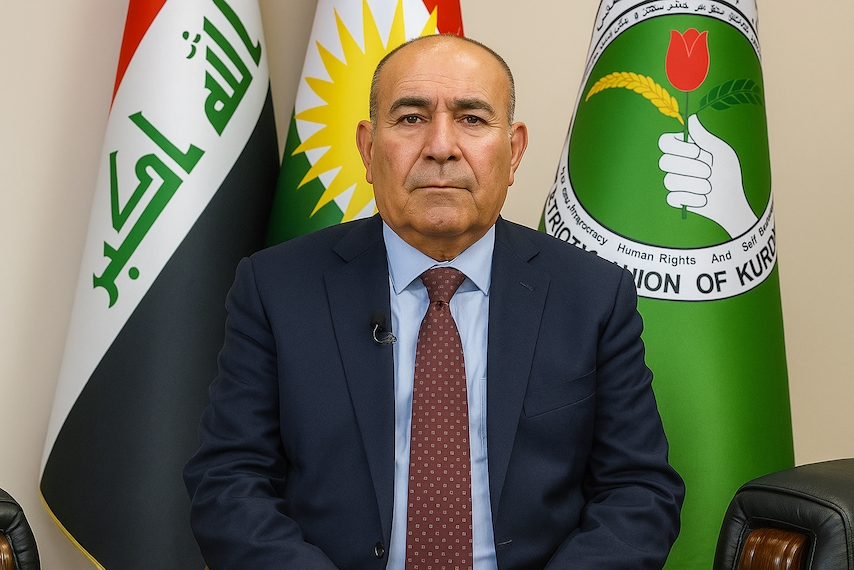
Interview with Saadi Ahmed Pira, a member of the PUK’s Political Bureau, on the evolving political roadmap for Iraq and the Kurdistan Region.
The Patriotic Union of Kurdistan has reasserted itself as a central force in Iraqi politics. In Iraq’s latest legislative elections, the PUK stood out as the only Kurdish party to expand its seat count, winning representation across nine provinces—a reach unmatched by its rivals. The party has long cast itself as a bridge between Erbil and Baghdad, advocating dialogue over confrontation and stability over brinkmanship. Yet, with Baghdad’s political landscape still unsettled, the PUK is treading carefully before aligning with any parliamentary bloc.
In this interview, Saadi Ahmed Pira, a member of the PUK’s Political Bureau, reflects on the evolving political roadmap for Iraq and the Kurdistan Region. He discusses what drove the party’s electoral gains, its strategy for navigating disputes with Baghdad, and the challenges of government formation in Erbil.
Manish Rai: The PUK has reemerged as a major force in Iraqi politics, becoming the only Kurdish party to win seats across nine provinces and to increase its overall tally. What, in your view, drove this success?
Saadi Ahmed Pira: The Patriotic Union of Kurdistan has always been a significant force in the political and historical landscape of Kurdistan. From the earliest days, the PUK led the core opposition forces during the Kurdistan Revolution and later became a central actor in establishing the Kurdistan Regional Government after the uprising. These roles have shaped how people across Iraq view us today.
We have repeatedly taken on the role of facilitator in resolving national issues, advocating dialogue and constitutional solutions rather than conflict. For this reason, our recent success is neither new nor surprising. Iraqis increasingly recognize the PUK as a genuine, patriotic party dedicated to the well-being of the entire country, not just one region. It is also worth noting that our vote share increased in the Kurdistan parliamentary elections held last year, reaffirming our long-standing position as the second-largest political force in the region.
Rai: During the campaign, the PUK emphasized that it is the only Kurdish party capable of effectively defending citizens’ rights in Baghdad. Why was this message central to your strategy?
Pira: The Kurdish people have been struggling with a deep and prolonged financial crisis for more than a decade. During this period, the Kurdistan Regional Government has not received its full and rightful annual budget allocation from Baghdad. I cannot definitively say whether the KRG or the federal government bears greater responsibility, because the roots of the crisis are complex and intertwined. However, it is clear that the shortage of salaries and the financial strain on the population are not solely the responsibility of the Kurdistan Regional Government.
The PUK has worked steadily to create a political environment that encourages cooperation between Erbil and Baghdad, especially with respect to the issues surrounding oil exports, revenue management, and finding practical long-term solutions to the financial crisis. Our campaign emphasized defending the rights of our citizens in Baghdad because we have proven, through our actions, that we are committed to safeguarding the interests of the Kurdish people regardless of political fluctuations.
Rai: The PUK has long advocated for constructive relations between Kurdistan and Baghdad. What concrete steps does the party propose to finally resolve the long-standing disputes over territory, hydrocarbon revenues, and budget allocations?
Pira: The federal budget and the salaries of employees in Kurdistan are constitutional rights of every Iraqi citizen. These are not favors from Baghdad but obligations mandated by law. There are several long-standing disputes between the federal government and the Kurdistan Region that have caused repeated disruptions in relations over many decades. They need to be resolved if we want to establish a stable and peaceful environment for all communities. Recently, a preliminary agreement was reached to return the oil revenues to Baghdad by the end of the year, and this step forms part of a broader effort to resolve the salary issue.
With regard to the disputed territories, the Kurdish leadership historically has not applied the necessary pressure on Baghdad to secure a lasting solution. These areas have remained unresolved since the 1960s and 1970s due to the legacy of dictatorial regimes and demographic manipulation. This time, Kurdish leaders must adopt a stronger and more united approach. The people living in those territories are our families, our communities, and they must have credible protection. We have a duty to ensure their rights, their security, and their future.
Rai: Kurdistan’s new government has been stalled for more than a year. Do you believe the outcome of the Iraqi legislative elections will help break the deadlock in Erbil?
Pira: The results of the Iraqi legislative elections have no direct connection to the process of forming the new government in Kurdistan. These are two fundamentally separate issues. We have already held numerous rounds of negotiations with the Kurdistan Democratic Party in an effort to overcome the obstacles that remain and to announce a new cabinet. As is natural with any political dialogue, we and the KDP have our own distinct viewpoints, priorities, and political calculations.
This is entirely normal, as we are two different parties with different political identities and responsibilities. The magnitude or outcome of the Iraqi elections has not caused the delay in forming the cabinet. The results of the Kurdistan parliamentary elections have already determined the first and second parties, and our differences concern internal issues that require patient and careful resolution.
Rai: Given Baghdad’s political fragmentation, which parliamentary bloc is the PUK most likely to support?
Pira: The PUK has maintained strong and constructive relations with Iraq’s political forces since the time of Mam Jalal, the founder of our party. Under the leadership of Mr. Bafel Talabani, we remain committed to the same political approach that Mam Jalal consistently upheld: building bridges, encouraging national dialogue, and supporting stability wherever possible. This is why the PUK continues to carry weight and credibility in Baghdad. Our leadership has traditionally played a positive and stabilizing role in Iraqi politics, and we intend to continue in this direction, contributing wherever we can to the political process and the betterment of all Iraqis.
Rai: The PUK maintained its strongholds in Kurdistan while expanding its presence in federal Iraq. To what do you attribute this breadth of support?
Pira: Our influence across federal Iraq and our strong positions in various parts of Kurdistan stem from the political honesty, integrity, and consistency of the PUK leadership. Our approach has always been centered on securing prosperity for the Kurdish people while promoting stability, coexistence, and peace across Iraq.
We have frequently emphasized that Iraq as a whole represents the strategic depth of Kurdistan, and that our long-term issues can be resolved within the framework of the Iraqi constitution. Our commitment to coexistence with all Iraqis has strengthened our relationships far beyond our traditional strongholds. There are many shared goals that unite us with other communities, and we remain determined to contribute positively to Iraq’s political process through responsible, principled engagement.
Rai: In 2022, the PUK backed Mohammed Shia al-Sudani for prime minister—a move that proved consequential. Based on the recent election results, do you expect the PUK to support him again?
Pira: It is still too early to make a definitive judgment about the next phase of government formation in Baghdad. We do not yet have clarity on what political equation will emerge or whether the Shiite forces will be able to reach a consensus. It is true that Mr. Sudani obtained favorable results in this election, but we must remember that not all Shiite voters supported him. Dozens of other Shiite groups have secured seats in parliament.
By political custom, the prime minister of Iraq is chosen by consensus among the Shiite blocs. I expect that reaching such a consensus will take considerable time—possibly several months—because the political scene remains fragmented and difficult to predict. At this moment, nothing is clearly visible. We must wait for the Shiite forces to complete their negotiations, and after that, we will join the parliamentary majority that forms around whichever candidate ultimately receives their support.
Special thanks to Besha Jawhar from PUKMEDIA English for facilitating this interview.
Manish Rai is a geopolitical analyst and columnist for the Middle East and Af-Pak region. He has done reporting from Jordon, Iran, and Afghanistan. His work has been quoted in the British Parliament.