
What We Eat Is Becoming a Security Issue
A rainforest thousands of miles away can seem remote from the daily business of national security. Its decline becomes harder to dismiss when it disrupts rainfall, damages harvests, and drives competition for food and water. A British government assessment now places that chain of consequences squarely within the security debate, with implications far beyond Britain.
On September 2, the UK House of Commons Library published a briefing examining how global biodiversity loss and the collapse of critical ecosystems could affect the country’s resilience, security, and prosperity. It revisits a government assessment released on January 20, a report entitled Global biodiversity loss, ecosystem collapse and national security. The government says analysts and experts across its departments developed the assessment. The Times reports that it “was put together with the help of the joint intelligence committee, which oversees MI5 and MI6.”
The report’s publication was itself contentious. According to press accounts summarized in the parliamentary briefing, a longer assessment had been expected in October 2025, but Downing Street blocked publication over concerns that it was too negative. Subsequent reporting alleged that the government ordered that it be toned down. The published document appeared following a freedom of information request, and The Times described it as an “abridged version” of an internal report.
The September House of Commons briefing brings those warnings into parliamentary discussion, connecting environmental decline with food security, defense, and economic resilience. Although the assessment focuses on Britain, the systems it examines sustain populations and economies across borders. Their deterioration would not stop at the edge of a national jurisdiction.
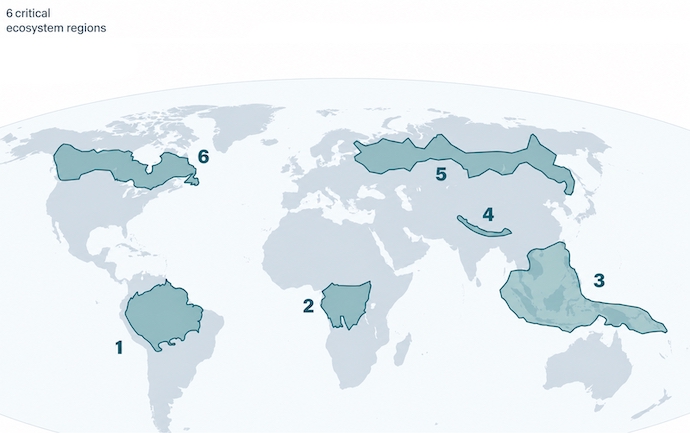
The report identifies six strategically important ecosystems: the Amazon rainforest, the Congo Basin, Southeast Asia’s coral reefs and mangroves, the Himalayas, and the boreal forests of Canada and Russia. Coral reefs and mangroves are treated separately; the Canadian and Russian boreal forests form one category. These ecosystems help sustain food production and regulate climate, water, and weather patterns.
The assessment examines how continued degradation could produce cascading security risks. It considers a reasonable worst-case scenario, rather than offering a prediction that every consequence will occur. That distinction matters: uncertainty about the timing and extent of collapse should shape preparation without becoming an excuse to ignore the underlying threat.
Migration could increase as development gains unravel and poverty deepens. Food and water insecurity can make staying in place increasingly difficult, especially where livelihoods depend directly on damaged ecosystems. Displacement, in turn, can put additional pressure on institutions and infrastructure already struggling to meet basic needs.
Organized crime could exploit scarcity, seeking control over resources and taking advantage of people pushed into poverty. Wildlife trafficking and illicit markets facilitated by social media illustrate how exploitation can spread through existing commercial and digital networks. Political instability could also create openings for terrorist groups and other armed actors to operate as mercenaries, assume governing functions, or control access to essential supplies.
States would face these pressures unevenly. Those exposed sooner to food and water shortages could move aggressively to secure their interests, intensifying competition over arable land, productive waters, safe transit routes, and critical minerals. Existing conflicts could worsen, while disputes over essential resources could create new ones within and between countries.
The health and economic consequences would compound those pressures. The assessment warns of greater pandemic risk as biodiversity deteriorates and opportunities for disease transmission between species increase. Economic insecurity could deepen as the natural systems underpinning production and trade become less reliable. Nature’s capacity is finite, even when economic planning treats its services as endlessly available.
Food and water insecurity could also sharpen political polarization, particularly where populations face repeated natural disasters. Disinformation could flourish amid the resulting uncertainty and resentment. Environmental deterioration would therefore affect the conditions under which governments operate, alongside their ability to provide basic goods and maintain public confidence.
One reported warning makes the stakes especially stark. According to the parliamentary account of press reporting, the original report stated that declining Himalayan rivers could intensify tensions between China, India, and Pakistan, potentially leading to nuclear war. The published assessment did not include that scenario. It should be understood as a reported security risk, not an inevitable outcome.
The broader deterioration is already measurable. The assessment links biodiversity loss to crop failures, intensified natural disasters, and infectious disease outbreaks. WWF’s 2024 Living Planet Report records a 73% decline in the average size of monitored wildlife populations between 1970 and 2020, with monitored freshwater populations declining by 85%. These figures describe population trends, not the percentage of all animals or species that have disappeared.
Extinction rates are also tens to hundreds of times higher than the average over the past 10 million years, raising concerns that a sixth mass extinction may be underway. Under current trends, the assessment judges that global ecosystem degradation is highly likely to continue through 2050 and beyond. The precise timing and pathways remain uncertain because the drivers and their interactions are complex.
Food production occupies a troubling position in this account: it depends on functioning ecosystems while being a major force behind their destruction. The assessment identifies it as the most significant cause of terrestrial biodiversity loss. As population growth increases demand, producing sufficient food sustainably will become more difficult unless that relationship changes.
The feedback loop is dangerous. Expanding food production can accelerate biodiversity loss; degraded ecosystems can then undermine harvests and intensify scarcity. Competition for remaining resources can turn those shortages into geopolitical tensions. A system organized to feed people can, through its environmental costs, weaken its own capacity to do so.
Some readers may find the warnings alarmist. Anne-Marie Weeden, a former environmental and climate security expert at the Royal United Services Institute, offered a different reading: “Don’t let certain actors dismiss it as green scaremongering. This is a report prepared by the most sober and serious security analysts and intelligence experts across government.”
Weeden continued: “And the language and findings within the report may sound extreme, but that’s just because we’re just not used to having honest, grown-up conversations about what it means when we lose the very systems we depend upon for all human and economic life.”
Addressing the role of food production is central to the proposed response. An initiative called ‘plantism’ advocates a voluntary shift from meat to plant-based foods, presenting dietary change as a matter of collective survival. Its argument focuses on the pressures associated with meat production, including land use, water extraction, emissions, and deforestation.
Plantism’s proponents favor changing demand without coercion. Measures such as rationing or prohibiting animal products would face formidable political resistance; taxation also raises questions about affordability and public acceptance. Voluntary dietary change offers another route, allowing individuals to reduce demand for resource-intensive foods without waiting for sweeping restrictions.
The initiative draws on diffusion-of-innovation research and social tipping-point theories to argue that behavior can spread more rapidly once enough people adopt it. Whether that process would deliver dietary change at the necessary global scale and speed remains an open question. Its potential warrants consideration, but the proposal’s ambitions should not be confused with demonstrated results.
A substantial shift toward plant-based diets could help reduce pressure on ecosystems. It would still need to accompany conservation, restoration, and changes in how food is produced. The security assessment gives those efforts a shared urgency: protecting the natural systems that sustain food and water supplies is part of protecting the societies that depend on them.