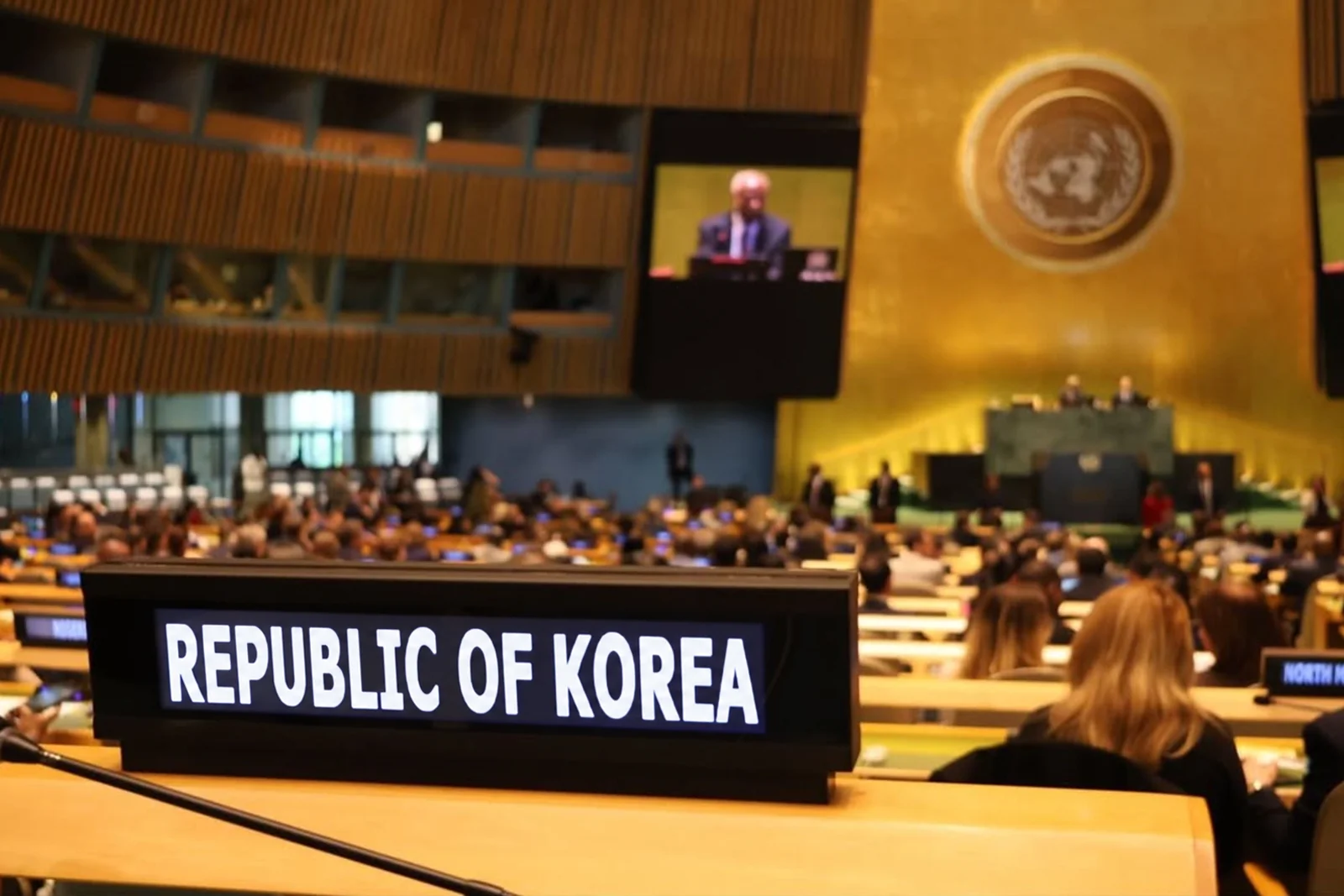

Why the United Nations Still Matters for South Korea
When South Korea joined the United Nations in September 1991, its security concerns were predominantly focused on the Korean Peninsula. For Seoul, the U.S.-ROK alliance remained a core mechanism for managing the most serious military threat, while North Korea was primarily treated as a peninsula-specific security problem.
Despite South Korea’s expanding international influence in the years after the 1988 Seoul Olympics, its major diplomatic and security issues were mostly handled within the context of bilateral relations with Washington and the strategic competition between the two Koreas. Yet the strategic environment has changed substantially over time.
South Korea’s security affairs are increasingly becoming internationalized, precisely as the United States is simultaneously involved in multiple theaters. North Korea’s nuclear program is no longer merely a Korean Peninsula issue. Meanwhile, deepening military-to-military relations between Pyongyang and Moscow, evidenced by North Korea’s deployment of forces to the European front to support Russia, have closely aligned South Korean security with that of Europe.
North Korea has been supplying massive amounts of ammunition and missiles to Russia, while the Korean People’s Army has accumulated battlefield experience through the deployment of its troops. For similar reasons, the Middle East is becoming increasingly relevant to Seoul. The South Korean government has acknowledged its intention to “substantively” contribute to restoring freedom of navigation in the Strait of Hormuz.
Although President Lee Jae-myung explicitly ruled out sending South Korean troops to directly engage in the regional conflict, instability in the Gulf is already raising immediate questions for South Korea about maritime security, energy supplies, alliance expectations, and potential contributions that extend well beyond Northeast Asia. Such developments help explain why the United Nations General Assembly (UNGA) once again deserves Seoul’s attention.
The 81st session of the UNGA entered its high-level period in late September 2026, with the General Debate beginning on September 22. During his address, President Lee Jae-myung explicitly asked the United Nations and the UN Security Council to play a “responsible and constructive role” in the process of halting North Korea’s advancement of its nuclear and missile capabilities, subsequently reducing them, and eventually moving toward a non-nuclear Korean Peninsula.
Such an appeal demonstrates a meaningful change in South Korea’s diplomatic environment. When Seoul joined the United Nations 35 years ago, membership itself was an important diplomatic milestone. By contrast, the contemporary UNGA could serve a different purpose: It could function as an additional platform for Seoul to link geographically separated security issues and build a broader coalition around them.
The UNGA should not be romanticized. It cannot replace the United Nations Security Council, the U.S.-ROK alliance, or bilateral diplomacy. In addition, many UNGA resolutions are not legally binding. Nonetheless, history illustrates that the General Assembly can be particularly useful when other institutions are dysfunctional because of competition among great powers. The 1956 Suez Crisis offers an instructive example.
The United Kingdom and France, participants in the military intervention against Egypt, exercised their vetoes on Security Council draft resolutions demanding their withdrawal. When the Security Council was paralyzed, the matter was referred to the General Assembly under the “Uniting for Peace” mechanism. The UNGA convened its first emergency special session, called for a ceasefire and withdrawal, and later established the United Nations Emergency Force (UNEF), which became the first armed UN peacekeeping force.
The UNEF was made possible not simply because governments in the 1950s had greater faith in the United Nations. Rather, a number of political conditions converged in an unusual manner. The United States and the Soviet Union both opposed the United Kingdom-France-Israel military operation, albeit for different reasons. Egypt consented to the presence of UN forces. The United Kingdom and France needed a politically acceptable way to withdraw. Canadian Foreign Minister Lester Pearson provided an important diplomatic concept, while UN Secretary-General Dag Hammarskjöld rapidly transformed the proposal into an operational system.
The contrast with Hungary, where Soviet troops crushed an uprising that same year, illustrates the limitations of the UNGA. Moscow considered Hungary a critical strategic interest and simply ignored the General Assembly’s request. In other words, the UNGA was able to help manage the Suez affair because the underlying political balance created room for multilateral diplomacy. In areas that great powers considered strategically essential, however, they could not be forced to withdraw. That distinction matters for South Korea today.
Seoul should therefore neither dismiss the UNGA as a mere stage for rhetorical exchanges nor expect it to resolve problems that require military deterrence or consensus among the great powers. Rather, Seoul should use the forum for functions that a universal diplomatic institution can realistically achieve.
First, South Korea should use the UNGA more systematically to internationalize the Russia-North Korea military relationship. North Korea’s troop deployment and Russia’s arms transfers should not be presented merely as Korean Peninsula affairs. They connect the security of the Indo-Pacific and Europe. Explaining that interconnectedness at the UNGA would enable Seoul to approach governments among NATO members, U.S. allies, and countries outside Northeast Asia that have traditionally treated North Korea as a distant regional problem.
Second, Seoul should focus on building issue-specific coalitions rather than waiting for universal consensus. On North Korea’s nuclear nonproliferation, missile development, cyber activities, or arms transfers, Seoul does not need every UN member to adopt an identical position. What it needs is a sufficiently broad group of countries willing to support specific diplomatic goals, monitoring mechanisms, humanitarian initiatives, or the implementation of existing international norms.
Third, the UNGA’s high-level period offers an effective venue for middle-power diplomacy. Compared with 1991, South Korea now possesses greater economic, technological, diplomatic, and military capabilities. Without organizing every initiative through Washington, South Korea could cooperate with Australia, Canada, Japan, European countries, and some Global South countries on specific issues. This would be especially important when the United States is dealing simultaneously with security matters involving Europe, the Middle East, and the Indo-Pacific. The U.S.-ROK alliance will remain a pivotal security framework in the years ahead, but that does not prevent Seoul from developing an additional diplomatic mechanism.
Fourth, Seoul should proactively use the General Assembly to link issues that are sometimes treated as separate, seemingly unrelated problems. North Korea’s participation in the Russo-Ukrainian war, for example, demonstrates how European and South Korean security interests can overlap. Likewise, the Strait of Hormuz issue shows how quickly instability in the Middle East can become a South Korean economic and security problem. The UNGA is one of the few existing institutions that represents the governments of these regions simultaneously.
Nevertheless, Seoul does not need to create another permanent bloc. A better alternative would be flexible coalitions organized around individual problems, such as supply-chain resilience and humanitarian assistance. The lesson of 1956 is that the UNGA can maximize its influence when the political situation creates an opening and states are prepared to propose practical, implementable institutional responses.
Taken together, South Korea should use the UNGA as an instrument of national strategy rather than simply as an annual venue for presidential speeches.
The lesson of Suez is not that Seoul should attempt to replicate the UNEF. It is that South Korea should understand how to use the unique diplomatic space available to multilateralism in an era when geopolitical disputes in multiple regions are increasingly beginning to resemble the strategic balancing of the 19th-century Concert of Europe. For Seoul, identifying and exploiting this space may be more important today than at any point since South Korea joined the United Nations.