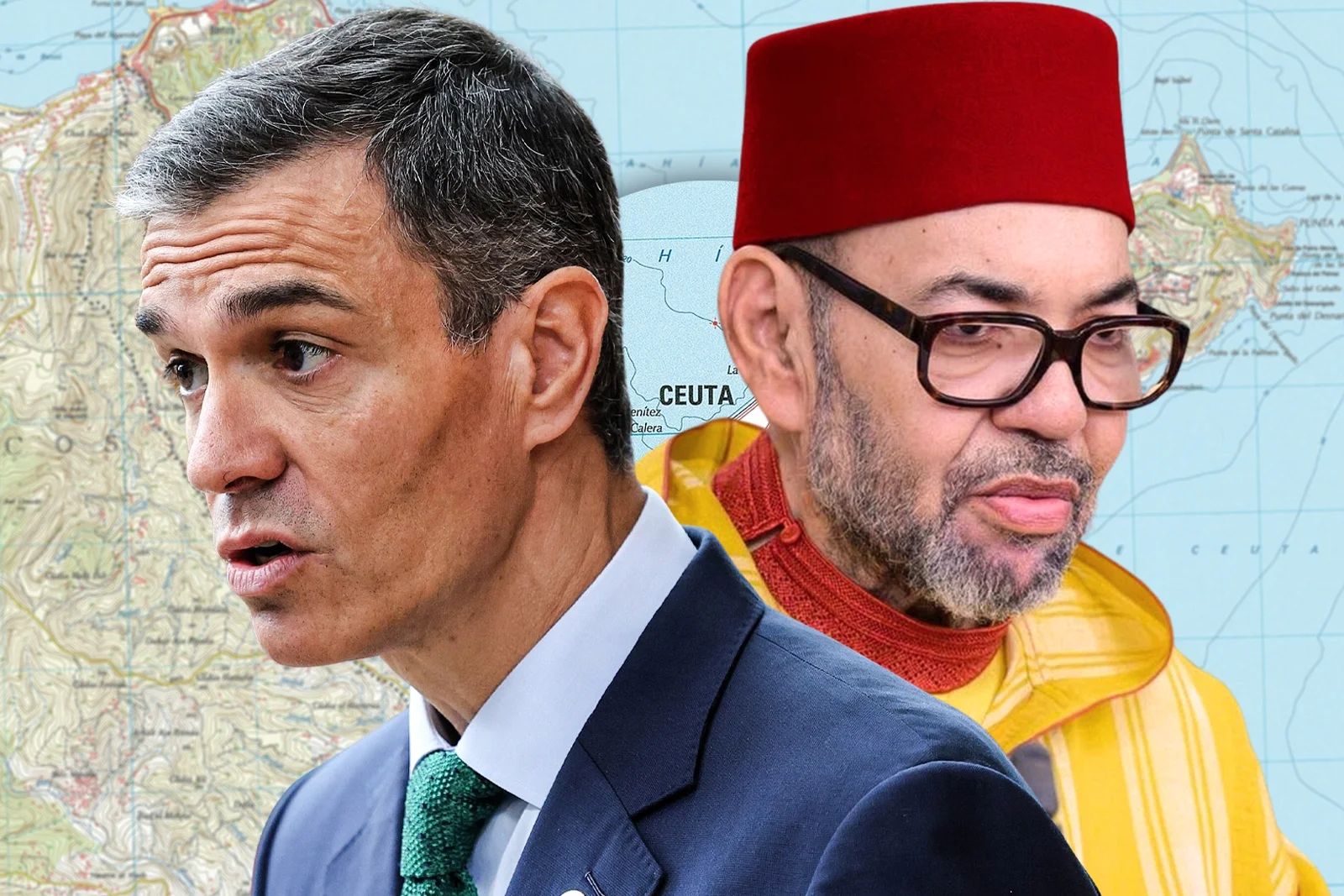

Morocco Turns Ceuta Into a Pressure Point
On July 30, roughly 60,000 people crossed from Morocco into the Spanish enclave of Ceuta in a single day. Twenty-four bodies were recovered by the Guardia Civil. Pedro Sánchez, arriving in Ceuta alongside his interior minister, called the episode an attack on Spain’s territorial sovereignty, language no Spanish head of government had previously used in a migration dispute with Rabat.
Madrid’s official explanation was legalistic: A July ruling by Spain’s Supreme Court barred the immediate return of anyone who reached the enclave by swimming, and traffickers exploited it. The UN refugee agency, UNHCR, rejected that account as insufficient to explain how a few hundred crossings a day became tens of thousands in 24 hours. Reuters, AFP, and Al Jazeera reported that Moroccan officers made little serious effort to stop the crowds. Morocco’s government said nothing publicly. NPR reported that the country’s Interior Ministry did not respond to requests for comment.
The sequence recalled the crisis of 2021, when Morocco relaxed border controls around Ceuta as Madrid provided medical treatment to Brahim Ghali, the ailing leader of the Polisario Front. Rabat admitted nothing; the crossings surged; reinforcements arrived only the following day. Once might be dismissed as happenstance. Twice begins to look like a method.
To understand why, it helps to go back half a century. Western Sahara was a Spanish colony until 1975, when King Hassan II sent 350,000 unarmed Moroccans across the border in the “Green March.” The maneuver pressured the dying Franco regime into signing the Madrid Accords, which divided the territory between Morocco and Mauritania without consulting the Sahrawi population, despite Spain’s promise of a UN referendum. The Polisario Front fought a 16-year war and secured a ceasefire in 1991, built around a UN mission, MINURSO, whose defining purpose was to organize that vote.
The referendum never took place. Morocco and the Polisario have never agreed on who qualifies as Sahrawi, and therefore who should be eligible to cast a ballot. Morocco now controls about 80 percent of Western Sahara, including its phosphate reserves and Atlantic fishing grounds, behind a fortified wall stretching roughly 1,700 miles. What was meant to be a temporary armistice has hardened into one of international diplomacy’s most durable evasions.
In December 2020, Donald Trump recognized Moroccan sovereignty over the entire territory as the price of Morocco’s normalization of relations with Israel under the Abraham Accords. A 45-year-old territorial dispute became a bargaining chip in a negotiation that had little to do with its merits. The transaction also established a method of its own: Washington could loosen a frozen territorial dispute to secure a broader geopolitical realignment elsewhere.
Since then, UN Security Council Resolution 2797, adopted in October 2025, and the European Union have endorsed Morocco’s autonomy plan. Spain followed suit in 2022. That reversal helps explain why Madrid’s more recent overtures to Algeria, along with a bill in the Spanish Parliament that would offer citizenship to Sahrawis born under Spanish rule, have landed badly in Rabat.
That history gives weight to what happened in Washington this spring. On April 1, Republican Rep. Mario Díaz-Balart, vice chair of the House Committee on Appropriations and chair of the National Security, Department of State, and Related Programs subcommittee, told the Spanish newspaper El Español that Ceuta and Melilla “are not in the geographic territory of Spain” but “in the territory of Morocco.”
Weeks later, the committee’s fiscal year 2027 report echoed that formulation almost verbatim. It described Ceuta and Melilla as cities “administered by Spain” but “located in Moroccan territory,” and urged Secretary of State Marco Rubio to encourage talks over their “future status.” The wording appeared in the same paragraph directing $40 million in security and military financing to Morocco.
Multiple outlets, including Morocco World News and Courthouse News, described the language as the first time a congressional committee had formally cast doubt on Spanish sovereignty over the enclaves. On July 15, two weeks before Ceuta’s border buckled, the House passed the text as part of H.R. 8595 by a 217–209 vote along party lines. The measure still requires Senate approval.
Then, on July 31, one day into the crisis, as Sánchez stood in Ceuta denouncing an attack on Spanish sovereignty and Morocco maintained its silence, Reps. Josh Gottheimer and Ronny Jackson introduced a bipartisan bill to designate the Polisario Front a terrorist organization. The measure alleged that the group had received drones from Iran’s Islamic Revolutionary Guard Corps. Two earlier, nearly identical bills, one from Senators Ted Cruz, Tom Cotton, and Rick Scott and another from Representatives Joe Wilson and Jimmy Panetta, had languished in committee for months.
None of this proves the existence of a coordinated operation. No document says the $40 million was intended to “buy” Ceuta. No public statement connects the Polisario legislation to the migration crisis. Morocco’s silence is not a confession. Treating any of those inferences as established fact would be a serious analytical error.
Yet the sequence is difficult to dismiss. A powerful congressman questioned Spanish sovereignty in April. A congressional committee paired funding for Morocco with an invitation to discuss Ceuta’s status. The House approved that language two weeks before the border failed. A renewed push against the Polisario arrived the next day. Taken together, the events read as the latest chapter in a 50-year story: A longstanding Moroccan claim is being quietly converted into diplomatic leverage that Washington appears increasingly willing to legitimize. Madrid, a NATO ally already pressured to concede ground over Western Sahara, is caught in the middle.
One further connection deserves attention, though not a leap to certainty. Under Sánchez, Spain has adopted one of the European Union’s most critical positions on Israel’s conduct in Gaza, while Morocco has been embedded in the Abraham Accords architecture since 2020. No available source directly links Congress’s language on Ceuta to Gaza. Still, the EU country that has gone furthest in confronting Israel is now also the country whose sovereignty an American congressional committee has called into question. For the moment, that is a coincidence worth watching, not a conclusion pretending to be evidence.
The unresolved question is not simply whether Morocco deliberately opened the border on July 30. Like the promised referendum, that may never be proved. The larger question is more unsettling: If a UN-mandated vote can remain frozen for 35 years without meaningful consequences for the party obstructing it, what other supposedly settled principles of international law become negotiable the moment geopolitics demands a different answer?