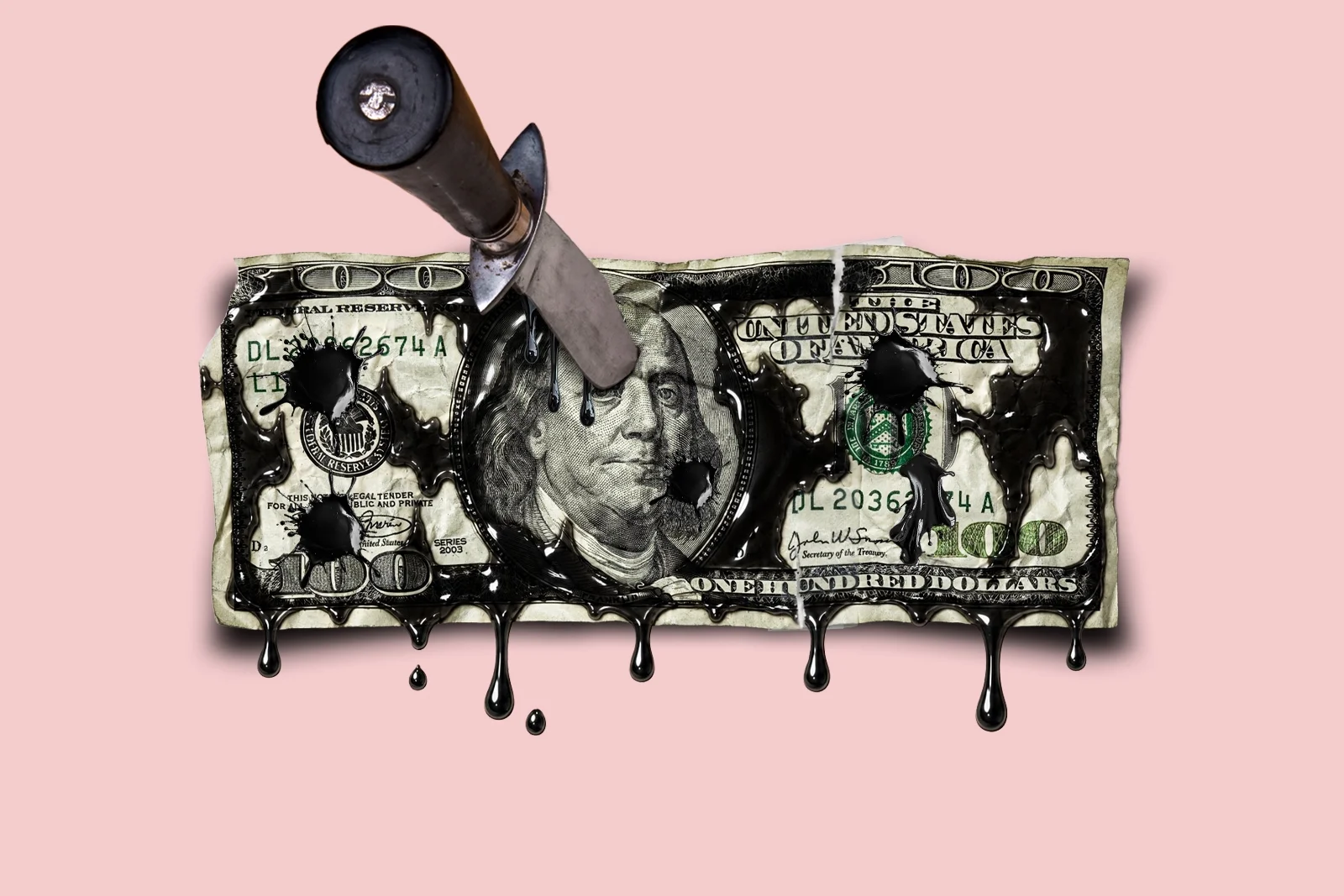

Trump’s Oil Buddies Won Big From the Iran War
When Senator Elizabeth Warren accused Donald Trump of presiding over a war with Iran while politically connected oil interests reaped extraordinary profits, the most tempting response was also the least useful: to decide immediately whether she had proved corruption.
She had not.
There is no publicly established evidence that campaign contributions from oil executives caused the United States to enter the conflict, or that energy companies purchased military policy. But the available evidence does establish something more interesting—and potentially more important.
The Iran war has delivered substantial financial gains to parts of the energy industry. Some of the industry’s most influential figures and companies had previously supported Trump’s political rise. At the same time, decisions made by his administration have had enormous consequences for oil prices, refining margins, shipping costs, and energy-company valuations.
That does not prove a conspiracy. It does raise a serious conflict-of-interest question.
The economic story begins with geography. Before the conflict, oil flows through the Strait of Hormuz averaged 20.9 million barrels a day—roughly one-fifth of global petroleum-liquids consumption, according to the U.S. Energy Information Administration. The strait also carried a substantial share of the world’s liquefied-natural-gas trade.
Alternative export routes exist, but they do not have enough capacity to replace Hormuz if traffic through the strait is severely disrupted. Saudi Arabia and the United Arab Emirates together had only about 4.7 million barrels a day of available bypass capacity. That makes Hormuz one of the world’s most important economic chokepoints.
Once the conflict with Iran disrupted shipping, markets reacted predictably. Tanker risks increased. Insurance costs rose. Freight routes became more complicated. Oil prices surged before retreating from their peaks, while consumers continued to face elevated fuel prices.
The consequences extend well beyond crude oil. A disruption in Gulf supplies changes the economics of refineries, airlines, shipping companies, manufacturers, and, eventually, households. The effects appear in places that may initially seem removed from war: a higher airline ticket, a larger logistics invoice, a more expensive supermarket delivery, or another dollar added to the cost of filling a car. War inflation rarely arrives with the word “war” printed on the receipt.
Recent energy-sector earnings show how large that redistribution can become. ExxonMobil reported roughly $14.5 billion in second-quarter 2026 earnings, about double its result from the same period a year earlier. Its financial reporting attributed approximately $4.65 billion in additional upstream earnings to higher crude realizations.
Chevron’s quarterly profit also rose sharply, reaching roughly $12.1 billion, compared with about $2.5 billion a year earlier. Its upstream and downstream businesses both benefited from stronger market conditions. ConocoPhillips reported approximately $3.9 billion in quarterly earnings, up from roughly $2 billion a year earlier, while Occidental also generated substantial cash flow as crude prices increased.
Yet the clearest beneficiaries may not have been the companies pumping oil from the ground. They may have been the refiners.
Marathon Petroleum’s quarterly profit rose from roughly $1.2 billion a year earlier to more than $5 billion, while its refining margin increased from $17.58 to $36.33 a barrel. Valero reported approximately $3.7 billion in quarterly earnings, compared with about $714 million a year earlier. Phillips 66 recorded a similar expansion: quarterly profit climbed from about $877 million to nearly $3.85 billion, while refining pre-tax income increased from approximately $359 million to more than $3 billion.
These figures require caution. Year-over-year changes in corporate earnings cannot be attributed entirely to a single geopolitical event. Acquisitions, refinery utilization, operating costs, production changes, maintenance cycles, and company-specific factors all matter. Exxon itself illustrates the complexity: Higher crude prices boosted its upstream earnings by several billion dollars, even as Middle Eastern disruptions reduced earnings by more than $1 billion.
But it would be equally misleading to pretend that a major energy shock had nothing to do with the profitability of companies whose margins are directly affected by shortages of oil and refined products. Higher prices redistribute income. The question is where the money goes.
The windfall has moved through the supply chain. Higher fuel prices and more dangerous trade routes have increased freight and insurance costs. Some transportation businesses have collected larger fuel surcharges, while shipping companies have benefited from higher freight rates on certain routes. Refineries capable of producing scarce diesel, gasoline, and aviation fuel can capture exceptionally strong margins when international supplies become constrained.
This is one of the less understood features of geopolitical commodity shocks. Consumers often imagine that the economic winner must simply be “Big Oil.” In reality, the profit pool can migrate among producers, refiners, traders, tanker owners, rail operators, and other infrastructure providers, depending on where the bottleneck forms. A war can therefore generate extraordinary gains for companies that played no role whatsoever in creating the conflict.
That distinction matters. Profit is evidence of economic consequence. It is not evidence of political causation.
The conflict-of-interest issue becomes harder to dismiss, however, when financial beneficiaries also have established relationships with political power. Trump openly courted the oil and gas industry during his 2024 presidential campaign.
Executives and donors supported his election effort as he promised a substantially more favorable policy environment for fossil-fuel development: faster approvals, more drilling, greater pipeline access, and the rollback of regulations the industry considered burdensome.
Continental Resources, for example, contributed $1 million to Make America Great Again Inc., the super PAC supporting Trump. Its founder, Harold Hamm, was also a prominent financial backer. Congressional Democrats later investigated reports that Trump had asked oil executives to raise $1 billion for his election effort while discussing regulatory and energy policies favorable to the industry.
Those facts do not prove that subsequent government decisions were purchased. Political donors routinely support candidates whose policy preferences align with their commercial interests. That is both legal and common in American politics.
But there is an important difference between an ordinary regulatory dispute and a military conflict capable of shifting hundreds of billions of dollars among industries and consumers. The higher the stakes, the stronger the safeguards should be.
Any serious examination of the issue must also confront evidence that complicates the simplest version of the “war for oil profits” theory. Trump has publicly attacked high fuel prices and criticized ExxonMobil and Chevron for earning what he described as excessive profits. His administration has sought ways to increase energy supplies and has brought refiners and fuel retailers into discussions about lowering prices at the pump.
Higher gasoline prices are politically damaging to any president. They reduce household purchasing power, fuel inflation, and give opponents an easily understood symbol of economic discontent. The war has therefore imposed political costs on the administration even as it generated profits for parts of the energy industry.
Oil companies have not benefited uniformly, either. A company can gain from higher global crude prices while losing money because of disrupted production, transportation complications, or exposure to operations in the Middle East. These facts weaken any simplistic claim that the administration launched or prolonged the conflict solely to enrich the energy industry.
They do not eliminate the governance problem. In fact, they clarify it.
Political debate tends to treat the matter as binary: Either someone can prove corruption beyond doubt, or there is supposedly nothing worth investigating. That is the wrong standard. Conflict-of-interest rules exist precisely because societies should not wait for proof of a corrupt transaction before limiting incentives that could compromise public decision-making.
The central question, then, is not whether an oil company bought a war. There is currently insufficient evidence to establish such a claim. The better question is whether institutional barriers are strong enough when industries benefiting from government decisions are also important financiers of the politicians making them.
That question becomes more urgent during wartime because the economic transfers can be enormous. By July, the Pentagon estimated that the Iran war had cost the United States $37.5 billion, including projected expenses through September. Consumers have paid more for fuel. Airlines and manufacturers have faced higher operating costs. Governments and militaries have absorbed larger logistical expenses. Meanwhile, parts of the energy and transportation industries have recorded exceptional profits.
None of this is unusual in strictly economic terms. Scarcity creates rents, and markets allocate them. The political challenge is deciding how much separation should exist between those collecting those rents and those wielding the power that can expand or eliminate them.
If policymakers want to address the appearance of a conflict without resorting to unsupported accusations, several reforms would be more useful than political theater. Governments could require the rapid disclosure of meetings between senior national-security officials and major donors from industries whose valuations are materially affected by an ongoing conflict.
Presidents and other senior decision-makers could also be required to divest individual corporate securities or place their assets in genuinely independent blind trusts. The purpose would not be to accuse them of trading on privileged information, but to remove the question altogether. Lobbying expenditures and significant political contributions from industries receiving extraordinary wartime windfalls could likewise be disclosed on a much faster timetable during military emergencies.
None of these measures assumes wrongdoing. That is precisely their advantage. Good institutional design reduces the need to divine someone’s private motives.
Warren’s allegation attracts attention because it is dramatic. The underlying economic question deserves attention because it is structural. The Iran conflict has redistributed enormous sums of money. Consumers and governments have absorbed higher costs, while parts of the energy, refining, and transportation sectors have captured extraordinary gains. Some of the people and companies operating in those sectors also helped finance the political movement now controlling the White House.
That does not demonstrate that the war was undertaken for their benefit. But democracies should not require proof of conspiracy before asking whether the boundaries separating political finance, private wealth, and public power are strong enough.
Profit does not prove motive. The more important question is whether a political system should tolerate avoidable ambiguity when the same government decision can send soldiers into battle, raise household energy bills, and create billions of dollars in private gains.
Markets will continue to price war. The responsibility of democratic institutions is to ensure that political power cannot be priced quite so easily.