They Not Like Us: Examining the Kendrick Lamar–Drake Feud, Two Years Later
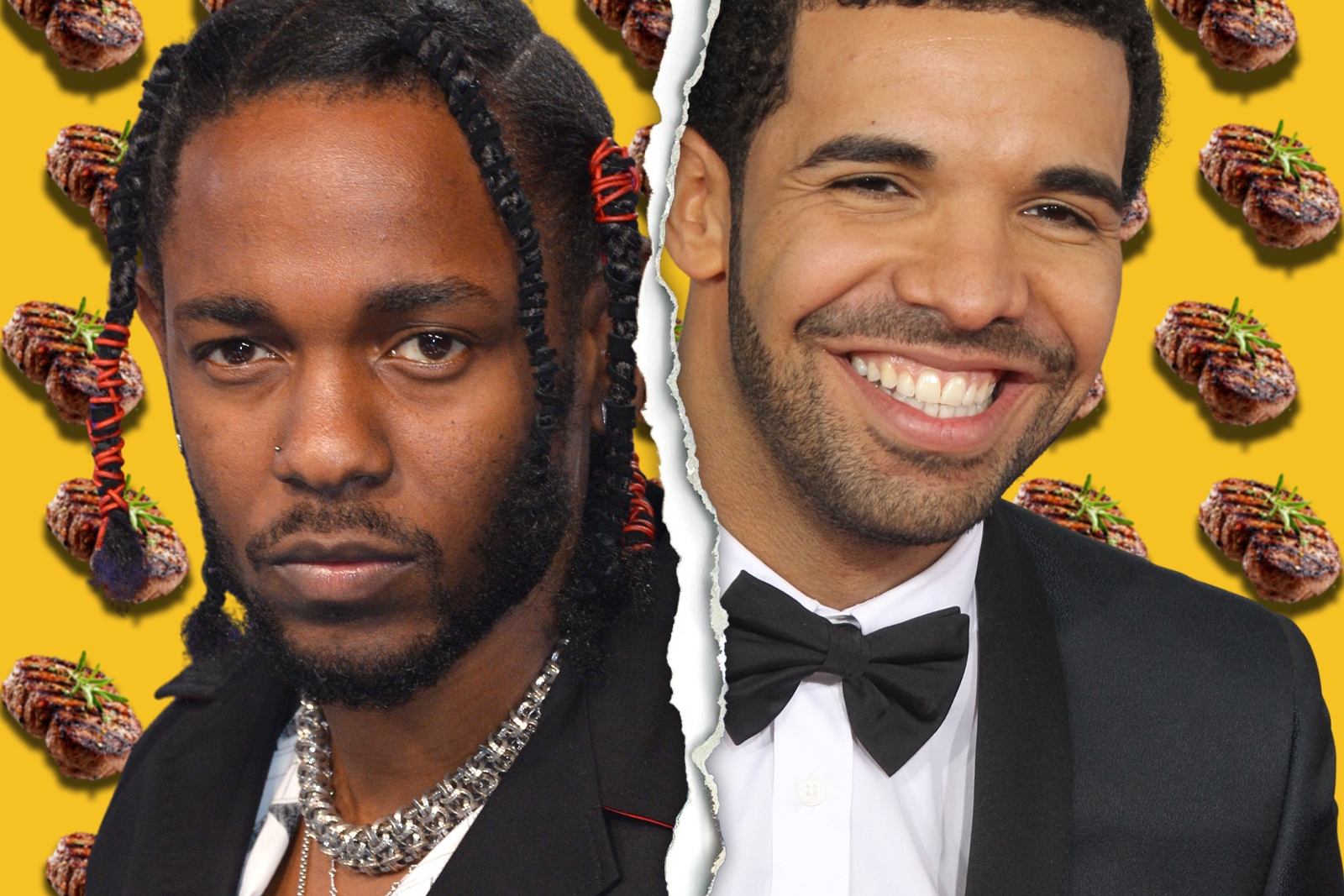
This past May, rapper Drake became the first artist to hold the top three positions on the Billboard 200 for his three simultaneously released albums Iceman, Habibti, and Maid of Honour. It was a remarkable comeback for someone I thought had been K.O.’d by one of the dominant and most visible stories in popular culture of the 2020s thus far: his feud with fellow rapper Kendrick Lamar.
Starting in April 2024, the two traded diss tracks until Lamar landed what many considered the feud’s coup de grâce: the song “Not Like Us,” widely regarded as the best individual song of the feud, earning massive public attention and sales, and ultimately winning all five Grammy Awards for which it was nominated: Record of the Year, Song of the Year, Best Rap Performance, Best Rap Song and Best Music Video.
Its most famous performance came during Lamar’s halftime show at Super Bowl LIX in February 2025, where he teased the song while performing a medley of his previous hits. When it finally came time for “Not Like Us,” the performance featured none other than tennis phenom Serena Williams doing the “crip walk” dance and Lamar looking straight into the camera for his infamous lyric “Say Drake/I heard you like ‘em young…” When an entire stadium sang along with the line “Tryna strike a chord/ and it’s probably A MINOR,” referencing Lamar’s unproven allegations about Drake and underage girls, which Drake denied, there was little doubt that Lamar had absolutely crushed his opponent as he performed on the biggest possible stage in America.
Reflecting on the feud two years later, what strikes me is how rare it is for something like this to happen in music these days. They used to happen all the time: even the former Beatles had snippy messages and lyrics for one another about how they thought their post-breakup careers were going once they were all going solo. Carly Simon’s “You’re So Vain” is probably about Warren Beatty, and Alanis Morissette’s “You Oughta Know” is probably about the guy on Full House who wasn’t either Bob Saget or John Stamos. For as long as music has had lyrics, there’s probably been someone using them to diss professional rivals, spurned lovers, or people they hold a grudge against for whatever reason.
But as rap in particular became far more mainstream and dominant in the 1990s, feuds and beefs like the one between Lamar and Drake could have consequences beyond a song’s lyrics. For example, Ice Cube effectively burned the bridge with his former collaborators in N.W.A. by releasing the track “No Vaseline” that directly insulted them after he had already left the group. Occasionally, it could spill over into real-world violence, as the era’s bitter rivalries and the high-profile murders of Tupac Shakur and Biggie Smalls still remind us. Rarely has something like the Kendrick/Drake feud captured the zeitgeist the way it did, particularly in the 21st century.
Of the two, Drake is probably the more populist, mainstream artist. Born and raised in Toronto, Drake is the chosen nom de plume of Aubrey Drake Graham. He first rose to prominence as a teen actor on the cult Canadian teen soap opera Degrassi: The Next Generation. By the time his run on the show ended in the late 2000s, Drake had already established himself and had released three mixtapes. In the early 2010s, he launched his first three albums: 2010’s Thank Me Later, 2011’s Take Care, and 2013’s Nothing Was the Same.
Arguably, the high-water mark for Drake was what might be his biggest success, the single “Hotline Bling” from his fourth album, 2016’s Views. Even then-presidential candidate Donald Trump danced to a spoof of the song while hosting Saturday Night Live during his 2016 campaign. Drake has always been exceedingly popular: his songs and albums regularly charted, and his streaming numbers place him among the most successful artists on platforms like Spotify. He won Grammys, too, but was never quite an awards darling.
However, the critical attention that always seemed to evade Drake was never an issue for his competitor, Kendrick Lamar. Born Kendrick Lamar Duckworth in Compton, California, Lamar’s rise represents something far more traditional: an artist born and bred in the city most associated with rap rising to become one of its most notable voices. Around the time Drake’s career had started taking off in the early 2010s, Lamar also emerged with viral hit songs like “Swimming Pools (Drank)” and “Bitch, Don’t Kill My Vibe” from his 2012 album Good Kid, M.A.A.D. City. As someone who was in college when those songs hit, I remember them being absolutely inescapable at parties, particularly if drinking was involved.
Lamar even performed at my college when I was a student in a concert he co-headlined with Big Boi of Outkast. In contrast to the performer the world saw at the Super Bowl halftime show accompanied by dancers, this was a far more muted, understated performance, with Lamar alone onstage.
Yet, for all his success, these party anthems didn’t truly reveal the artist who was about to come into his own. That came with the release of Lamar’s seminal 2015 album, To Pimp a Butterfly. Lamar came into his own with that album, blending genres from the vibrant funk of “King Kunta” to the protest anthem “Alright,” a song that manages to be defiant and reassuring at once. All of these displayed Lamar’s lyrical prowess as he addressed racial issues, police brutality, social inequality, and his own insecurities as he struggled with newfound fame. A poem Lamar recites throughout the album begins “I remember you was conflicted/Misusing your influence/Sometimes I did the same/Abusing my power, full of resentment/Resentment that turned into a deep depression…”
His next album, 2017’s DAMN., only solidified his reputation, becoming the first non-jazz or non-classical album to win the Pulitzer Prize for Music. It too is an eclectic but successful experiment in different sounds and genres. For the second track on the album, Lamar samples a Fox News story criticizing him before launching into “DNA,” his energetically defiant anthem. Fox News comes up again in the lyrics of his next song, “Yah”: “Interviews wanna know my thoughts and opinions/Fox News wanna use my name for percentage/My latest muse is my niece, she worth livin’/See me on the TV and scream: ‘That’s Uncle Kendrick!’/Yeah, that’s the business…” I’m also a big fan of tracks like “Pride,” which contains the profound lyric “I don’t love people enough to put my faith in man,” and “Humble,” with its cadenced repeated chorus of “sit down, be humble.”
Lamar continued to release music, including as part of the soundtrack for Marvel’s Black Panther in 2018, resulting in an Oscar nomination for his collaboration with SZA, “All the Stars,” as well as his 2022 album, Mr. Morale & the Big Steppers, a more self-reflective and introspective piece than his previous albums. Lamar was arguably somewhat out of the spotlight when the feud began, with the rapper J. Cole appearing on the Drake song “First Person Shooter” and claiming he, Drake, and Lamar constituted the “big three” of contemporary rap. Lamar responded to that in a guest appearance on the Future and Metro Boomin song “Like That” by saying “motherfuck the big three… it’s just big me.”
And that’s when the feud truly began. Drake and Lamar had taken swipes at each other, but never with the intensity that followed when Drake released his two opening attacks in April 2024: the songs “Push Ups” and “Taylor Made Freestyle,” the latter mocking Lamar’s relationship with Taylor Swift and suggesting that her release schedule dictated his own. “Taylor Made Freestyle” received the wrong kind of publicity for using an AI-generated vocal of the late Tupac Shakur, prompting a legal threat from Shakur’s estate and leading Drake to remove the track from his social media shortly thereafter.
Lamar responded with his first diss track aimed specifically at Drake, titled “Euphoria,” a possible swipe at him for producing the HBO series of the same name. As YouTuber music critic Todd in the Shadows said of “Euphoria”: “What Kendrick really brought to the feud in that track was something you can’t fake: real, genuine hatred.” With lyrics like “You’re not a rap artist, you a scam artist with the hopes of being accepted,” “But don’t tell no lie about me and I won’t tell truths ’bout you,” and most especially “I hate the way that you walk, the way that you talk, I hate the way that you dress, I hate the way that you sneak diss…,” it’s easy to see why.
Drake retaliated with a song called “Family Matters,” and things got personal as he accused Lamar of domestic assault, an allegation that remains unproven. Another of Drake’s main attacks was that he was essentially a virtue signaler, such as when he rapped that Lamar “always rapping like you bout to get the slaves free/You just acting like an activist, it’s make believe.” Drake also complained Lamar was critically overpraised, such as in the lyric “Kendrick just opened his mouth/Someone go hand him a Grammy right now.” It struck me as jealousy over the accolades Lamar had received and that had eluded Drake for much of his career.
But within an hour of the song’s release, Kendrick stole Drake’s thunder by releasing the track “meet the grahams,” invoking Drake’s legal last name, in which he addresses members of Drake’s family one by one, rapping about Drake’s perceived shortcomings. The first verse is addressed to Drake’s son (“Let me be your mentor since your daddy don’t teach you shit”), the second to Drake’s parents (“You raised a horrible fuckin’ person…your son’s a sick man with sick thoughts”), the third is addressed to a supposed secret daughter, whose existence Drake denied; the final verse is addressed to Drake himself (“You fucked up the moment you called up my family’s name”).
Shortly thereafter, “Not Like Us” was released and served as the finishing blow to the entire feud. Credit is due to Mustard, the track’s producer, who helped turn what could’ve just been another addition to the back-and-forth into the defining hit of that summer. Drake released another diss track the day after “Not Like Us” dropped, but at that point, it just didn’t matter. That June, after the song had become a certified sensation, Lamar performed it five times at a concert called “The Pop Out: Ken & Friends” held in Los Angeles to celebrate the Juneteenth holiday.
The feud, in many ways, solidified Lamar’s reputation. He stuck to his guns, his central argument seeming to be that there was just something off about Drake, from reports of him texting teenage celebrities to what Lamar portrayed as his problematic attitudes toward women. In contrast to the accusations of womanizing leveled against Drake, Lamar has been in a relationship with his long-term partner Whitney Alford, with whom he shares two children, since they were high school sweethearts.
Drake’s credibility took a hit, but his chart success this year suggests the commercial damage was hardly permanent. It reminds me of how singer Chris Brown still has a career despite proven domestic abuse of his former girlfriend, Rihanna.
The allegations against Drake are not equivalent to Brown’s documented abuse. But Drake may occupy a similar commercial space in the culture: not as embraced as he was previously, but nevertheless holding onto a loyal fan base that turns out for him despite his plethora of controversies.
The whole feud was a massive story in popular culture: it, alongside Taylor Swift’s groundbreaking success with the Eras Tour, was probably the biggest story to happen in music since the pandemic. But this feud attracted a level of discourse the Eras Tour never could. It happened at the intersection of respectability and “street cred,” critical evaluation and fan enthusiasm, and a host of related conversations about race, masculinity, and how both are projected onto Black men, particularly prominent ones in the entertainment industry.
Two years later, it feels fair to say that Kendrick Lamar and Drake are at very different points in their respective careers. Lamar has been rightfully validated as a voice of his generation, solidifying what his fans and supporters had known all along. The perception was that Drake took time to lick his wounds after the feud, only to return to the public spotlight and prove that he still had staying power even after what had transpired. Drake still takes smaller potshots at Lamar in his most recent albums, but that’s to be expected.
The story of the feud feels more or less concluded at this point, but I’m curious what its impact and legacy will be as the years continue to pass. My guess? From punk rock to grunge, gangsta rap to rap metal, the underlying cultural trends responsible for movements in music always appear more obvious in retrospect. I imagine future pop culture historians, scholars, and theorists will speculate that it all made sense: where Drake was professionally; where Kendrick Lamar was professionally; the greater environment in rap and in music generally at the time.
Hell, maybe its arrival in this strange period after the pandemic, as AI was beginning to reshape popular culture, will only add to its resonance and mystique: the idea that this could’ve happened only at this specific time in history. But for now, this was easily one of my favorite events to witness play out in the culture, certainly this decade and perhaps in my lifetime. That could be because it felt relatively unprecedented. Perhaps for others, the memory of it will fade in time, but I can’t imagine that being the case for me.