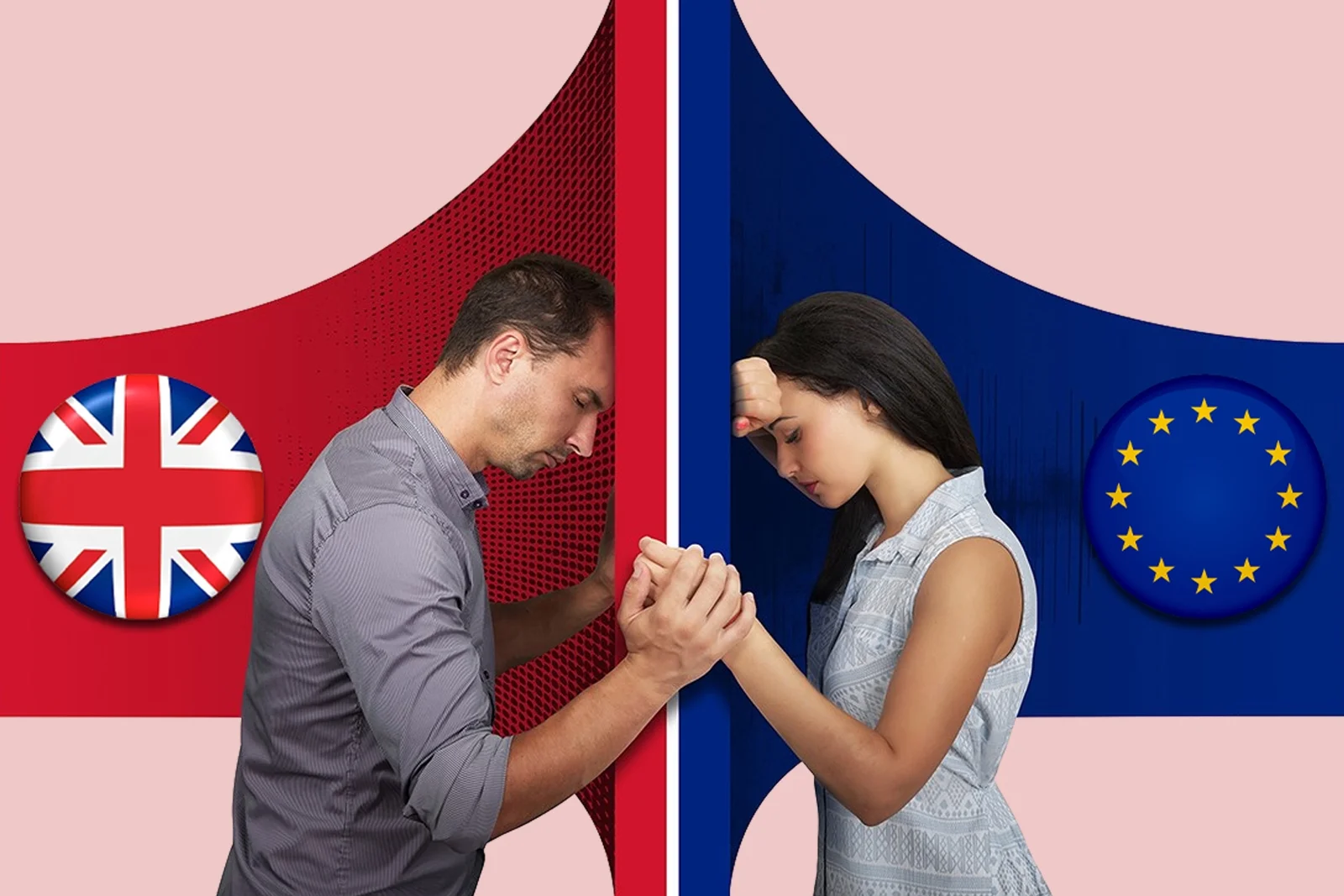

Brexit Has Made Falling in Love a Bureaucratic Nightmare
Brexit promised to restore British control over immigration. For thousands of couples caught between the United Kingdom and the European Union, however, that promise has come at a deeply personal cost. New research reveals how the end of free movement has upended relationships, separated families, and inflicted serious psychological harm on people whose only ambition is to build a life together.
Some have seen their finances depleted and careers disrupted. Others have endured prolonged separations from partners and children. In the most distressing cases, the strain has been so overwhelming that individuals have contemplated suicide.
These are among the findings of a new study examining the experiences of so-called “Brexit couples,” relationships involving a British citizen or UK resident and a partner from the EU, European Economic Area, or Switzerland who must navigate Britain’s post-Brexit immigration system to live together.
Before Brexit, EU free movement provisions allowed many such couples to settle in Britain with relatively few obstacles. That changed when the Brexit transition period ended on December 31, 2020. Although EU citizens already living in Britain could generally preserve their residence rights through the EU Settlement Scheme, those seeking to relocate afterward faced a considerably more restrictive immigration regime.
The consequences have been profound.
The Brexit Couples project, conducted by Katharine Charsley, Nicole Hoellerer, and Katie Cross of the University of Bristol, alongside Helena Wray and Jasmin El Shewy of the University of Exeter, documents the challenges confronting families caught in this new legal reality.
The findings were presented at a meeting of a UK parliamentary group concerned with EU citizens’ rights, bringing together researchers, lawmakers, and people directly affected by the changes. The discussion offered an opportunity to examine personal testimonies, consider the emerging evidence, and explore potential reforms.
Wray, a professor of migration law at Exeter, and Charsley, a professor of migration studies at Bristol, outlined the project’s principal findings. Their conclusions arrive amid renewed efforts to repair relations between Britain and the EU, raising uncomfortable questions about the human consequences of Brexit that have received comparatively little political attention.
Speaking afterward, Charsley emphasized the dramatic transformation in the treatment of cross-border relationships.
“There is a dramatic contrast between the EU free movement enjoyed by UK-EU couples and families before Brexit, and the UK’s family migration system, one of the most restrictive in the world,” she said.
“UK-EU couples who want to start their lives together in the UK and families wanting to return after living in the EU often find their plans scuppered by a high and rigid minimum income threshold, extortionate visa fees and other costs, and an over-complex application process.”
Even couples who ultimately succeed, she added, often emerge from the experience emotionally and financially exhausted.
“Even for those who successfully apply for a visa, the experience is highly stressful, impacting on relationships and financial and mental wellbeing.”
The research focuses on the first generation of EU citizens required to enter Britain through the partner visa system following Brexit. Their experiences illustrate how an immigration framework designed to regulate migration can also complicate the lives of British citizens seeking to live with the people they love.
“The position of this group was barely considered during the Brexit negotiations even though UK-EU relationships were commonplace, are likely to continue to develop after Brexit, and UK-EU couples living overseas will continue to seek to return,” the researchers write.
They describe Britain’s partner migration rules as “among the most restrictive, complex and expensive in the world.”
One particularly significant obstacle is the minimum income requirement imposed on British sponsors. In 2024, the threshold increased from £18,600 to £29,000, making it substantially harder for some couples to satisfy the financial conditions for living together.
But the financial burden extends beyond income requirements. Applicants must also contend with substantial visa fees, additional costs, extensive documentation, and a complicated administrative process in which mistakes can have serious consequences.
The project’s 75-page report, Brexit Couples: UK-EU Couples in the British Immigration System, found that applications from UK-EU couples began increasing significantly after an initially slow start.
Researchers interviewed more than 50 couples at different stages of the immigration process. Some were considering applying for visas, others had submitted successful or unsuccessful applications, and still others had concluded that the requirements were impossible to meet.
Their accounts reveal not only bureaucratic frustration but also a profound shift in how individuals understand their relationship with Britain and Europe.
“Having lived through an era of almost unrestricted movement between the UK and the rest of the EU, many were shocked to be now treated as migrants,” the report observes.
For some participants, this experience prompted broader reflections on the meaning of migration, national identity, and belonging. Others became newly conscious of inequalities embedded in immigration systems that they had previously encountered only indirectly.
“Some interviewees hoped for legal recognition of their position as European citizens while, for others, there was a new appreciation of the global and racialised inequalities caused by border controls,” the researchers explain.
The study also challenges assumptions about who is most vulnerable to the pressures of immigration restrictions.
Its statistical analysis found that UK-EU couples living in Britain before Brexit were, on average, more highly educated and more likely to hold professional or managerial jobs than couples in which both partners were born in Britain.
Yet even these relatively advantaged households struggled with the demands of the system.
The researchers found that participants consistently experienced the visa process as difficult, expensive, complex, and stressful, regardless of their educational or professional backgrounds.
In some cases, administrative errors or inflexible procedures resulted in parents being separated from their children for months, even when families otherwise satisfied the immigration requirements.
The consequences extended into nearly every aspect of their lives, affecting employment, financial stability, family relationships, and psychological well-being.
One EU citizen in a relationship with a British national described the accumulating emotional strain.
“It takes a mental toll on you. Not everyone is going to be equipped to deal with it very well…The anxiety of it is intense…There are people who…are going to have a nervous breakdown.”
Another participant, a British citizen undergoing cancer treatment, compared the pressure of the visa process to the burden of the illness itself.
“Throughout the whole damn process that visa was eating away at me, just like you’d imagine the cancer would, and affected my sense of wellbeing…It was just too much, it was just so overwhelming.”
For others, the psychological consequences were even more alarming.
The study documented cases of anxiety and depression, including that of a woman prevented from moving to Britain to care for her seriously ill partner. She told researchers that the prolonged uncertainty had driven her to contemplate suicide.
“I just wanted it all to end…I just got depressed and it got worse and worse. At some point I just planned, in great detail, the way I wanted to end my life because of this…I still haven’t recovered entirely from that.”
These experiences, the researchers argue, are consistent with existing evidence of the damage Britain’s partner migration policies can inflict on individuals and families.
They also expose a contradiction at the heart of the post-Brexit immigration system. Even couples who enjoy certain advantages, including higher education, geographical proximity, and the ability to make visa-free visits, can find the process extraordinarily difficult.
If relatively well-resourced couples struggle to meet the requirements, the implications for families with fewer financial and professional advantages are particularly troubling.
The researchers stress that relationships between British and European citizens will not simply disappear because the legal framework governing them has changed.
“British citizens and settled residents will continue to meet and fall in love with EU citizens despite Brexit,” they write.
They argue that the government’s ambition to establish a new relationship with Europe must account for the realities of families whose lives span national borders.
“The current partner migration rules do not meet that challenge as they are too complex, difficult and expensive. The rules also affect British citizens in relationships with non-nationals from across the globe.”
The report recommends reducing the minimum income requirement, introducing greater flexibility into immigration decisions, extending the duration of initial visas to reduce recurring costs, and recognizing the importance of visits in maintaining relationships when couples cannot live together permanently.
These proposals are intended to address problems extending well beyond UK-EU relationships. The researchers contend that the contrast between European free movement and Britain’s current immigration framework reveals deeper structural inequalities in the country’s approach to family migration.
Ultimately, the study raises a question that Brexit’s political architects rarely confronted: What happens when the pursuit of tighter border controls collides with the ordinary human desire to live alongside a spouse, partner, or child?
For the couples caught in Britain’s immigration bureaucracy, that conflict is neither theoretical nor merely political. It is measured in months of separation, mounting expenses, damaged relationships, and the distress of not knowing when, or whether, they will finally be able to share a home.