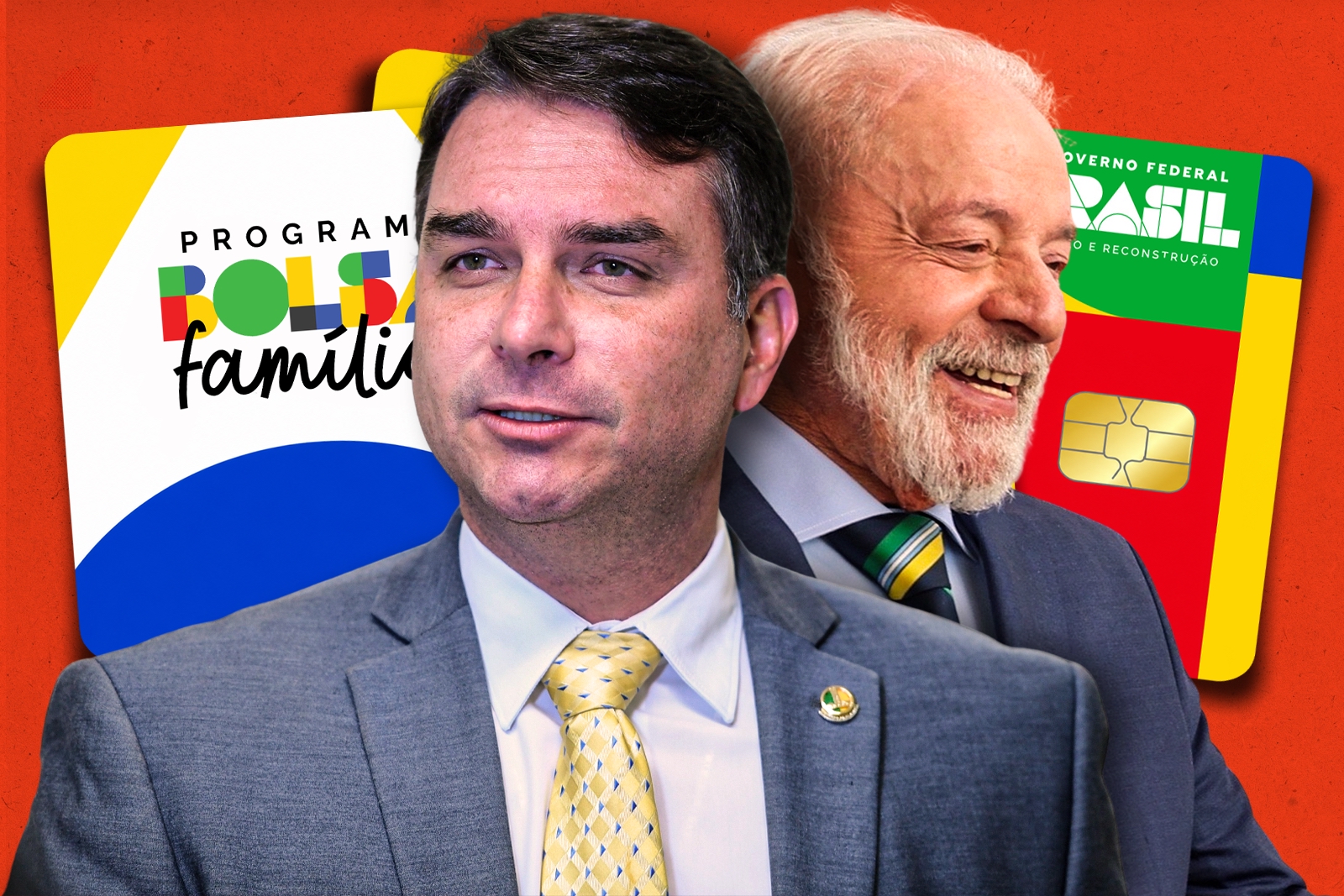

Brazil’s Election Puts Bolsa Família in Schrödinger’s Box
In classical physics, the movement of an object can be described through measurable quantities such as position, velocity, and trajectory. Provided we know its initial conditions and the forces acting upon it, we can, at least in principle, predict where it will go.
Quantum physics presents a considerably stranger picture. Rather than describing the world through fixed trajectories and predictable outcomes, it operates through probabilities. Its principle of superposition allows quantum states to exist as combinations of different possibilities, including outcomes that classical physics would consider mutually exclusive.
An electron, for example, can exist in a superposition of states associated with different positions. This is not simply a matter of scientists lacking the information necessary to determine its location. Rather, quantum theory describes a reality in which combinations of otherwise incompatible states are possible until a measurement produces an observable result.
To illustrate the unsettling implications of this principle, Austrian physicist Erwin Schrödinger proposed one of science’s most famous thought experiments: Schrödinger’s cat.
Imagine a cat sealed inside a box containing a radioactive atom that may or may not decay. If the atom decays, a detector triggers a mechanism that releases poisonous gas, killing the animal. If it does not, the cat survives. Because radioactive decay is governed by quantum probabilities, the idealized description of the entire system combines both outcomes: the atom has decayed, and the cat is dead, or the atom has not decayed, and the cat remains alive.
In this theoretical sense, the cat exists in a superposition of life and death until the uncertainty is resolved through observation.
Brazil’s presidential election presents a political variation on this unsettling experiment. Inside the metaphorical box sits Bolsa Família, the country’s principal cash-transfer program for families living in poverty. Whether it emerges intact may depend on a political choice whose consequences voters cannot yet fully know.
Bolsa Família is a federal conditional cash-transfer program intended to provide financial assistance to Brazil’s poorest households. Eligibility depends on household income per person, registration in the Cadastro Único, the country’s Unified Registry for Social Programs, and compliance with applicable requirements.
Beyond alleviating poverty and hunger, the program connects financial assistance to healthcare and education through conditions involving school attendance, childhood vaccination, and prenatal medical care. Its broader ambition is to interrupt the intergenerational transmission of poverty, giving vulnerable families a measure of economic security while improving opportunities for their children.
Yet statements attributed to Flávio Bolsonaro’s presidential campaign have raised a fundamental question: What, exactly, does the campaign intend to preserve?
Daniella Marques, an economic adviser to the campaign, announced a proposed two-year transition period during which beneficiaries would be expected to find employment or establish businesses. What remained unclear was when that period would begin and, more importantly, what would happen to families still living in poverty after it expired.
The proposal was widely interpreted as establishing a deadline for beneficiaries to leave the program. Following a negative reaction, the campaign issued clarifications and denied that recipients would be removed.
Those assurances, however, did not settle the underlying question. Was the controversy simply the result of careless communication, or did it expose a politically unpopular proposal that the campaign subsequently sought to soften?
The distinction matters because social protection cannot be measured by political promises alone. Without a detailed explanation of how the proposed transition would operate, assurances that no beneficiary would suffer adverse consequences offer little certainty about the program’s future.
The ambiguity becomes more consequential when examined against Bolsonaro’s political record and economic priorities.
A prominent figure in Brazil’s far-right movement and the son of former President Jair Bolsonaro, Flávio Bolsonaro has previously criticized Bolsa Família and advocated an economic agenda emphasizing market freedom, fiscal restraint, and a reduced role for the state.
His economic vision draws inspiration from Argentine President Javier Milei, whose aggressive approach to cutting public expenditure has become internationally synonymous with the chainsaw. Brazilian media reports have also highlighted Bolsonaro’s proposal for approximately $50 billion in public spending reductions, a sweeping fiscal contraction described domestically as a tesouraço, or massive round of budget cuts.
The priorities of such an approach are unmistakable: smaller government, tighter public expenditure, and greater reliance on market mechanisms. None of these objectives automatically requires dismantling social assistance. But neither do they establish that protecting Bolsa Família would take precedence if fiscal austerity and the needs of vulnerable households came into conflict.
This is where the campaign’s promises deserve closer scrutiny.
Bolsonaro’s previous criticism of the program, the magnitude of the proposed spending cuts, the economic philosophy embraced by his advisers, and the emphasis on moving beneficiaries toward employment or entrepreneurship collectively provide grounds for questioning whether Bolsa Família would survive unchanged.
One plausible interpretation is that the proposed economic agenda could ultimately narrow the scope of social assistance, while the campaign’s public messaging has been adjusted to avoid alienating voters who depend on it. That remains an inference, not an intention expressly acknowledged by Bolsonaro or his advisers. Nevertheless, it is a possibility that cannot be dismissed merely because the campaign denies it.
Preserving the name Bolsa Família is not the same as preserving its funding, coverage, eligibility rules, or protections for families unable to secure employment.
Although the campaign has suggested that former beneficiaries could be automatically readmitted when necessary, it has yet to clearly explain the criteria governing such readmission. Would families have to demonstrate renewed hardship? Would administrative requirements change? And what safeguards would prevent people from falling through the cracks?
There is insufficient evidence to conclude that restrictive measures have already been decided. But there is equally insufficient justification for treating the campaign’s assurances as guarantees.
The central question remains whether an administration committed to significant fiscal adjustments would prioritize protecting families who remain in poverty or reducing the number of people receiving assistance.
Until the campaign explains how those competing objectives would be reconciled, its promise to preserve Bolsa Família remains less a firm commitment than an unresolved political proposition.
This brings us back to Schrödinger’s cat.
Within the campaign’s competing narratives, Bolsa Família appears simultaneously alive and dead: alive in Bolsonaro’s promises of continuity, yet potentially threatened by the economic policies his administration might pursue.
Of course, political uncertainty is not quantum superposition. The comparison is a metaphor, not a scientific equivalence. Its usefulness lies in illustrating how sharply different outcomes can remain plausible while the information needed to distinguish between them remains unavailable.
For now, the box stays closed.
Inside it sit promises that social assistance will survive, alongside proposals for substantial reductions in public expenditure. Voters are being asked to trust assurances that remain difficult to reconcile with the campaign’s broader economic priorities.
Bolsonaro’s past criticism of Bolsa Família, his advisers’ statements, and his apparent enthusiasm for an austerity-oriented economic model do not establish that the program would be dismantled. They do, however, make its future uncertain.
And that uncertainty carries a political cost.
In the logic of the metaphor, opening the box means seeing what happens after an election victory. Only then would the country learn whether a Bolsonaro administration intended to preserve Bolsa Família as a meaningful instrument of social protection or reshape it into something considerably more restrictive.
The trouble is that by the time the box is opened, the electoral decision will already have been made.
Unlike Schrödinger’s imaginary cat, the people who depend on Bolsa Família are not theoretical subjects. Their circumstances are measured in meals, medicine, school attendance, and the ability to survive another month without falling deeper into poverty.
For families living on the economic margins, the consequences of a mistaken political calculation cannot be undone as easily as a campaign promise can be revised.
Brazilian voters therefore face a choice that extends beyond competing economic philosophies. They must decide how much uncertainty they are prepared to accept about the future of a program that millions of their fellow citizens rely upon.
Schrödinger’s cat was a thought experiment about the paradoxes of quantum mechanics. Bolsa Família is a test of political accountability, in which the consequences will be anything but imaginary.
The question is not simply whether the program will survive. It is whether Brazilians should have to vote before discovering what survival will actually mean.