
Culture
How Kyiv’s Jewish Community Is Holding Together Through War
In wartime Kyiv, community support can be as practical as finding a doctor, connecting a young entrepreneur with a mentor, or helping an elderly neighbor buy groceries. For Rabbi Ariel Markovitch, these connections are central to sustaining Jewish life amid disrupted sleep, economic hardship, and electricity shortages.
Markovitch directs JCC Beit Menachem in Kyiv and founded Shabbat Young Professionals Kyiv. A Chabad rabbi serving young Jewish adults and the Israeli community, he brings together religious education, professional networking, communal gatherings, and assistance for vulnerable older residents. In a conversation with Scott Douglas Jacobsen, he discusses intergenerational volunteering, faith, social divisions, and the everyday work of maintaining a community during war.
This interview has been edited for length and clarity.
Scott Douglas Jacobsen: Kyiv is home to a substantial professional community, including many people displaced from elsewhere in Ukraine. How has the war affected young Jewish professionals, particularly those trying to establish careers or businesses? What are their most pressing concerns, and how do you help address them while managing the demands of community leadership?
Rabbi Ariel Markovitch: It’s a very good question. Young Jewish people are facing the same problems as all the young people in Ukraine, in Kyiv. Not all the problems are the same, but most of the problems, of course, are the same.
It’s very hard to go to work after you haven’t slept all night. It’s very hard to go to school, and so on. In all the hard times that we are facing in Ukraine, of course, there are a lot of problems. There are also a lot of problems for people who run businesses, especially young people who just started building something.
It’s very hard to make a living now. If someone has a restaurant, sometimes a lot of people don’t come. All the businesses are facing a big problem now, also because of the electricity. And if someone wants to find a new job, it’s not easy today either. So the problems are very big.
First of all, we try to connect people. A lot of times, we all need help with some issues we have. And a lot of times, we don’t know that we know how to solve this problem. I mean, we know someone who can actually help us solve it. But we don’t necessarily know this person, so we need to look for them. What I try to do is be the connector, to connect people.
If someone has a problem or is just looking to meet someone, I try to be the connector, to help people connect. A lot of times, it actually helps a lot to find a doctor, find a lawyer, whatever everyone needs. This is the first thing.
Second, I think one of the best ways to learn is to study with people who have actually done it. For example, if someone wants to be a doctor, of course you need to go to university to study, but also study with someone who is a doctor right now, who can tell them what problems or challenges they will face.
This is also what we try to do. We’re doing it, having lectures to connect people who just started their way with people who already… I wouldn’t say ended it, because they are doing it now, but people who started much earlier. Of course, they can give them a lot of advice.
Or, to be correct, as someone already told me, a guy who opened an IT company in Ukraine told me, “I can’t tell people what to do. I can tell them what not to do, what my mistakes were.” They can study what not to do and avoid making the same mistakes.
It’s actually a very successful way to help people. These are the two biggest things we try to do: connect people with people who can actually help them right now, or at least be in contact, and connect them with people who have already made the same journey, so it’s much easier for them to understand.
The third way is to give all the religious tools to do it better. First of all, of course, we try the material way, because we live in a material world. We need to go to work, study, and live. This is one way. Also very important, not less important, is the religious way. We also need to thank God for whatever we have.
This is what we do about all the daily things that people are facing. But not less important, and very important, we try to connect- not try, we’re connecting the old generation with the young generation for a few reasons. First of all, it helps both the young generation and the old generation.
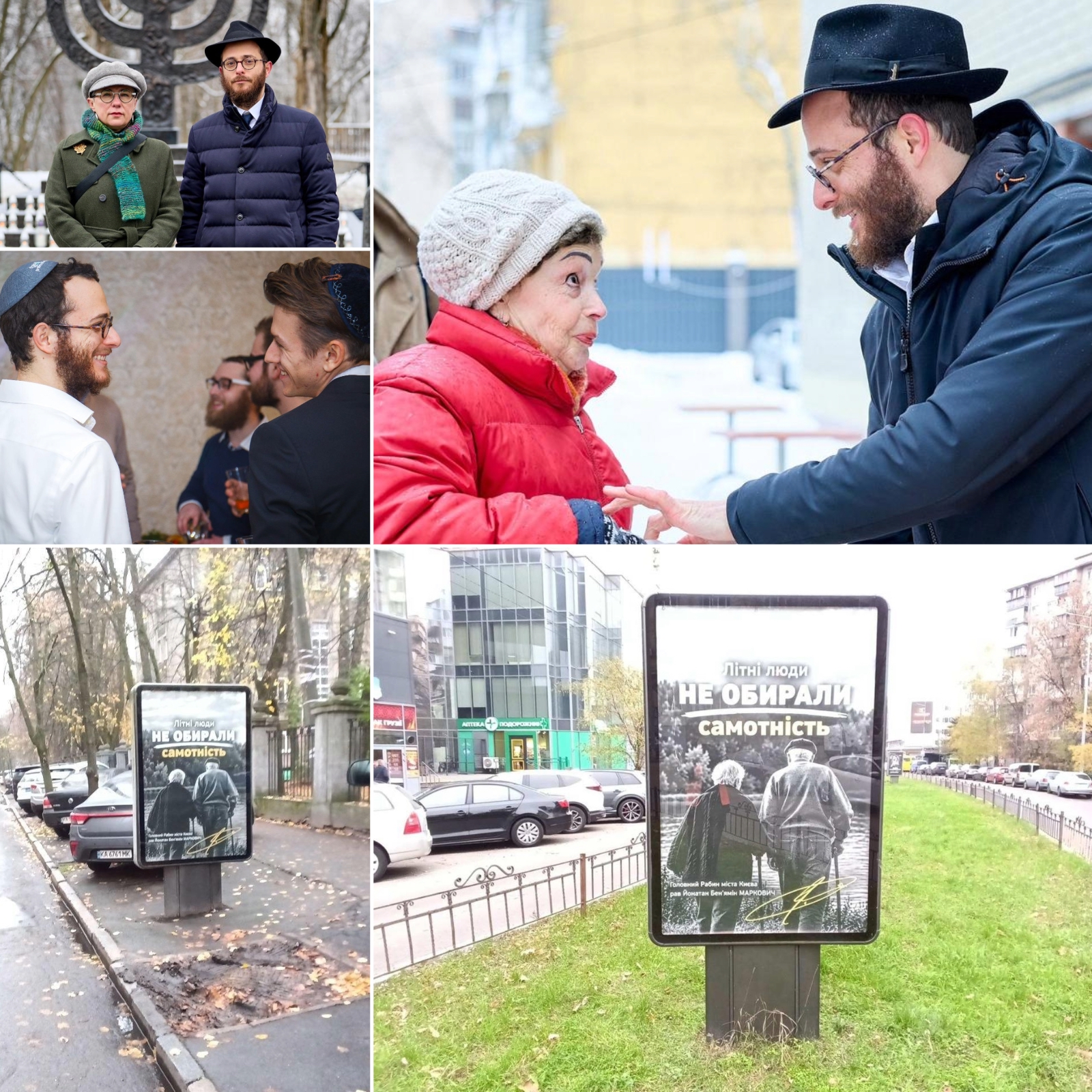
We started in Kyiv. I don’t know if you saw it outside, but we have big boards. Big boards all over the city to help older adults. Winter will be here soon in Kyiv; I mean everywhere, but it will be freezing in Kyiv. Many older adults need help. They need help.
It’s possible to go outside. It’s freezing outside, and unfortunately, a lot of the time it’s also freezing inside their apartments because they don’t have the money to… Sometimes there is no electricity, and it’s very cold. So we try to connect the younger generation with older adults.
It’s possible to talk to them. Then they will know they are not alone, because many of them don’t have any family to support them. They will know that they are not alone just by getting a phone call.
Second, if they need help going to a supermarket, maybe a young guy- not maybe, of course- it will be much easier for a young guy to go to a supermarket to buy something. So, of course, to help in this way. Or if they need to go to the doctor, even a little help can save a life. This is one part of what we do.
Also, the young generation must know to appreciate whatever they have and to be thankful, not just in words, to pray to God and say, “Thank you very much,” but also in action, to do something. When someone helps someone else, of course, in his family it’s much easier, but someone outside the family, when he does something, you can’t even imagine the impact. It changes lives, and it also changes the lives of the young people who do it.
They get up in the morning and know that in two days, it’s Monday; on Wednesday, they will go to the supermarket to buy something. If they need to make any plans, they know, “For Wednesday, I can do it,” because they must help someone. So even if someone does something, helps someone for one hour a week, he thinks about it the entire week.
When you think about good things that you will do, of course, the person himself is changing. It’s also very, very important. I must also add that some of them are veterans of the Second World War, and some of them are Holocaust survivors. The impact is very important both ways.
Also, for the young generation to hear all the stories of how the old generation managed, how they lived, how they survived until now, it’s very, very important for everyone to know the past, so that we will not only not make the same mistakes, but also change ourselves to be better.
So the combination between the young generation and the old generation, it’s so important that it’s very hard even to describe it. This is also one way that we help both communities, and it’s actually going very well.
Jacobsen: Beyond the economic challenges facing young professionals, how important are interfaith cooperation and community solidarity during wartime? What role can religious leaders play in fostering understanding and unity amid these pressures?
Markovitch: Of course, it’s very important. We need unity everywhere. Unfortunately, today, we see that a lot of times, everywhere, we are facing the same problem with unity.
Some people say that it’s because of social media. Today, it’s much harder because when you enter, I don’t know, TikTok, Facebook, Instagram, it’s programmed so that you see whatever interests you, whatever you want to see.
You don’t even see the other side. It doesn’t matter what your thoughts are, but you see whatever you want to see. A lot of times, you will think, “Okay, if this is what I see, probably everyone sees it the same way.” If someone doesn’t see it, here we have a problem.
Of course, we have a lot of problems understanding each other. A lot of times, we try to give people the opportunity to understand that someone else can think differently. You don’t have to agree, but you need to accept. And no, it’s not so easy.
Jacobsen: As Ukraine’s capital, Kyiv brings together people from different religious, cultural, and social backgrounds. Does that diversity make acceptance and mutual understanding especially important to your work as a Jewish community leader?
Markovitch: Correct. It also makes it much more interesting, because when you see so many people, so many cultures, you see different people. It’s very interesting. It actually makes you think about how, even if we look different or think differently, most people want the same things.
Most of us are the same people. We are the same. Even if we look different, and of course, there are different religions, different societies, a lot of different things can actually be between us, but mostly we are the same.
I can think in one language, someone else can think in a different language, and our friend can think in another and cannot even understand us in our languages. In Kyiv, in a big city, it’s much more interesting. It’s actually one of the pluses that we have.
Jacobsen: In a recent interview with the Congress of African Journalists alongside Chinese poet Cao Shui, I described cultural diversity with a simple phrase: “Same species, different contexts.” It captures how people can share fundamental human experiences while approaching life through very different cultural perspectives.
Markovitch: Same. I saw it also in China. I used to live in Shanghai. You see a different culture that I didn’t know. Actually, when I lived there, it was the first time I lived in such a different community from where I used to live. They are beautiful people.
It gives you a lot to think about when you see people who, most of them, of course, don’t understand you or your background. It’s the same for me. It’s very hard for me to study Chinese or understand the background exactly. We are totally different, but it was amazing. Maybe I can ask you?
Jacobsen: Sure.
Markovitch: After a few months in Kyiv…
Jacobsen: Since January.
Markovitch: You’ve been in Kyiv for a few months. How have you found it?
Jacobsen: I like it very much. In many ways, Kyiv has become a second home. I feel comfortable with everyday life, whether shopping for groceries, preparing meals, navigating the metro, walking through the city, or traveling by bus and train to other parts of Ukraine. I’ve also developed a real appreciation for the city’s layered architecture, which reflects centuries of cultural and political change.
One thing that strikes me about Ukrainian culture is its continuity despite successive periods of upheaval and repression, from the tsarist era through Soviet rule and into the post-Soviet period. Architecture is a particularly revealing example.
The craftsmanship evident in the city’s stonework, brickwork, marble, and tilework speaks to traditions of skill and artistic achievement passed down through generations. In some ways, it reminds me of the intricate embroidery of the vyshyvanka, the traditional Ukrainian shirt. Both reflect a cultural appreciation for craftsmanship, detail, and continuity.
I’ve also noticed a certain frankness in how Ukrainians communicate. People tend to express their opinions directly and concisely, although understanding the full meaning sometimes requires looking beneath the surface. It’s a little like a matryoshka doll: there are layers to unpack before reaching the heart of what someone is saying.
Another striking characteristic is resilience. Ukrainian society has endured extraordinary hardship, from the Holocaust and the Holodomor to Soviet repression of Ukrainian language and culture. That history of suffering has shaped a society accustomed to confronting adversity, although the current war presents challenges of an entirely different magnitude.
Compared with Canada, Ukraine has a very different historical experience. Canadians have enjoyed a degree of geographic and military security that Ukrainians have rarely known. I sometimes joke that Canada has three security blankets: the Pacific Ocean, the Atlantic Ocean, and the U.S. military. That relative comfort inevitably influences how Canadians understand hardship, security, and resilience.
I’m also aware of your family’s connection to Montreal and your lineage tracing back to Rashi. We may have discussed this before. These personal and historical connections are interesting because they show how identity and resilience can be shaped by experiences stretching across generations and national borders.
Something else I’ve noticed is the importance Ukrainians place on family, relationships, and personal responsibility. Love, marriage, and children seem central to many people’s understanding of a meaningful life. At the same time, economic uncertainty and the pressures of war complicate these aspirations, particularly for young people considering marriage or starting families. Traditional expectations surrounding men and women also remain influential across different religious and social backgrounds.
There are smaller cultural observations, too. I think the coffee, meat, and bread are better here, while the milk is about the same. But beneath the routines of everyday life, there are unmistakable signs of psychological strain. Anxiety, depression, and the effects of wartime trauma are part of the broader social reality, even when they aren’t immediately visible.
Public presentation and professionalism also seem particularly important. I’ve noticed how frequently people assess behavior in terms of whether something is considered professional. Appearance, conduct, and social expectations carry considerable weight, with somewhat different standards for men and women.
International Women’s Day on March 8 offers an interesting example of those cultural differences. In Canada, the emphasis tends to be on women’s rights and achievements. Those themes are certainly present in Ukraine, but the occasion also seems to celebrate femininity and traditional expressions of appreciation for women. It’s a different cultural emphasis, and one that illustrates how the same occasion can carry distinct meanings in different societies.
Ultimately, what I find most interesting about living in Ukraine is that these differences aren’t necessarily about one society being better or worse than another. They’re about history, circumstances, values, and the ways people adapt to them. There is a great deal to appreciate here, and the longer I stay, the more I recognize how much there is to learn.
Jacobsen: Thank you very much for your time today.
Markovitch: Thank you very much.