Trump’s Tech War Puts Southeast Asia in an Impossible Position
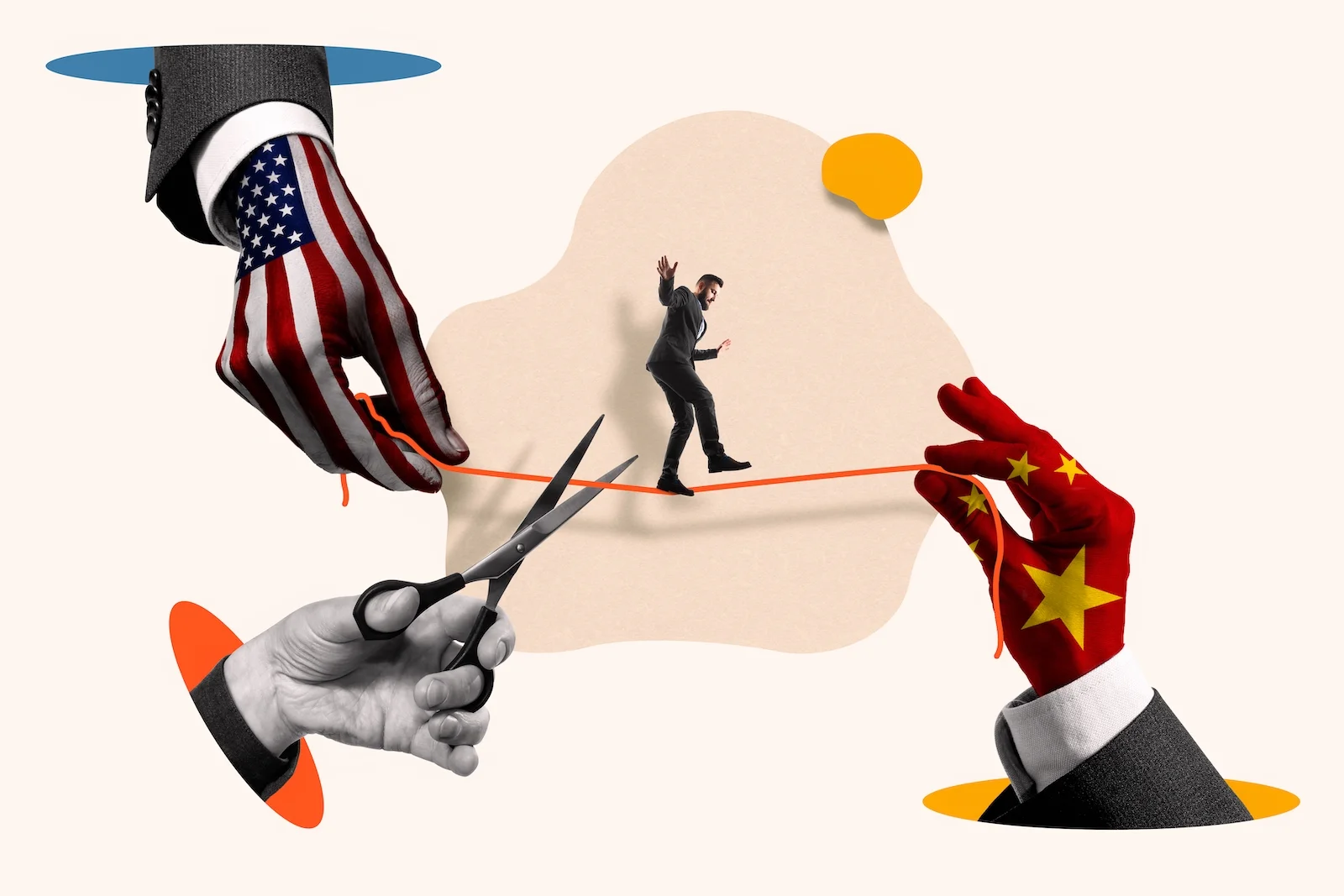
By the time Air Force One departed Manila for Shenzhen on Wednesday, the diplomatic groundwork had already been laid for President Donald Trump’s arrival. A day of summit speeches had exposed the increasingly delicate position of Southeast Asian governments, which are determined to preserve their access to Chinese investment and American technology without becoming casualties of Washington’s escalating confrontation with Beijing.
In Manila, Trump reaffirmed Washington’s security commitments while leaving unresolved questions about tariff relief and a controversial supply-chain initiative. Meanwhile, in China’s leading technology hub, regional leaders were delivering their own message: Southeast Asia welcomes American investment but has little appetite for being forced to choose between competing technological ecosystems.
The central question emerging from this 48-hour diplomatic encounter is whether Southeast Asian governments can maintain their economic relationships with China while navigating increasingly restrictive U.S. semiconductor and artificial intelligence regulations.
Trump’s Wednesday morning meeting with Philippine President Ferdinand Marcos Jr. at Malacañang Palace illustrated the opportunities and complications of Washington’s transactional approach to regional diplomacy.
For Manila, the immediate priority was securing relief from the 12.5 percent U.S. tariff imposed on Philippine exports in July while advancing its ambitions under Pax Silica, a U.S.-led initiative intended to establish critical-mineral and semiconductor supply chains less dependent on China.
Yet the visit produced no signing of the proposed Pax Silica framework. Marcos confirmed that the agreement was not on the agenda, underscoring the political sensitivities surrounding a project that has already generated opposition over environmental concerns, land rights, and the potential displacement of local communities.
Trump subsequently announced what he described as a major new trade arrangement with the Philippines, although neither government immediately provided the details necessary to establish its scope. The contrast between the president’s expansive rhetoric and Manila’s more cautious response highlighted the uncertainty surrounding Washington’s economic commitments.
That uncertainty was equally apparent in Shenzhen, where Southeast Asian leaders used the Asia-Pacific Economic Cooperation (APEC) CEO Summit to articulate a vision of regional development that resists pressure from competing superpowers.
Malaysian Prime Minister Anwar Ibrahim framed that resistance through the experience of postcolonial independence, arguing that emerging economies should no longer be expected to accept economic arrangements dictated by more powerful countries. Having endured decades of colonial domination, developing nations were entitled to greater dignity, equality, and control over their economic futures.
His message extended beyond conventional trade disputes. With artificial intelligence, semiconductors, and digital infrastructure increasingly determining economic competitiveness, access to advanced technology has become inseparable from questions of national sovereignty.
Thai Prime Minister Anutin Charnvirakul offered a more commercially focused version of the same argument. Having reached a preliminary trade understanding with Washington in Manila, he arrived in Shenzhen emphasizing Thailand’s attractiveness to international investors and the importance of predictable economic conditions.
Anutin pointed to investment applications exceeding $50 billion during the first nine months of 2026, driven in considerable part by interest in artificial intelligence, cloud computing, semiconductors, and advanced electronics. Shenzhen, he suggested, demonstrated what sustained openness to investment and technological development could accomplish.
Across Southeast Asia, from Bangkok and Malaysia’s Johor state to Jakarta and Singapore, the expansion of data centers and cloud infrastructure has become a cornerstone of regional economic strategy. These projects attract American technology companies and Chinese investors alike, creating an increasingly interconnected industry that cannot easily be divided along geopolitical lines.
Washington’s efforts to restrict Chinese access to advanced American computing capabilities therefore threaten more than bilateral commercial relationships. They risk complicating the investment model on which Southeast Asia’s emerging digital economy increasingly depends.
Beijing has been quick to recognize the opportunity.
As Washington tightens restrictions on advanced semiconductor exports and remote access to American computing infrastructure, China is presenting itself as an alternative source of investment, technology, and commercial connectivity. Its broader economic outreach, including the upgraded China–ASEAN Free Trade Area 3.0 framework, reinforces Beijing’s argument that regional prosperity depends on continued integration rather than technological separation.
The timing is particularly advantageous for China. Washington’s latest regulatory push follows a leadership crisis at Nvidia that has intensified political scrutiny of American semiconductor exports and exposed disagreements over how aggressively the United States should restrict China’s access to advanced computing technology.
For Southeast Asian governments, however, Beijing’s alternative comes with significant complications of its own. Greater dependence on Chinese cloud systems, telecommunications infrastructure, and digital networks could eventually constrain access to Western technologies and enterprise markets.
The region consequently faces an uncomfortable choice: accepting deeper technological dependence on China could invite American restrictions, while accommodating Washington’s demands could jeopardize investments essential to its economic development.
The diplomatic stakes will intensify Thursday as Trump prepares for discussions with Xi Jinping and Russian President Vladimir Putin on the sidelines of APEC.
The U.S. Commerce Department’s newly announced restrictions on advanced computing technology have already complicated the regional environment. The measures impose additional licensing requirements on certain semiconductor shipments and establish new scrutiny of overseas data centers providing computing services to Chinese customers, although some compliance provisions allow a transition period.
Putin, meanwhile, has used the summit to criticize sanctions and economic barriers, portraying Western restrictions as incentives for Asian economies to pursue greater technological independence.
Trump appears more interested in securing visible diplomatic achievements than becoming entangled in the technical complexities of semiconductor regulation. His willingness to entertain additional high-profile encounters, including a possible meeting with North Korean leader Kim Jong Un, reinforces the impression of a president pursuing diplomatic spectacle alongside substantive negotiations.
For Southeast Asian governments, that preference may create opportunities to press Washington for flexibility. But any concessions would have to contend with an American political establishment increasingly convinced that advanced computing technology constitutes a strategic national-security asset.
The deeper challenge is unlikely to disappear after the summit concludes. Southeast Asia has spent years developing an economic model built on openness to competing markets, investors, and technological systems. Its governments see diversification not as geopolitical indecision but as an essential protection against dependence on any single power.
Washington and Beijing increasingly regard technological interdependence as a vulnerability. Southeast Asia continues to regard it as an opportunity.
Whether those competing visions can coexist will determine far more than the outcome of this week’s diplomatic meetings. It may shape the future of the region’s digital economy and its ability to preserve meaningful strategic independence in an increasingly divided world.