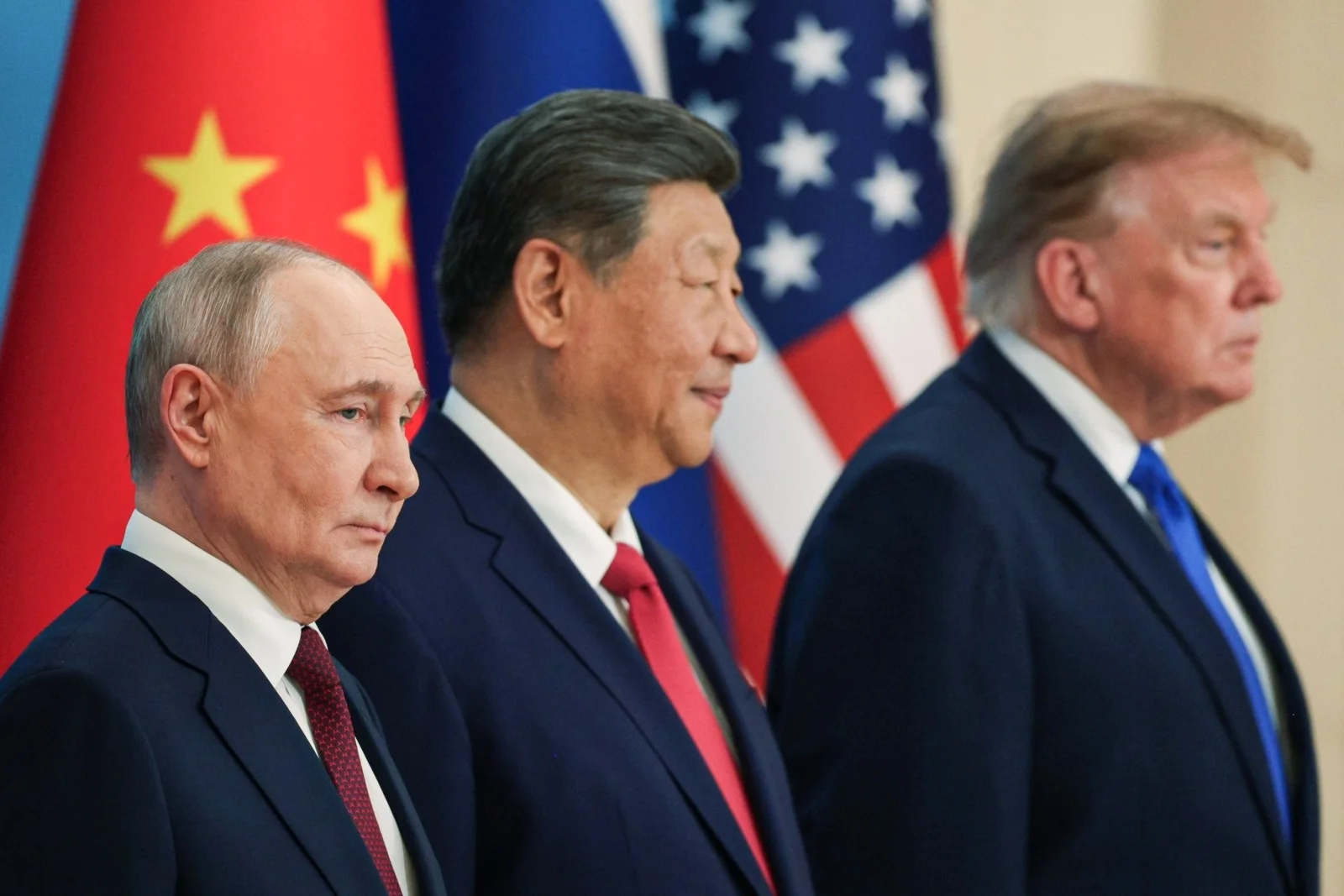

Three Presidents, One World They Cannot Control
The meeting between Donald Trump, Xi Jinping, and Vladimir Putin in the Chinese city of Shenzhen on November 19 offered a revealing portrait of a world in transition. Political arrangements built over decades are giving way to a more unsettled distribution of influence, marked by great-power competition, weakening confidence in multilateral institutions, and a renewed belief that the future of international affairs can be negotiated directly by the leaders of its most powerful states. The summit mattered not because it settled those questions, but because it exposed how difficult they have become to answer.
Bringing the leaders of the United States, China, and Russia to the same table amounted to an acknowledgment of an undeniable reality: the international order is undergoing a profound transformation. The ability to exercise influence no longer rests solely on military strength or economic size. It increasingly depends on technological leadership, diplomatic reach, control of strategic resources, and the capacity to shape choices made by governments far beyond any one country’s borders.
Trump brought to Shenzhen his familiar transactional understanding of international relations. He has long presented direct negotiation between powerful leaders as a way to overcome the procedural limitations of conventional diplomacy. The attraction is obvious: personal conversations can break deadlocks, signal political intent, and produce commitments that bureaucracies might otherwise struggle to deliver. But the approach carries a fundamental contradiction. Conflicts rooted in territory, security, national identity, and competing visions of international order cannot reliably be resolved through personal understandings or arrangements designed to secure an immediate political victory.
For Xi, hosting the meeting offered an opportunity of broader strategic significance. China could present itself not merely as an indispensable economic power but as a diplomatic center of gravity capable of convening the principal actors in world politics. The symbolism was difficult to miss. Beijing is no longer content to occupy a secondary position in the management of international crises; it intends to help write the rules under which the international system will operate in the decades ahead.
Yet China’s position involves a delicate calculation. Beijing wants to expand its influence without jeopardizing the stability on which its economic development depends. Its rivalry with Washington now extends across technological leadership, supply-chain security, access to strategic minerals, and artificial intelligence, whose importance as an economic, political, and military instrument continues to grow. China may benefit from a more multipolar world, but it has little interest in a disorderly one that threatens the trade and investment on which its prosperity relies.
Putin approached the gathering from a different position. For the Russian president, simply taking part offered a means of reaffirming Moscow’s international relevance despite the prolonged war in Ukraine, sanctions, and the political costs associated with the conflict. Russia still possesses military capabilities, energy resources, and diplomatic instruments that make it impossible to exclude from major strategic questions. Putin’s objective was to turn that reality into recognition: any attempt to reorganize the global balance of power, he wants other capitals to understand, must take Russian interests into account.
None of this means the three governments have discovered a common strategic purpose. Their appearance together did not create an alliance or erase the profound differences between them. Washington, Beijing, and Moscow pursue frequently conflicting interests, and their relationships are defined as much by mistrust as by mutual dependence. That combination of rivalry and the need for continued communication gave the Shenzhen gathering its significance. Competition among major powers now unfolds simultaneously in military planning, trade, technology, energy, and diplomacy. A misunderstanding in one arena can quickly spill into another.
Nuclear security illustrates the danger particularly clearly. The expiration of the New START Treaty in February 2026 ended the last legally binding limits on the strategic nuclear arsenals of the United States and Russia. That development increased the urgency of finding new arrangements for transparency, predictability, and arms control, even as China’s growing capabilities complicate efforts to build a framework that all three governments consider acceptable. Modernizing weapons systems and emerging technologies only increase the potential consequences of miscalculation or decisions made under extraordinary pressure.
The challenge is not simply to negotiate limits on weapons. It is to establish even a minimum degree of trust among governments with sharply different understandings of security. The United States wants to preserve its strategic advantages. China seeks room to expand its influence without accepting a framework designed by Washington and Moscow. Russia insists that its security priorities be recognized. Any serious agreement would require concessions that each leader would find difficult to defend before a domestic audience accustomed to hearing that compromise is a form of weakness.
The summit’s limited results underscore that difficulty. The leaders discussed nuclear risks and other international disputes, but the meeting did not produce the sweeping arms-control settlement that the moment demands. Diplomatic contact is valuable, particularly among governments capable of inflicting enormous damage on one another. It should not, however, be confused with durable progress. A cordial conversation can reduce immediate uncertainty without resolving the policies and ambitions that made such a conversation necessary in the first place.
There is a second concern, perhaps more consequential than anything announced in Shenzhen: the gradual substitution of bargaining among centers of power for genuinely multilateral diplomacy. When the strongest states seek to define the boundaries of international competition among themselves, stability can become a succession of temporary bargains dependent on the preferences of individual leaders. Smaller countries then risk being treated as subjects of negotiation rather than participants in decisions that directly affect their security and sovereignty.
History offers little assurance that concentrating diplomatic power in a few hands produces lasting stability. The ability to impose terms is not the same as the ability to build legitimate consent. An international order sustained principally by the influence of major states may generate temporary balances, but it struggles to provide the predictable rules that an interconnected global economy and a fragmented security environment require. Institutions are often slow, imperfect, and frustrating. Their purpose, however, is precisely to prevent international relations from becoming an endless contest over who possesses the greatest leverage at a particular moment.
The real challenge for Trump, Xi, and Putin is therefore not to demonstrate who can exert the most pressure or extract the largest concession. It is to recognize that competition without effective channels of dialogue and restraint can turn political disagreements into military crises and economic disputes into confrontations with consequences no government can fully control. Their countries may possess extraordinary power, but that power does not grant them the ability to insulate themselves from the instability they help create.
No single meeting could reasonably have been expected to overcome decades of mistrust, resolve ongoing wars, or lay the foundations of a new international order. Nor should the significance of three leaders speaking directly be dismissed. At a time when an absence of communication among rival powers can be as dangerous as the rivalries themselves, even limited engagement has practical value. The test is whether dialogue becomes a sustained effort to manage dangerous differences rather than a performance designed to produce an impressive photograph.
Shenzhen will ultimately matter less for the image of three presidents seated together than for what follows it: whether their governments establish more reliable mechanisms for handling competition, reducing nuclear risks, and preventing disputes from escalating beyond anyone’s control. The world does not need its future apportioned among three capitals, nor an artificial peace maintained only by fear of military escalation. It needs an international architecture in which force does not displace law, rivalry does not extinguish diplomacy, and strategic ambition does not compromise the security of generations yet to come.
The question left by Shenzhen is not simply what Trump, Xi, and Putin are prepared to negotiate. It is whether they understand that the exercise of power also requires acknowledging its limits. History may remember this gathering not for the speeches delivered or the understandings announced, but for whether its participants chose to manage the rivalries dividing them—or allowed those rivalries to determine everyone else’s future.