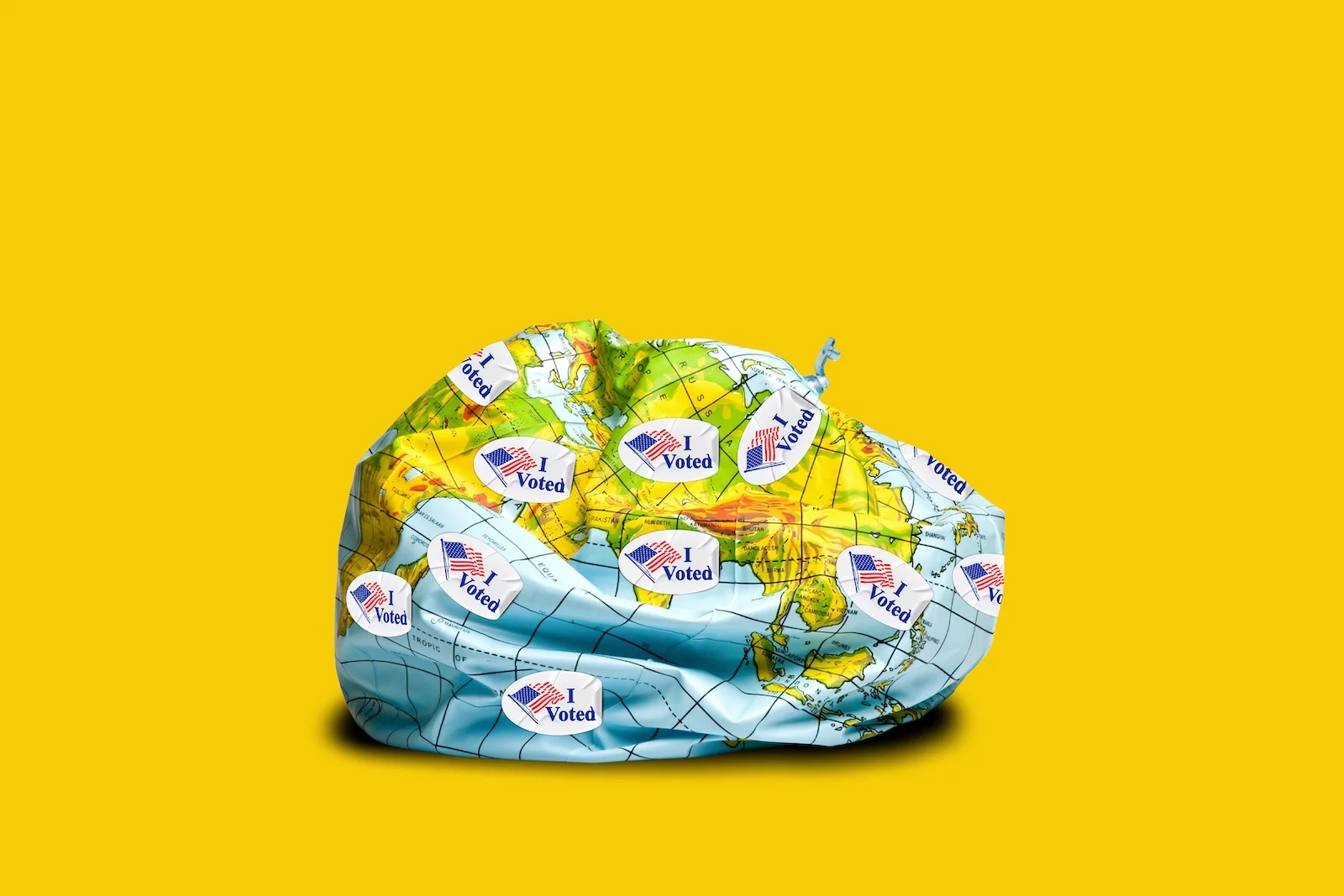

The World Is Changing Faster Than Democracy Can Govern It
The American midterm elections of November 3 have dramatically altered the balance of power in Washington. Democrats have regained control of both the Senate and the House of Representatives, with victories extending beyond traditional battlegrounds into Republican strongholds, including Texas, Kansas, and South Carolina. Although the precise composition of the new Congress is still taking shape, the political consequences are already apparent. Beginning in January 2027, President Donald Trump will confront a Congress considerably less inclined to accommodate his administration and far more determined to challenge its authority.
For many voters, the concerns driving the election were immediate and personal: the rising cost of living, government accountability, immigration, presidential conduct, and the economic consequences of the war with Iran. An Associated Press voter survey found that roughly seven in ten believed Congress was doing too little to restrain presidential power. Yet even an election producing such a decisive domestic political shift cannot be interpreted as a unified judgment on the international questions shaped by American policy.
That distinction matters because the elections occurred against the backdrop of transformations that extend far beyond any electoral cycle. China’s ascent has redistributed economic and technological influence. Artificial intelligence is expanding the boundaries of human and machine capabilities. Climate change is making the accumulated consequences of industrialization increasingly difficult to ignore. Wars in Ukraine and the Middle East are testing the authority of international law, while the enduring legacies of slavery and empire, persistent economic inequality, and global migration continue to connect distant histories with contemporary political struggles.
These developments have different origins and unfold at different speeds. Their convergence nevertheless raises a larger question: Are we witnessing a genuinely distinctive historical transformation, or merely another moment when contemporaries mistake the anxieties of their own age for unprecedented upheaval?
Every generation develops its own language of crisis. Confronted with unfamiliar changes, societies often imagine themselves standing at a decisive break with the past. Historians, looking backward, tend to discover something more complicated: a gradual, uneven transition in which continuity and disruption coexist. Even events celebrated or condemned as historical turning points acquire their full significance through consequences that remain invisible to those experiencing them.
The French Revolution challenged inherited assumptions about sovereignty, citizenship, and legitimate political authority. It also strengthened the belief that the future could be deliberately shaped rather than passively inherited. The nineteenth century carried that ambition into economic life. Industrialization transformed labor and production, while railways, steamships, electricity, and telegraphic communications fundamentally altered humanity’s experience of distance and time.
Between approximately 1870 and 1914, an earlier wave of globalization connected markets, encouraged mass migration, and accelerated technological innovation. Germany and the United States emerged as formidable industrial competitors to Britain. European empires imposed unequal political and commercial arrangements across much of Asia and Africa. Economic integration encouraged hopes of lasting stability, but it developed alongside nationalism, military expansion, and imperial competition. Growing interdependence did not prevent the catastrophe of 1914.
The decades that followed offer an important warning against extravagant claims of contemporary exceptionalism. Two world wars, economic depression, revolution, genocide, and the collapse of empires overturned established expectations on a scale difficult to match against the upheavals of our own time.
The institutions established after 1945 represented an attempt to transform those experiences into a more durable international settlement. The United Nations, the Bretton Woods system, and successive trade institutions rested partly on American predominance, but also on the recognition that unrestricted competition among powerful states had proved catastrophically destructive.
Decolonization transformed the international system’s membership without eliminating its inherited inequalities. The Cold War’s conclusion generated another wave of optimism. Economic integration and liberal constitutional government appeared to offer a path toward political convergence. That confidence now belongs to history as surely as the bipolar international order it replaced.
There is another reason to approach contemporary claims of unprecedented crisis with caution. Instantaneous communications expose audiences to an almost uninterrupted succession of emergencies occurring across the world. The resulting impression of permanent disorder may reflect our expanded awareness as much as changes in the underlying international environment. Earlier centuries were hardly peaceful simply because news of distant suffering traveled more slowly.
Yet the circulation of information also changes politics itself. It shapes expectations, mobilizes public opinion, and compresses the time available for governments to respond. The capacity to witness events almost immediately does not necessarily translate into a comparable ability to understand or influence them.
What distinguishes the present, then, is not simply the existence of war, technological innovation, or shifts in great-power relations. Its particular character emerges from the interaction of these forces with planetary environmental pressures and an interconnected global economy, even as the institutions responsible for collective decisions remain largely rooted in national political communities. This is a distinctive historical configuration, not evidence that humanity has entered some final, all-encompassing crisis.
China’s development offers perhaps the clearest geopolitical expression of this transition. Within a few decades, the country has become a leading center of manufacturing, international commerce, and technological research. Its rise has challenged the assumption, especially influential after 1989, that economic modernization would inevitably produce Western-style liberal political institutions.
Yet the familiar narrative of American decline giving way to inevitable Chinese predominance is misleadingly simplistic. The United States retains immense financial, military, scientific, and cultural influence, supported by an alliance network of exceptional geographic reach. China, meanwhile, faces demographic pressures, economic imbalances, and significant domestic challenges.
India, the European Union, and other influential powers are seeking greater freedom to pursue their own interests rather than permanently aligning themselves with either side of an emerging rivalry. Countries commonly grouped under the label of the Global South are hardly passive spectators. Their governments negotiate, establish institutions, assemble coalitions, and challenge existing arrangements governing finance, trade, and access to technology.
The redistribution of political agency is therefore as consequential as the redistribution of material resources.
What is changing is not merely the balance of power but the terms under which its exercise is regarded as legitimate. Institutions designed around one historical distribution of influence must now accommodate another. Countries that benefited from established rules seek to preserve their advantages, while those whose economic and political weight has increased demand a greater role in shaping them.
Complicating matters further, strategic competitors remain deeply connected through trade, finance, and technology. Rivalry and mutual dependence increasingly exist within the same relationships.
War has exposed the limitations of that interdependence. Russia’s full-scale invasion of Ukraine directly challenged the prohibition against aggressive war and territorial conquest. Moscow’s permanent seat on the United Nations Security Council has also demonstrated how difficult it becomes to enforce international principles when one of the institution’s most powerful members is implicated in violating them.
The conflicts involving Israel, Palestine, and the wider Middle East arise from different historical and legal circumstances. Nevertheless, they similarly expose the distance separating international rules from the political will and practical power needed to enforce them. The U.S. war with Iran has further demonstrated how quickly military decisions can transmit economic consequences across national borders through energy markets, inflation, and disruptions to trade.
The material evidence of growing insecurity is considerable. According to the Stockholm International Peace Research Institute, global military expenditure reached $2.887 trillion in 2025, marking the eleventh consecutive annual increase. Yet diplomatic relationships, commercial exchanges, and international institutions continue to operate.
The postwar international order has neither disappeared nor remained intact. Instead, it is undergoing a contested process of adaptation, with no broadly accepted understanding of what might eventually replace it.
Geopolitical competition has abundant historical precedents. Artificial intelligence and climate change, however, raise a different and potentially more consequential question: How can political authority govern powers whose effects extend far beyond the institutions responsible for controlling them?
Technological innovation has repeatedly transformed what societies can accomplish. The printing press revolutionized the circulation of knowledge. Industrial machinery reorganized labor and production. Computers and the internet transformed communication, information, and economic activity. Artificial intelligence belongs within that history, but it pushes technological capabilities into language, analysis, design, and forms of problem-solving previously associated primarily with human judgment.
Its possibilities are substantial. AI could accelerate scientific discovery, improve medicine and education, and create new methods of production. Yet its development also raises difficult questions about employment, concentrated corporate power, political manipulation, and military applications.
Stanford University’s 2026 AI Index documents rapid improvements in artificial intelligence capabilities and a narrowing performance gap between leading American and Chinese systems. It also underscores an essential distinction: technical performance, reliability, and social benefit are not interchangeable.
Earlier generations frequently exaggerated the immediate consequences of technological innovation while underestimating its longer-term effects. It would therefore be premature to declare artificial intelligence more transformative than the printing press, steam power, or electricity.
Nevertheless, questions of accountability, ownership, and democratic oversight cannot be postponed until its ultimate trajectory becomes clear. Technological innovation is advancing far more rapidly than the political consensus and regulatory institutions needed to govern its consequences.
Climate change operates on a different historical timescale. Its causes have accumulated over centuries, while its consequences increasingly fall upon societies and generations that contributed unequally to the problem.
The Intergovernmental Panel on Climate Change has established that human activity is responsible for contemporary global warming. According to the World Meteorological Organization, the years from 2015 through 2025 were the eleven warmest on record, with temperatures in 2025 approximately 1.43°C above the 1850–1900 average.
Earlier civilizations transformed their environments, sometimes with disastrous consequences. Industrial civilization has extended humanity’s influence to planetary systems. The economic benefits of fossil-fuel-driven development were distributed unequally, as are the financial and technological resources now available for adaptation.
Historical responsibility and contemporary political authority rarely coincide neatly. Governments answer primarily to present-day electorates, while meaningful climate action requires commitments that extend across national borders and multiple generations.
The future, however, is not without constructive possibilities. According to the International Energy Agency, roughly 800 gigawatts of renewable generating capacity were added worldwide in 2025, setting another record. Scientific innovation and industrial ingenuity can expand the range of practical responses, even if they cannot independently resolve political disagreements over who should bear the costs.
Artificial intelligence and climate change thus embody two contrasting historical rhythms: the rapid expansion of what humanity can do and the gradual accumulation of consequences from actions already taken. Both reveal the growing difficulty of governing capabilities whose effects exceed the geographical and temporal boundaries within which political decisions are made.
These transformations are unfolding across an economic landscape shaped by earlier generations. Slavery, imperial expansion, colonial extraction, and uneven industrialization helped establish the distribution of wealth, infrastructure, and political influence that continues to characterize much of the international system.
In the Atlantic world, coerced labor sustained extensive commercial networks. Elsewhere, colonial administrations frequently reorganized land ownership, production, and taxation to serve imperial interests. Political independence altered the formal distribution of sovereignty, but it did not automatically eliminate the economic and institutional consequences of colonial rule.
History, however, cannot explain every contemporary disparity. Education, domestic institutions, public policy, and emerging economic opportunities have also shaped national development. Nor can the world be neatly divided into a prosperous North and an impoverished South. China, India, and numerous other economies have fundamentally transformed their international positions.
Indeed, longer life expectancy, improved access to education, and substantial reductions in poverty rank among modernity’s most significant achievements. Any credible assessment of the contemporary international order must acknowledge these advances alongside its inequalities and failures.
Yet progress remains uneven and vulnerable to reversal. The World Bank estimates that 811 million people live in extreme poverty in 2026, while UN Trade and Development reports that developing countries’ external debt reached $12.3 trillion in 2025.
Debt-servicing obligations can restrict the public investment needed for education, healthcare, technological development, and climate adaptation. The ability to prepare for and shape a shared future is itself distributed profoundly unequally.
Migration brings these structural differences directly into domestic politics. The United Nations estimated that 304 million people were international migrants in 2024, representing fewer than four percent of the world’s population.
Forced displacement is a distinct phenomenon. At the end of 2025, the United Nations High Commissioner for Refugees recorded approximately 117.8 million people displaced by persecution, conflict, violence, human rights violations, and related circumstances.
Economic opportunity, family relationships, war, and environmental pressures generate different patterns of movement. These experiences should not be reduced to a single political narrative.
Receiving societies may benefit from migrant labor, entrepreneurship, and cultural exchange while also confronting legitimate challenges involving housing, public infrastructure, integration, and democratic consent.
Migration consequently exposes a fundamental tension between economic relationships that routinely cross borders and political membership that remains tied to territory. Inequalities originating far beyond national frontiers become immediate questions of belonging, responsibility, and governmental authority.
It is tempting to characterize these developments collectively as a crisis of the international order. But the word “crisis” suggests a disturbance with a recognizable beginning and some prospect of resolution. The transformations now unfolding resist such a straightforward description.
China’s rise has developed over decades. The causes of climate change stretch across centuries. The legacies of slavery and empire persist across generations. Artificial intelligence may advance within months, even as its institutional and social consequences require decades to become fully apparent. Wars can erupt suddenly from disputes whose origins reach deep into history.
The challenge is not that every transformation is advancing at unprecedented speed. It is that these changes proceed at different speeds while placing competing demands on the same political institutions.
Three tensions are particularly revealing.
The first concerns scale. Climate change, technology, finance, conflict, and migration routinely cross national borders, but political authority remains concentrated within sovereign states. International organizations can facilitate negotiation and coordination, yet their effectiveness still depends heavily on the consent, resources, and decisions of national governments.
The second concerns time. Electoral mandates are comparatively brief, while the consequences of political choices may extend across generations. Governments must address immediate demands for affordable housing, employment, and public security while confronting challenges whose benefits or costs may fall upon people not yet born.
Democratic politics cannot simply disregard the needs of living citizens in pursuit of an uncertain future. Equally, it cannot escape responsibility for foreseeable consequences merely because those consequences will emerge beyond the next election.
The third tension concerns legitimacy. International cooperation frequently requires sacrifices whose costs are distributed unevenly, including among citizens of the same country. People are entitled to ask who determines those obligations, whose interests are represented, and how decisions taken beyond national borders can be subjected to democratic accountability.
Greater reliance on international expertise cannot substitute for political consent. Yet national sovereignty, considered in isolation, cannot effectively manage conditions that no country possesses the capacity to control independently.
These tensions reveal a profound institutional predicament, but they do not necessarily demonstrate that the international system is collapsing.
The arrangements created after 1945 have supported international trade, economic development, public health initiatives, and mechanisms for diplomatic cooperation. Their durability deserves recognition. Nevertheless, these institutions must now accommodate geopolitical, technological, and environmental realities far removed from the circumstances in which they were established.
Modernity has continually expanded the boundaries of human capability. It has been far less successful in resolving what humanity should accomplish, who possesses the authority to decide, and how the resulting benefits and burdens should be distributed.
Material, political, and moral progress are connected, but they do not necessarily advance together. The widening gap between technological capability and collective political authority may therefore be the most distinctive characteristic of the present historical transition.
The American midterms provide a revealing illustration of this predicament.
The elections have transformed the institutional environment in which Trump must govern. When the new Congress convenes in January, Democrats will control the Senate, giving them greater influence over legislation, presidential nominations, and investigations. Their victory in the House will also provide control over legislative proceedings, committee oversight, and negotiations over federal spending.
The presidency nevertheless retains substantial authority, particularly in diplomacy and national security. A divided government may produce institutional restraint and compromise, but partisan confrontation could just as easily result in legislative paralysis.
The electoral geography is also significant. Democratic victories in traditionally Republican Senate seats, including those in Texas and Kansas, demonstrate that the political backlash extended well beyond states normally regarded as competitive.
Even so, the meaning of the election should not be exaggerated. The Associated Press voter survey identified the cost of living and concerns over democratic accountability as major influences on voters. The war with Iran and its economic consequences also shaped public assessments.
The result reflects substantial political discontent, not necessarily a coherent national consensus about America’s place in the world.
Yet the connection between international developments and domestic politics is impossible to ignore.
Decisions involving war, trade, technology, and energy do not remain remote matters reserved for diplomats and foreign-policy specialists. Their consequences return home through prices, employment prospects, concerns about national security, and arguments over political responsibility.
Citizens respond through national elections to forces whose origins are partly international. In exercising their democratic rights, they can also influence the lives of millions of people who have no vote in those decisions.
That imbalance is hardly unique to the United States. It is a defining characteristic of an international system in which economic and technological relationships are increasingly shared, while the institutions that confer political legitimacy remain divided along national lines.
What distinguishes the United States is the extraordinary reach of its power and, consequently, the worldwide implications of its domestic political choices.
Neither the midterm elections nor the next Congress can determine the direction of China’s development, the ultimate consequences of artificial intelligence, or the trajectory of the global climate. Nor should the present be understood as an inevitable progression toward international decline or catastrophe.
Earlier international settlements have collapsed, but others have endured through adaptation. Modern history contains extraordinary improvements in human welfare alongside immense destruction and inequalities that remain unresolved.
What makes our historical moment significant is not the certainty of an approaching rupture. It is the confrontation between institutions shaped by accumulated experience and emerging possibilities that increasingly exceed the boundaries of that experience.
An election can rearrange political authority within the United States in a matter of days. The transformations against which that authority must be exercised will continue across years, decades, and generations.
History offers no assurance that humanity’s expanding ingenuity will be accompanied by comparable political wisdom. Neither does it rule out that possibility.
The future will emerge from the constraints we inherit, the choices we make within them, and the consequences we cannot yet fully anticipate. Whether our expanding powers become instruments of shared progress or renewed division remains an open political question. And it is one that no election, however consequential, can answer alone.