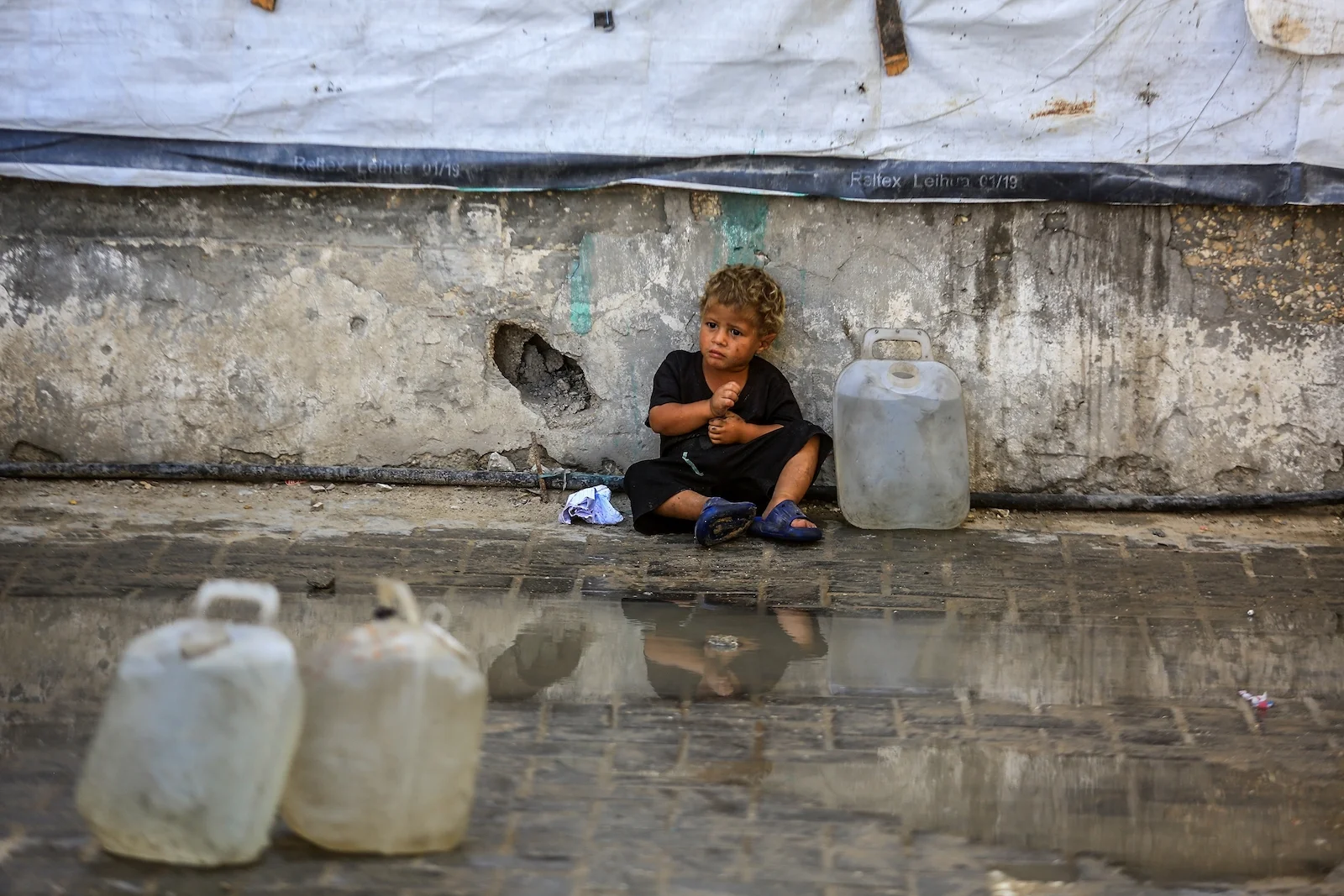

Rains and Despair: Flooding and the Humanitarian Crisis in Gaza
There may well be a time when a note on Gaza will describe something fragrantly hopeful rather than dankly despairing. That time, however, will be some time off. Those on the strip continue to live in precarious conditions, accommodated in makeshift, overcrowded shelters and tents brought about by a war waged with catastrophic consequences. Even now, the Israeli authorities remain cool to efforts to improve the lot of Gazan citizenry even as they advance the demarcated Yellow Line that is shrinking the already diminished territory.
Heavy rainfall since November 6 has added to the complement of misery for residents, 65% of whom live in tents or rudimentary shelters. Just under a million people populate areas prone to flooding, with 400,000 living in areas seen by the World Health Organisation as “extremely high risk.” Tens of thousands of tents housing displaced Palestinians have been flooded. Instances of respiratory illnesses are on the rise. “The numbers already show the pressure,” Dr. Reinhilde Van De Weerdt, WHO representative in the Occupied Palestinian Territory, told reporters in Geneva from Jerusalem. “Acute respiratory infections are 33,000 cases higher than at the same time last year.”
According to the United Nations Office for the Coordination of Humanitarian Affairs (OCHA), the rains “damaged displacement sites, shelter and humanitarian facilities, and disrupted services across all five governorates.” The damage caused within twenty-four hours was depressingly formidable, affecting 26,000 households. (That number has since risen to 46,000.) Over 6,000 family shelters were destroyed in that time, with 17,400 damaged. Damaged buildings have collapsed, and the rains have added to existing structural and environmental risks. To this can be added the problems of exposed ordnance buried under the debris or shifted to other areas, endangering the lives of residents and humanitarian personnel.
The November 13 humanitarian situation report from OCHA is evenly grim. Between November 3 and 9, Israeli airstrikes, shooting and shelling continued, killing 22 Palestinians and injuring 90. This brought the total number of reported deaths since the October 2025 ceasefire agreement to 1,613, with 5,833 suffering injuries. The Ministry of Health in Gaza retroactively added 12 fatalities once their identification details were verified.
Instead of seeing an increase of humanitarian supplies to cope with the rain-borne crisis, the opposite is true. Between November 2 and 8, 228 of the 262 UN and partner trucks intended for entry into Gaza were offloaded on the Israeli side of Kerem Shalom; 128 from Ashdod, 25 from Egypt, 44 from Israel, 12 from the West Bank and 18 from Jordan. The OCHA reports that the number of trucks offloaded constituted a fall of 42% from the previous week. The lower figure was explained by Israel’s suspension of the Egyptian corridor citing concerns over smuggling. Between November 3 and 8, no trucks were offloaded. The overall figures also fell due to, in the UN agency’s words, “reduced aid volumes available to partners amid funding constraints.”
COGAT (Coordinator of Government Activities in the Territories), that most Orwellian of entities responsible for coordinating aid, insists on a different reality. The crisis is being addressed; poor sanitary conditions were being improved prior to the rain, an effort coordinated with international bodies. More than 93,000 tents and over 8,600 trucks holding tarpaulin sheets, blankets and winter clothing have entered Gaza since the winterization plan was launched by the Board of Peace, UN agencies and NGOs.
The sceptics at Haaretz newspaper effectively burst that presumptuous bubble by obtaining data revealing a growing decline in food deliveries to Gaza to add to severe shortages of medical supplies, tents and materials to repair crippled infrastructure. Under the ceasefire deal, Israel had pledged that it would permit 4,200 vehicles carrying essential humanitarian aid and commercial items, including food, fuel, vital medical equipment and supplies, shelter materials and equipment for repairing essential infrastructure into Gaza each week.
COGAT’s own figures supplied to the US-led International Gaza Support Center (IGSC) show totals well short of the promised monthly rate of 18,200 vehicles allowed into the Strip: 4,700 in March, 5,300 in April and over 9,600 in May. In June, the number had risen to 12,000 only to fall again to 10,000 for the months of July and August. September proved to be the highpoint with 13,000, while October saw a dramatic plummeting to 6,500 vehicles. Seemingly caught out by this unusual affliction of verisimilitude, COGAT called its own figures “inaccurate,” saying that Israel had met and even exceeded its humanitarian commitments.
COGAT’s mangled version of reality has not impressed various foreign ministries eyeing the worsening situation caused by the floods and the onset of cold weather. In its November 14 statement, the Council of the European Union expressed concern that flooding and wintry conditions were “further aggravating the living conditions of an already exhausted population, exacerbating unsafe conditions and human suffering.” The Council also noted the lethal strike on Nasser Hospital by the IDF that left six dead, including a surgeon and a 13-year-old boy. Israel was urged “to allow immediate, unimpeded access and sustained distribution of humanitarian assistance and early recovery support at scale, and to reopen all Gaza border crossings.”
A few days later, a joint statement from the foreign ministers of Australia, Canada, Italy and the United Kingdom warned that “as winter takes hold in Gaza, the humanitarian situation on the ground is dire.” 150,000 tents, along with other essential supplies were “being held at the border and prevented from entering Gaza. The situation is entirely reversible – and there is still time to act before the winter fully sets in.” Israel was called on “to stop the delays now and allow immediate, rapid and unimpeded humanitarian access throughout Gaza.” The crossings had to be opened, and tents permitted to enter. “Dual-use items necessary for humanitarian operations and early recovery must be granted entry before it is too late.”
Van De Weerdt is filled with foreboding at a crisis that promises to deteriorate, further aided by callousness and cruelty. “It is shocking that just a few days of rain really showed us what the coming months will bring. And winter has not even fully set in. The worst really is yet to come.” COGAT may just prove the good doctor correct in his bleak assessment.