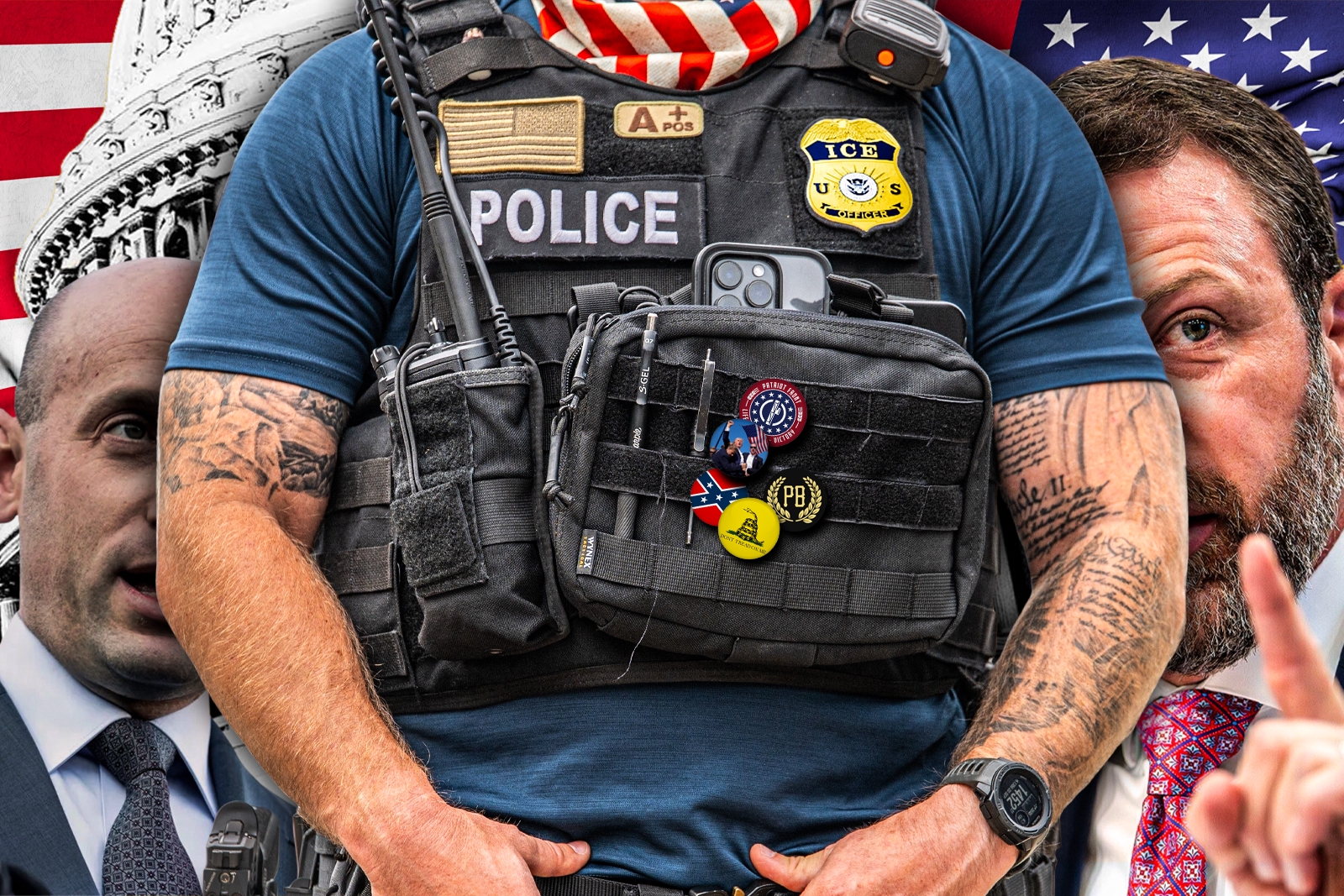

America is Building a National Police Force Through ICE
For roughly one day, the federal government appeared to recognize that something had gone badly wrong.
After Immigration and Customs Enforcement officers fatally shot drivers during separate operations in Houston and Maine, the agency suspended most vehicle stops while it reviewed its tactics. President Donald Trump reversed that decision the following morning, declaring the stops too important to abandon.
A safety measure adopted after two deaths vanished before ICE could complete an after-action review, determine what had failed, or retrain its officers. A consequential law-enforcement policy was imposed, withdrawn, and reinstated in approximately 24 hours—not through a disciplined review process, but under political pressure and following a presidential social-media post.
The episode exposed a much larger problem. ICE is being transformed from a specialized immigration agency into a nationwide street-enforcement institution, even as its professional safeguards struggle to keep pace.
Congress has financed the machinery. The administration has supplied the mission. Neither has built an accountability system proportionate to the power being assembled.
Congress is Building an Institution, Not Funding a Surge
The scale of the investment is difficult to overstate.
The Congressional Research Service reports that the 2025 reconciliation law provided ICE with $74.85 billion in supplemental funding through fiscal year 2029, including $45 billion for detention capacity and $29.85 billion for operations and procurement. ICE’s regular appropriation for fiscal year 2025 was approximately $10 billion.
This was not merely a dramatic budget increase. It amounted to the capitalization of a permanent enforcement institution: detention centers, officers, vehicles, aircraft, databases, surveillance technology, government contractors, and partnerships with state and local police.
ICE says it hired approximately 12,000 officers and agents during the expansion. A Reuters analysis found that departures reduced the agency’s net workforce gain to about 6,200. Even the lower figure represents extraordinary growth in an armed federal force over a remarkably short period.
The comparisons are instructive. The FBI lists more than 13,700 special agents nationwide. The Drug Enforcement Administration’s published staffing data identifies approximately 4,650 special agents, while the Bureau of Alcohol, Tobacco, Firearms and Explosives reported 2,403 special agents in fiscal year 2025.
Their job categories and missions differ, but ICE’s gross hiring during a single expansion approached the size of the FBI’s entire special-agent corps and exceeded the combined agent workforces of the DEA and ATF.
ICE is not literally the nation’s largest federal law-enforcement agency. The Government Accountability Office identifies Customs and Border Protection, with more than 45,000 law-enforcement personnel, as the larger force.
But ICE is becoming one of the country’s largest armed federal institutions primarily devoted to enforcement within the American interior. Its officers operate on highways, in neighborhoods, at workplaces, and outside courthouses, often exercising civil immigration authority rather than investigating a specific federal crime.
That is an institutional transformation, not a temporary deportation campaign.
Growth Outran Vetting
A professional law-enforcement organization cannot be created simply by hiring people, issuing weapons, and placing them in vehicles. It requires rigorous screening, extensive training, supervised field experience, stable operational rules, and a culture in which restraint is treated as a mark of competence rather than weakness.
ICE’s rapid expansion strained those systems.
A Reuters investigation found that some recruits began working or attending the academy before their full background investigations had been completed. At least five trainees were reportedly dismissed after active warrants were discovered, two were flagged for suspected gang affiliations, and more than 200 recruits were removed during the hiring surge.
Not every blemish should disqualify an applicant. A lawsuit is not a conviction, financial hardship does not establish dishonesty, and an allegation does not prove misconduct. But such warning signs require careful investigation before the government entrusts someone with a firearm, a badge, and federal arrest authority.
The question became more urgent after the Associated Press reported that the officer involved in the Maine shooting had a documented history that included psychiatric hospitalizations, suicide attempts, protective orders, and allegations of violent conduct by family members.
That history does not determine whether the shooting was lawful, and mental illness alone should not disqualify anyone from public service. It does, however, raise legitimate questions about what ICE’s investigation uncovered, how the agency evaluated adverse information, and whether pressure to hire quickly overwhelmed the judgment required to hire well.
ICE should publicly explain its minimum qualifications, the experience required for armed positions, whether background investigations must be completed before operational deployment, and how allegations of prior misconduct are evaluated. These are ordinary questions of police administration, not partisan attacks.
Training was shortened when it should have been strengthened.
ICE officers approach occupied vehicles, enter homes, conduct workplace operations, carry firearms, and make split-second decisions about the use of force. Yet as the agency rapidly enlarged this workforce, it reduced its basic academy program from 72 days to 42.
After mounting criticism, Homeland Security Secretary Markwayne Mullin announced that ICE would restore the 72-day program beginning July 1. ICE maintained that the shortened course still covered firearms, constitutional rights, and de-escalation, but the decision to revive the longer program suggests that speed had overtaken professional development.
Even 72 days is modest preparation for officers expected to conduct high-risk operations in uncontrolled public settings. By comparison, ATF special agents ordinarily complete 12 weeks of general criminal-investigator training followed by 15 weeks of agency-specific instruction.
The duties are not identical, but the underlying principle is the same. Officers entrusted with coercive federal power need repeated, scenario-based training in approaching vehicles, avoiding crossfire, observing constitutional limits, de-escalating confrontations, providing emergency medical assistance, and recognizing when disengagement is the safest course.
The vehicle-stop reversal illustrates the danger. A mature law-enforcement institution studies a critical incident, preserves evidence, interviews participants, consults instructors, and changes policy only after determining what went wrong. It does not redesign a high-risk tactic through a television announcement followed by a presidential social-media post.
Political urgency is not police protocol. An agency can expand quickly. It cannot manufacture sound judgment at the same speed.
Cameras Should Have Come Before Expansion
The absence of body cameras during the Texas and Maine shootings may be the clearest evidence that ICE expanded its street operations before establishing the basic infrastructure of accountability.
Congress had already provided $20 million for Department of Homeland Security body cameras, yet the ICE officers involved in the Houston shooting had not been issued them. DHS subsequently promised that every ICE field office would receive cameras within 60 days.
But equipping an office is not the same as equipping every officer. Under the plan described to Axios, each arrest team apparently needs only one officer wearing a body camera.
One camera cannot necessarily capture what another officer sees, says, or does. Every ICE officer participating in an arrest, vehicle stop, or planned enforcement operation should be required to wear and activate one.
Body cameras are not anti-police. They protect officers against false accusations, preserve evidence, strengthen prosecutions, improve supervision, and allow the public to assess conflicting accounts. They are particularly important when officers use unmarked vehicles, conceal their identities, or operate under a federal chain of command that local voters have no power to remove.
A government capable of spending nearly $75 billion to expand an enforcement agency can afford to document what its officers do.
Weber’s Warning
Max Weber, the German sociologist whose work helped define the modern understanding of bureaucracy, recognized both its efficiency and its danger. His central insight was that bureaucracy is built to endure.
Once a government creates offices, careers, budgets, procedures, and institutional constituencies, the machinery develops its own reasons to preserve and expand itself. In a 1909 discussion of social bureaucratization, Weber asked how society could restrain the bureaucratic machine and protect individual freedom from its growing power.
Congress may believe it has financed a temporary response to an immigration emergency. History suggests otherwise. Detention centers acquire contractors and congressional constituencies. Officers build careers. Databases accumulate information. Local police departments grow dependent on federal reimbursements. Surveillance systems begin searching for additional purposes.
A future president may reduce deportation targets. The machinery will remain.
That should concern Americans on both sides of the immigration debate. Supporters of vigorous enforcement should want officers who are carefully selected, thoroughly trained, and protected by reliable evidence. Critics should recognize that an institution backed by nearly $75 billion will not simply vanish when political control changes hands.
Congress should require completed background investigations before operational deployment, comprehensive academy instruction followed by supervised field training, a body camera on every officer, independent reviews of critical incidents, and regular public reporting on uses of force, complaints, mistaken arrests, and disciplinary actions.
America is not merely expanding an immigration agency. It is constructing a permanent national enforcement institution.
Before that bureaucracy becomes too entrenched to reconsider—and too powerful to control—it must be made professional, transparent, and accountable.