Assad Is Gone. Russia Isn’t.
For decades, the Assad regime served as Russia’s most dependable Arab ally, a relationship that hardened into something closer to strategic dependence after the uprisings of 2011. When Syria’s civil war erupted, Moscow poured resources into keeping Bashar al-Assad in power and enlarging its own footprint across the Eastern Mediterranean, culminating in the 2015 intervention that it framed as a campaign against ISIS and other Islamist militants.
The dividends were concrete: a durable naval presence at Tartus, an air hub at Khmeimim, and a logistical corridor that later functioned as connective tissue for the former Wagner Group’s operations in Africa. Russian firms, meanwhile, secured lucrative promises tied to Syria’s postwar reconstruction, including leverage over oil-producing assets and related contracts.
Then, in December 2024, the Assad government collapsed into the hands of Hay’at Tahrir al Sham (HTS), an outcome that seemed, at least on paper, to put nearly all of Russia’s gains at risk. Yet within months, Moscow not only preserved its bases and much of its economic relationship with Damascus, but also saw the new government invite Russian patrols as a stabilizing force along parts of Syria’s southern frontier.
The speed of that reversal poses a question worth taking seriously: how did Russia normalize relations with former enemies so quickly, and what does that tell us about the post-Assad order?
Part of the answer lies in the uncomfortable geometry facing Damascus. Even with Washington’s favor, the new Syrian leadership found itself wedged between two militarily entrenched neighbors with competing objectives: Israel in the south and Turkey in the north. The fragility of the fledgling regime, and the violence that flared between Islamist fighters and minority communities—Alawite, Christian, Druze—created openings for external “security” measures that were, in practice, assertions of control.
Israel moved to establish a buffer zone near the Golan Heights, closer to Israeli kibbutzes, justifying the move as protection for border communities and, implicitly, for Druze populations vulnerable to reprisals. Turkey, for its part, treated northern Syria as an extension of its own national security perimeter, maintaining dozens of military sites and pursuing a long campaign against Kurdish forces.
Ankara also worked to deepen influence inside the Syrian armed forces, including by elevating loyal officers whose allegiance to Damascus was, at best, conditional. Saudi Arabia and the UAE became important partners for the new authorities, but finance and diplomacy are blunt tools against rivals who can project force on the ground.
In this environment, Damascus had reason to seek a great-power counterweight that already had boots on the ground, runways, and leverage inside Syria. Russia was the obvious candidate.
Moscow’s own behavior after Assad’s fall was calibrated to keep options open rather than burn bridges. Russia provided Bashar al-Assad and his family with shelter, reinforcing its reputation as a patron that protects clients to the end—a pattern visible in earlier cases, including the former Ukrainian President Viktor Yanukovych.
But the Kremlin did not attempt an immediate restoration of the old order, nor did it try to roll back HTS by force. It was consumed by the war in Ukraine, and in any case, a Syria do-over would have been strategically reckless. Instead, Russia adopted a wait-and-see posture, quietly negotiating over the status of its military infrastructure and economic stakes.
By April, a Russian representative at the UN Security Council was already positioning Moscow as a defender of Syrian sovereignty, arguing that Syria’s territorial integrity must not be called into question regardless of who is in power in Damascus. The remark was aimed squarely at Israel’s moves in the south, but it served a broader purpose.
Russia signaled it could still function as Syria’s diplomatic shield at the UN. At the same time, the new authorities in Damascus gained a pathway to legitimacy and an argument for reinvention—away from their earlier branding as “Al-Nusra terrorists,” a label Russian officials had repeatedly emphasized.
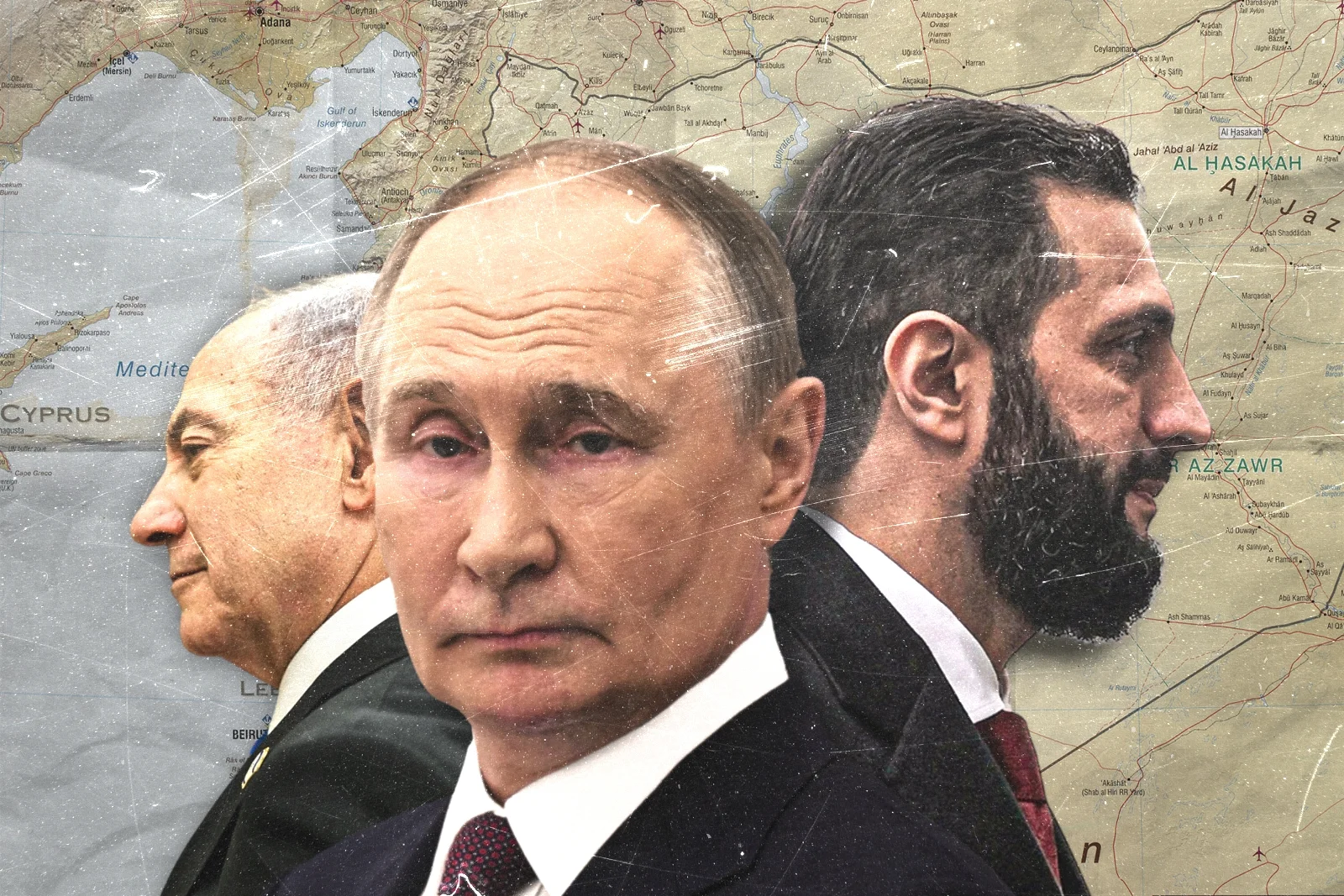
The negotiations culminated in Ahmed al-Sharaa’s visit to Moscow and his meeting with Vladimir Putin. According to Deutsche Welle, Damascus agreed to preserve the treaties signed under Assad, including those governing Russia’s bases; in return, Moscow pledged not to rearm remaining Assad loyalists and offered assistance in rebuilding the Syrian army under the new government.
For Israel, Turkey, and Saudi Arabia, Russia’s partial restoration is an uneasy paradox. Each, in different ways, sought Assad’s removal and the rise of a more Western-friendly government in Damascus—an outcome that would have weakened Iran’s so-called Axis of Resistance and reduced Tehran’s reach in the Levant.
Russia’s 2015 intervention helped frustrate those ambitions, extending Assad’s rule and, by extension, Iran’s influence for nearly a decade. And yet, in the post-Assad landscape, Russia has also become one of the few actors plausibly positioned to prevent Syria from devolving into a direct battlefield for regional powers.
Turkey does not want Israel absorbing Druze villages in the south, even if Israel casts annexationist moves as protective. Israel does not want Turkey to entrench itself from the north toward the country’s center, building new bases that could shift the strategic balance against it. Saudi Arabia, meanwhile, does not want its investments and financial leverage in Syria sacrificed to Israeli security doctrine or Turkish expansion.
Iran—and the broader anti-Western bloc often described as the Russia–China–Iran–North Korea alignment—has no interest in watching Syria slide cleanly into the Western orbit. In that crowded arena, Moscow’s utility is not that it can restore the past, but that it can arbitrate among competing futures.
In the best-case scenario for the Kremlin, Russia emerges not as Syria’s master but as its indispensable mediator, capable of dampening regional rivalries and, eventually, facilitating a recalibrated relationship between Damascus and Tehran—one that preserves Syrian sovereignty without simply trading one dependency for another.