

Brexit Poll Shows Buyer’s Remorse
A major new polling report suggests that British voters across the political spectrum—including many who support Reform UK—now believe the United Kingdom’s decision to leave the European Union has had a negative impact on the country.
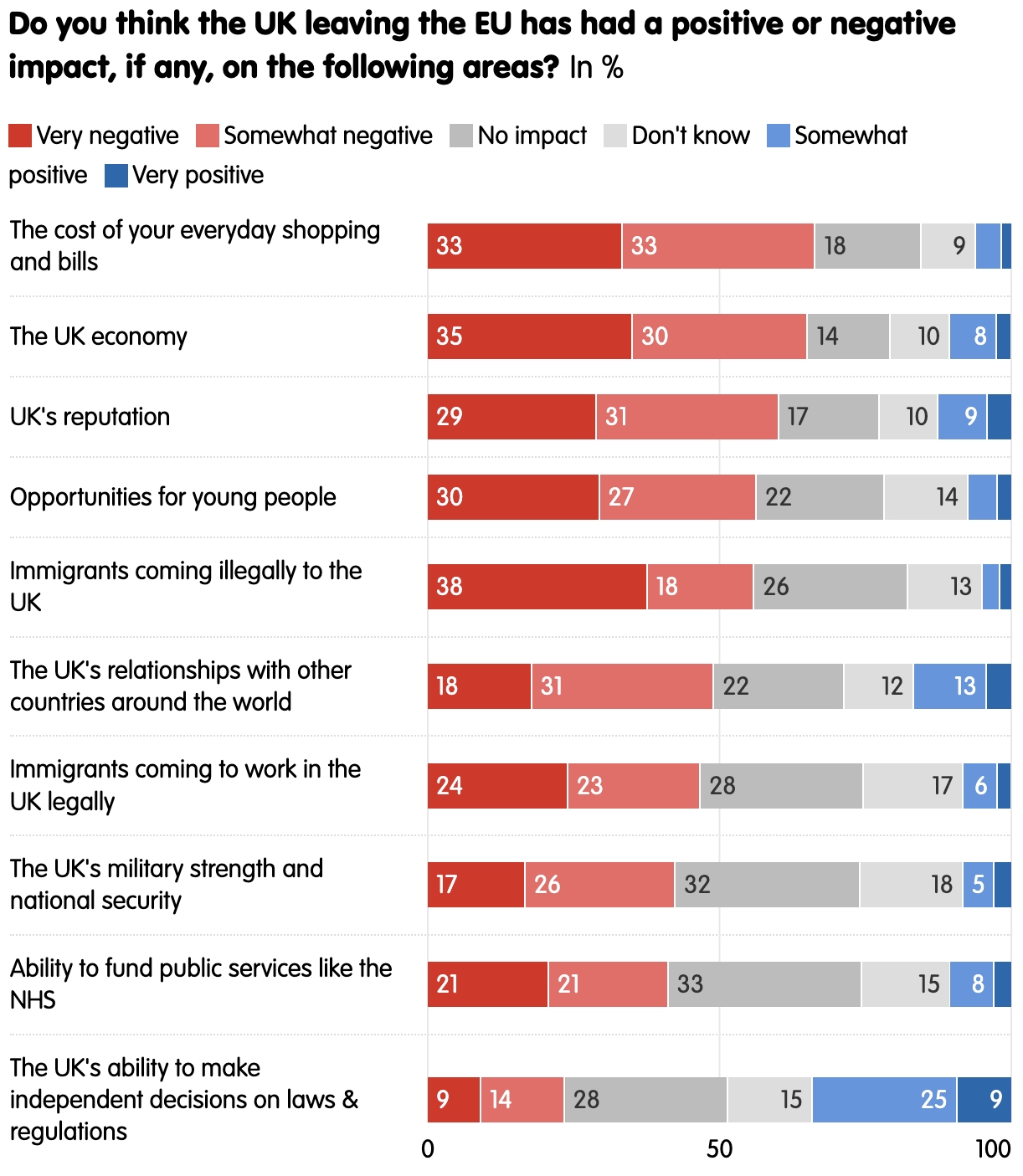
According to the survey, Brexit is increasingly viewed as having worsened many of the issues that defined the original referendum campaign. Respondents cited its effect on the cost of living (66% negative), the economy (65%), opportunities for young people (57%), and even efforts to tackle illegal immigration (56%).
The polling was conducted by the European Council on Foreign Relations (ECFR) and published on the eve of the tenth anniversary of the Brexit referendum on June 23. Released shortly after Andy Burnham’s decisive election victory in Leave-voting Makerfield in northwest England, the findings suggest that a growing majority of Britons now favour a closer relationship with Europe.
Commissioned through Mandate Research and YouGov between May 7 and May 14, the study consisted of four rounds of independent fieldwork involving samples of 2,210, 2,134, 2,126, and 2,146 respondents respectively.
Among the most striking findings is that 75% of British voters would prefer a closer relationship with the EU and increasingly see Europe, rather than the United States, as the UK’s most important strategic partner. The survey found majority support for closer economic integration, the reintroduction of freedom of movement, and the development of a European nuclear deterrent independent of Washington. A plurality of respondents also expressed support for British participation in a future European army.
The report’s authors argue that support for greater European integration now cuts across many of the divisions that once defined the Brexit debate. Even among those who voted Leave in 2016, 57% now say they would accept freedom of movement, while only 66% say they would vote to remain outside the EU if another referendum were held today.
For ECFR founding director Mark Leonard, the findings point to a profound shift in public attitudes since 2016 and suggest that Europe has become a political opportunity rather than a liability for the government.
In an interview, Leonard argued that the public has largely moved beyond the binary divisions that have dominated British politics for the past decade.
“While Westminster obsesses about the divide between remainers and leavers, the public have started to move on, thinking about how to live in a world that looks very different from 10 years ago. Brexit divisions should be treated like the battle between ‘roundheads and cavaliers’—historically important but not a guide to the future.”
Leonard contends that the familiar labels of “Leave” and “Remain” no longer explain political behaviour as effectively as they once did. Instead, he identifies three emerging voter blocs that better capture how Britons now view the country’s place in the world.
The first group, which he describes as “Optimists,” represents roughly 28% of the electorate. Younger, wealthier, and disproportionately male, this constituency is heavily concentrated among Labour, Green, and Liberal Democrat supporters. Optimists are particularly concerned about the cost of living and tend to view closer European cooperation as a geopolitical necessity in an increasingly unstable world.
The second group, labeled “Realists,” accounts for around 35% of voters. Politically diverse and demographically balanced, Realists are motivated primarily by concerns over immigration and living costs. While they favour closer ties with Europe, they also continue to see the United States and Commonwealth countries as natural partners. This bloc includes significant numbers of Conservative, Labour, Liberal Democrat, Green, and Reform UK supporters.
The third category, “Loners,” comprises approximately 27% of the electorate. Older, predominantly male, and heavily represented among Reform UK voters, this group places a premium on national sovereignty and immigration control. Members of this bloc are more likely to favour maintaining or even increasing Britain’s distance from Europe while seeking security partnerships beyond the EU.
Rather than revisiting the arguments of 2016 or returning to what Leonard describes as outdated models such as Norway or Switzerland, he argues that political leaders should develop an entirely new case for European cooperation—one centred on lowering living costs, strengthening energy security, and improving migration enforcement.
“To succeed,” he argues, “policymakers must overcome their fear of reopening old wounds and act quickly to seize fleeting international windows of opportunity, such as the final months of Emmanuel Macron’s presidency or the systemic shocks of the Trump administration.”
The survey’s findings suggest that the public may be receptive to such an approach.
A majority of Britons now believe Brexit has negatively affected almost every major issue they care about. Two-thirds say it has worsened the cost of living, while similar numbers cite negative effects on the economy. Majorities also believe Brexit has harmed opportunities for young people, increased trade barriers and bureaucracy, and weakened efforts to tackle illegal immigration.
Perhaps most notable is the finding that 58% of Brexit voters themselves believe leaving the EU has exacerbated problems related to illegal migration, an issue that sat at the heart of the original referendum campaign. When respondents were asked to identify the principal benefits of Brexit, the most common answer by a considerable margin was “don’t know,” followed closely by “none of the above.” Overall, 57% of those surveyed now believe it was wrong for Britain to leave the European Union.
The polling also reveals a strong appetite for closer relations with Europe. Nearly three-quarters of voters favour a closer relationship with the EU, while only 8% would prefer a more distant one. Economic cooperation appears particularly popular, with 46% supporting closer economic ties compared with just 13% opposed. Even among Reform UK supporters, advocates of stronger economic links outnumber opponents by more than two to one.
The survey further suggests that British attitudes toward security and defence are changing. Only 18% of respondents now regard the United States as Britain’s primary ally, while majorities increasingly view countries such as France, Germany, Poland, and Spain as partners that share common interests and values.
When asked about defence cooperation, 58% favoured closer security ties with Europe compared with 19% who preferred deeper alignment with the United States. Nearly half said they would turn to the EU for assistance in a crisis, while only 10% would look first to Washington. Even among Conservative voters, support for closer strategic cooperation with Europe now outweighs support for stronger ties with the United States.
The same pattern emerges on energy and technology. Majorities favour closer European cooperation on energy security and digital services, while more than 60% support a “Buy European” approach over purchasing additional military equipment from the United States.
Pluralities also back more ambitious forms of cooperation, including common European borrowing to finance defence spending and participation in collective security efforts in the Baltics or Ukraine. Perhaps most strikingly, nearly two-thirds of respondents say they would support reducing Britain’s dependence on the United States and participating in the development of an alternative European nuclear deterrent.
The survey also points to a significant shift in attitudes toward migration and freedom of movement. More than half of respondents believe Brexit has negatively affected the government’s ability to control illegal immigration, while 40% say there were fewer migrants arriving in small boats before Brexit.
That perception cuts across party lines. Significant numbers of Labour, Green, Liberal Democrat, Conservative, and Reform UK voters all believe migration pressures were lower before Britain left the EU, suggesting broader support for deeper cooperation with European partners on border management and enforcement.
The perceived failure of post-Brexit immigration policy appears to have transformed attitudes toward freedom of movement as well. Two-thirds of respondents—including 45% of those who voted Leave in 2016—say they would now accept freedom of movement, while only 18% remain opposed. Even among voters who identify immigration as their top concern, a plurality would support freedom of movement if it came as part of a closer economic relationship with Europe.
On the question of rejoining the EU, the survey finds that progressive voters are increasingly united while conservative voters remain divided. Labour, Liberal Democrat, and Green supporters overwhelmingly favour closer ties and eventual reintegration into European structures.
Conservative voters, by contrast, appear increasingly fragmented. Around one-third would now support a future vote to rejoin the EU. The divisions are particularly visible among those who abandoned the Conservatives after the 2024 election, many of whom moved either to Reform UK or the Liberal Democrats. Yet majorities within both groups still support closer relations with Europe.
The report also examined attitudes across the European Union itself. According to a separate ECFR survey conducted in 15 EU member states, support for Britain’s eventual return remains remarkably strong.
Across the bloc, an average of 66% of respondents would welcome the UK back into the European project. That figure exceeds support for maintaining the current relationship and significantly outpaces opposition to renewed integration. Support ranges from 56% in Bulgaria and 59% in both France and Italy to 75% in the Netherlands and Denmark, where nearly half of respondents strongly favour British re-entry.
Perhaps unexpectedly, supporters of several European right-wing parties also expressed positive views toward closer UK-EU relations. Majorities of voters backing Poland’s Confederation, Germany’s AfD, and France’s National Rally all favour stronger ties with Britain, while most also regard the UK as either an ally or an essential partner.
Reflecting on the findings, Leonard argues that the political meaning of Brexit has changed dramatically over the past decade.
“Ten years ago, Brexit was the insurgent vehicle for a nation rejecting the status quo. However, a decade on, Brits realise their hopes for a better life outside the EU are going unfulfilled and that Brexit is undermining the UK’s ability to manage the issues voters care about most. This data shows that the vast majority of citizens is open to a closer relationship. Rather than refighting the battles of 2016, the government must push for a new relationship with Europe that speaks directly to the everyday concerns of citizens on cost of living, migration and security,” Leonard said.
“Rather than talking about red lines, we should have a green light to a debate about how Europe can help rebuild the UK and its global influence for the 2030s and 2040s.”