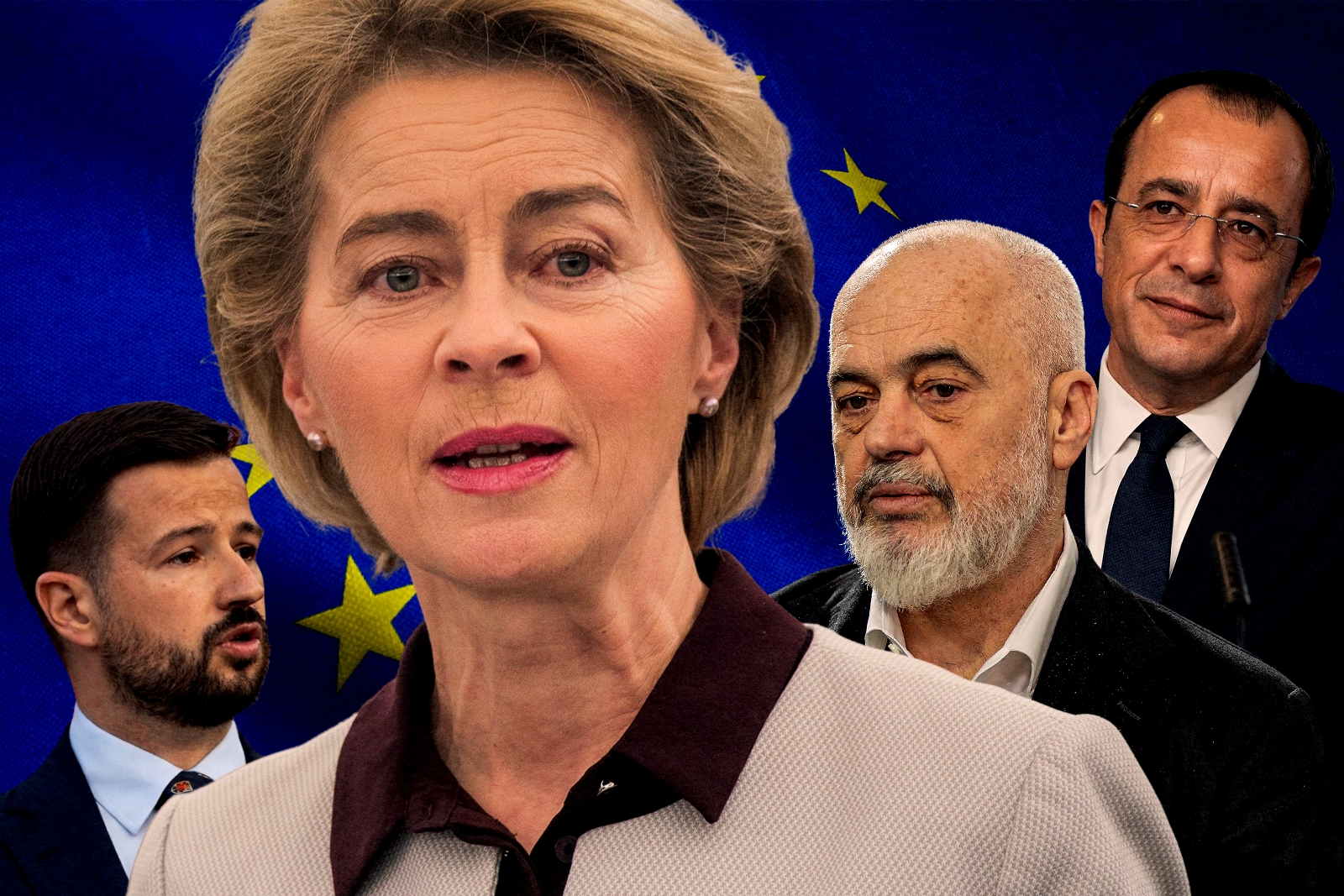

Can the EU Expand Without Compromising its Principles?
For years, European Union enlargement has hovered somewhere between aspiration and exhaustion. What once felt like an unstoppable widening of the bloc—now 27 member states strong—gradually gave way to what Brussels insiders began calling “enlargement fatigue.” The project had expanded quickly and, some argued, unevenly. Then came a cascade of crises: a global pandemic, economic shocks, and wars still raging on Europe’s doorstep. Enlargement slipped down the agenda.
Now, however, it is back.
Antonio Costa, president of the European Council, has recently reasserted that expansion remains a strategic priority. At a late-2025 summit with Western Balkan leaders, Costa declared that countries such as Albania “belong” in the European Union. Enlargement, he insisted, remains “central to our shared objectives” and must proceed as a merit-based process—“not a race or a competition between candidates.” Those that move faster, he said, should set the pace for the rest.
Costa has gone further, calling this the first European Commission mandate since 2010–2014 in which enlargement is again a “realistic possibility.” Cyprus’s president, Nikos Christodoulides, echoed that sentiment upon assuming his country’s rotating EU presidency, arguing that the Union must remain open to the world.
Among the Western Balkan hopefuls, Albania and Montenegro are widely seen as frontrunners. Both have been praised in Brussels for accelerating reforms and advancing through negotiating chapters at a brisk pace. This week, members of the European Parliament’s influential Committee on Foreign Affairs (AFET) traveled to Podgorica and Tirana for a fact-finding visit to assess the state of accession talks and the reforms still outstanding.
Leading the delegation was veteran German center-right lawmaker David McAllister, who made clear that the rule of law remains decisive. “The rule of law is a fundamental pillar of the European Union and an essential criterion for Albania’s EU accession process,” he said in an interview. Albania, he acknowledged, has taken meaningful steps in judicial reform. But concerns persist over consistent implementation, judicial independence, and the effective separation of powers.
In particular, he highlighted the continued use of pre-trial detention. “Pre-trial detention must remain an exceptional measure,” he said, “applied only when strictly necessary, proportionate, and subject to rigorous judicial oversight.” Sustainable progress, he added, will determine Albania’s trajectory toward membership.
Parliamentary officials described the visit as an opportunity to evaluate reform priorities and reaffirm the legislature’s support for both countries’ European paths. But behind the formal language lies a sharper debate: whether Albania’s justice reforms are delivering not just institutional redesign but tangible safeguards for fundamental rights.
One flashpoint is the detention of Erion Veliaj, the three-term mayor of Tirana.
This month marks one year since his arrest—an episode his supporters describe as unjust and emblematic of deeper problems within Albania’s judicial system. Veliaj, 46, was detained in February 2025 on corruption and money laundering charges. He denies wrongdoing and has argued that he was held for months without formal charges. In November, Albania’s Constitutional Court rejected attempts to remove him from office, affirming his mandate through 2027.
His case has become a litmus test for Albania’s reform credentials.
According to recent figures, roughly 58 percent of Albania’s prison population—about 2,653 individuals—are being held in remand. That proportion is significantly higher than the EU average. Pre-trial detention in Albania reportedly lasts an average of 253 days, compared with roughly 155 days across EU member states. The World Organisation Against Torture has warned that the high rate of remand detention contributes to significant prison overcrowding.
Veliaj’s international counsel, Ben Brandon of the London law firm Mishcon de Reya, argued in an interview that the detention is unjustified. Regardless of the allegations, he said, Veliaj is a democratically elected mayor with strong ties to the country and every incentive to participate in legal proceedings. Continued detention, Brandon contended, undermines both his ability to govern and to defend himself effectively.
At the heart of Albania’s reform architecture is SPAK—the Special Structure Against Corruption and Organized Crime—established between 2019 and 2020 as an independent anti-corruption authority. Widely praised in Brussels, SPAK has become the centerpiece of Albania’s judicial overhaul.
Yet critics argue that independence must be matched by procedural rigor. A report co-authored last year by the New York law firm Kasowitz LLP claimed that SPAK escalated its investigation of Veliaj by detaining him on unspecified allegations before formally announcing charges months later. The report concluded that the case raises troubling questions about due process.
More broadly, veteran commentator Paul Taylor, formerly of Reuters, observed that the EU has demonstrated over the past year that combating corruption and safeguarding anti-corruption bodies are central accession conditions. He pointed to the Commission’s public warnings to Ukraine’s President Volodymyr Zelensky last summer when legislation appeared to threaten the independence of Ukraine’s anti-corruption agency—evidence, Taylor suggested, that Brussels is willing to intervene when institutional autonomy is at stake.
Concern over Veliaj’s detention has also spread across the region. The mayors of 76 municipalities within the B40 Balkan Cities Network issued a joint letter warning that prolonged pre-trial detention of sitting mayors represents a “dangerous trend” that threatens local democracy.
They cited findings from the Venice Commission, the Council of Europe’s constitutional advisory body based in Strasbourg. In a 2025 report, the Commission warned that using pre-trial detention against elected mayors risks disenfranchising voters by sidelining their chosen representatives without due process. It noted that excessive detention may implicate multiple Convention rights.
At the same time, Brussels continues to signal confidence in Albania’s overall direction. The European Commission’s 2025 Rule of Law Report praised significant progress toward meeting the accession criteria, highlighting continued judicial reforms and the vetting of judges and prosecutors as measures that strengthen accountability. Commission President Ursula von der Leyen commended Albania’s “tremendous” progress, while Costa lauded Tirana for opening all negotiating clusters in a notably short period, including the final ones in November 2025.
Even so, Members of the European Parliament across party lines insist that reforms must deepen.
Lithuanian MEP Petras Auštrevičius, Parliament’s rapporteur on enlargement, argued in an interview that concerns about pre-trial detention demonstrate why judicial reforms must produce real results in citizens’ daily lives—not merely legislative change on paper. There can be no shortcuts on EU values, he said, though he remains confident that Albania can meet the necessary standards with sustained effort and EU support.
Others are more skeptical. Danish lawmaker Anders Vistisen contends that justice systems in some candidate states remain seriously deficient and warns that pre-trial detention can serve as political pressure or financial punishment. Irish MEP Barry Andrews, by contrast, insists that Albania’s future lies within the EU—provided it fulfills all rule-of-law requirements.
Austria’s Andreas Schieder, Parliament’s rapporteur on Albania, stressed that achieving membership by 2030 will require not only judicial reform but economic diversification, job creation, and inclusive electoral reform. SPAK, he said, plays a crucial role in fighting corruption and demonstrates governmental seriousness. Yet investigations must also be followed by swift judicial processes.
José Antonio Moreno Díaz, president of the Fundamental Rights and Rule of Law Group within the European Economic and Social Committee, expressed concern after visiting Albania that judicial independence remains fragile despite reform efforts.
Edward McMillan-Scott, a former vice president of the European Parliament, describes Albania as entering 2026 with a mixed human rights record even as accession expectations grow. High-profile prosecutions, he argues, have raised questions about selective justice and prosecutorial independence—vulnerabilities that matter when compliance with core European human rights treaties is under scrutiny.
Willy Fautre, director of Human Rights Without Frontiers, points to statistics showing that around 58 percent of Albanian prisoners are awaiting a final court verdict—far higher than the roughly 20 percent typical across EU states. The duration of detention, he adds, is also longer than the European average.
For Denis MacShane, a former British Europe minister, the principle is straightforward: any candidate country must be in full conformity with Council of Europe conventions and the rulings of the European Court of Human Rights. Human rights protection, he argues, cannot be optional.
Shada Islam, founder of the advisory firm New Horizons Project, sees risk in the growing political momentum behind Albania’s accession timetable. The fact that senior EU figures are publicly setting early deadlines, she argues, reflects a troubling lack of attention to human rights and democratic standards. If enlargement proceeds for geopolitical reasons while overlooking systemic weaknesses, it could damage both Albania and the EU’s credibility as a normative power.
Yet even among skeptics, there is recognition that enlargement carries strategic weight. Giles Merritt, founder of the Brussels think tank Friends of Europe, suggests a potential compromise: accession with limited rights and responsibilities that expand over time as a new member demonstrates sustained adherence to EU values. Such a phased approach, he argues, could balance geopolitical urgency with institutional caution.
Albania’s government and its mission to the EU were approached for comment, but did not respond before publication.
For now, Albania enjoys considerable goodwill in Brussels. Its negotiating chapters are opening; its leaders speak the language of reform; EU officials signal encouragement. But enlargement, as Costa reminded Western Balkan leaders, is merit-based. The question facing Albania is whether its justice reforms—particularly in the sensitive realm of pre-trial detention—will convince a skeptical Europe that belonging is not merely a political declaration, but a legal and democratic reality.