
Christopher Nolan Has Become Bigger Than His Movies
Vanity Fair’s revived New Establishment list for 2026 seeks to measure something more consequential than celebrity or personal wealth: hard power, the ability to reshape industries, influence institutions, alter behavior, and transform culture. Sam Altman occupies the top position, followed by Anthropic’s Dario Amodei and Elon Musk. Jensen Huang, political figures, financiers, and media executives dominate much of the remaining list. Christopher Nolan appears at number 26.
In a ranking populated largely by people who control artificial intelligence, capital, technological infrastructure, and political machinery, the presence of a filmmaker is revealing. Nolan has become something larger than a conventional director. His name now carries a kind of institutional authority. Studios finance enormous original productions around it. Audiences purchase tickets on the strength of it. IMAX has become inseparable from his public identity. His filmmaking techniques generate publicity long before a movie reaches theaters.
A Christopher Nolan film arrives with an established set of expectations, often before audiences know precisely what it is about. That is what happens when a director’s artistic identity evolves from a recognizable signature into an organizing principle for an entire industry.
Nolan’s path to this position is particularly revealing because his creative identity did not emerge from commercial scale. Following, released in 1998, was produced with minimal resources, largely on weekends. Yet the techniques that would eventually define productions costing hundreds of millions of dollars were already evident: fractured chronology, carefully withheld information, unreliable perspectives, and narrative structures that contribute to meaning rather than merely contain it.
Memento, released two years later, refined that approach. Its protagonist cannot form new long-term memories, and the audience is denied the reassuring continuity of conventional storytelling. The film’s reverse chronology does more than demonstrate technical ingenuity. It forces viewers into an uneasy relationship with evidence, memory, and causality. The story cannot be separated from the mechanism through which it is experienced. Nolan had discovered something more enduring than a distinctive visual style. He had developed a recognizable method of organizing perception.
That distinction is essential. Many filmmakers possess identifiable visual signatures. Nolan has something closer to an identifiable operating logic. Memory in Memento, obsession and duplication in The Prestige, symbolic identity in his Batman trilogy, nested realities in Inception, relative time in Interstellar, reversed causality in Tenet, and moral fragmentation in Oppenheimer: the subjects change, but the pressure exerted on identity remains remarkably consistent.
His characters repeatedly confront the question of who they are within systems that make certainty difficult, sometimes impossible. Information is incomplete. Time becomes unstable. Roles consume the people who perform them. Ideas outlive their creators. Individuals who believe they control the systems around them frequently discover that those systems have begun transforming them instead.
The Batman trilogy gave Nolan the commercial scale to demonstrate that this approach could survive within one of Hollywood’s most valuable franchises. Batman Begins reconstructed Bruce Wayne around fear, discipline, theatricality, and the deliberate creation of a symbol. Bruce does not simply become Batman. He designs Batman as an identity capable of achieving what Bruce Wayne cannot.
The costume, voice, rumors, darkness, and seemingly inhuman qualities of the character form a carefully constructed public image. Gotham does not need to know the man beneath the mask. It needs to believe in the symbol. Batman therefore embodies one of Nolan’s most persistent concerns: the distance between an individual and the identity that individual creates for the world.
Then The Dark Knight introduced an adversary capable of attacking that construction at its most vulnerable point.
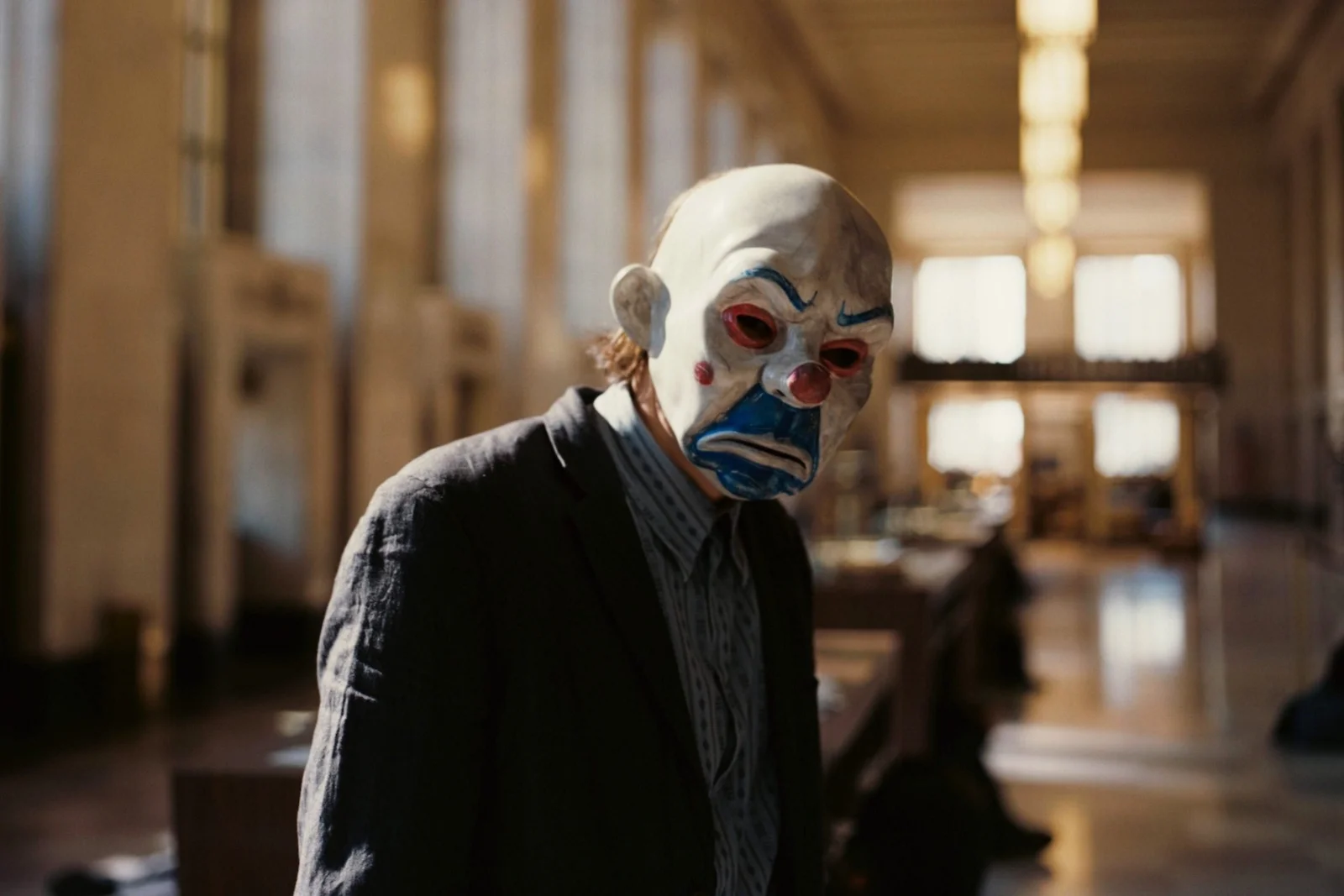
The Joker does not need Bruce Wayne’s biography. He has no particular interest in uncovering Batman’s childhood, discovering the Batcave, or creating a rival heroic mythology. Instead, he attacks the assumptions that allow Gotham’s identities to remain coherent.
Police officers can become criminals. Ordinary citizens can become killers. A district attorney can become a monster. A hero can be made to accept responsibility for crimes he never committed. The Joker’s most effective weapon is not violence alone, but interpretation. He creates circumstances, manipulates information, applies pressure, and waits to discover whether the identities people have constructed can withstand the consequences.
Batman creates a symbol intended to stabilize behavior. The Joker engineers situations designed to make those symbols collapse.
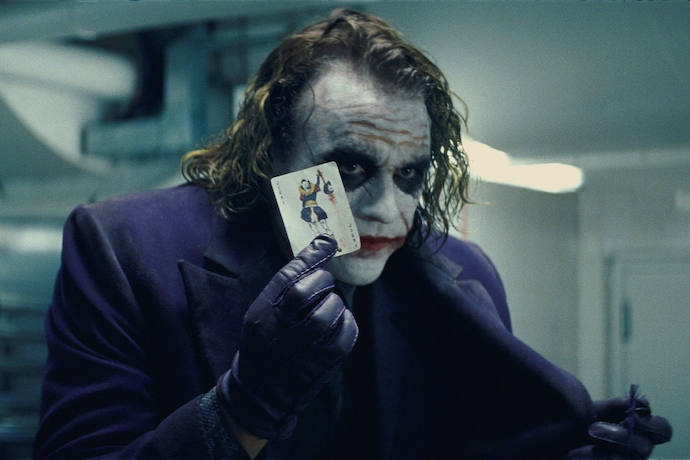
Heath Ledger gave that philosophical conflict a physical presence. His Joker has no reliable origin because every explanation he offers can be discarded. His scars acquire different histories depending on the audience. His clothing appears deliberately assembled without ever seeming polished. His makeup deteriorates as he wears it. His movements alternate between calculation and apparent improvisation. Even his voice resists easy classification.
Nolan and Ledger created a character whose power emerges from rejecting the ordinary requirements of identity. There is no dependable biography to expose, no reputation to destroy, no institution from which he can be expelled, and no future standing he appears interested in protecting. He can manipulate everyone else’s incentives precisely because conventional incentives have so little power over him.
For me, Ledger and Nolan’s Joker remains my favorite film character of all time. That preference has little to do with conventional rankings of villains according to menace, charisma, or popularity. The character represents an almost perfect demonstration of identity wielded as an asymmetric weapon.

Batman devotes extraordinary resources to constructing a controlled public identity. The Joker achieves comparable cultural power by making his identity impossible to define. One depends on coherence; the other weaponizes incoherence. Their conflict is compelling because both understand that Gotham is ultimately governed by what people believe about themselves, one another, and the symbols that shape their world.
Ledger died in January 2008, months before The Dark Knight reached theaters. His performance subsequently became inseparable from an extraordinary cultural moment. The film grossed slightly more than $1 billion worldwide, while Ledger received the Academy Award for Best Supporting Actor posthumously in February 2009. His father, mother, and sister accepted the award on his behalf.
The ceremony was marked by a standing ovation and an atmosphere of palpable grief. Members of the audience, including prominent actors, were visibly emotional. The response transcended the promotional machinery surrounding the film. A comic-book antagonist had become the center of one of Hollywood’s most emotionally charged awards moments.
The achievement also transformed Nolan’s position within the industry. The Dark Knight demonstrated that a demanding, morally ambiguous cinematic vision could succeed on an enormous commercial scale without surrendering its distinctive qualities to the conventions of franchise filmmaking.
With a production budget of approximately $185 million, the film crossed the billion-dollar threshold while remaining morally uncomfortable, narratively intricate, and resistant to the reassuring emotional resolution typically associated with superhero films.
Its financial success gave Nolan something more valuable than another box-office triumph: creative authority backed by commercial evidence. Once a studio can see that a filmmaker’s distinctive approach is capable of attracting enormous investment and delivering equally enormous returns, that approach becomes part of the institution’s calculations about risk.
The consequences became apparent in Nolan’s subsequent work.
Inception attached a substantial studio budget to an original screenplay about dreams nested within dreams, with different layers of reality moving at different speeds. It asked millions of viewers to follow an elaborate structure involving architecture, memory, guilt, simulation, and competing experiences of time without reducing its underlying complexity to conventional exposition.
Its ending famously withholds the certainty audiences have been conditioned to expect. The spinning top became a lasting cultural image because Nolan understood that unresolved interpretation could extend a film’s life beyond the theater.
A definitive ending settles a question. Carefully constructed ambiguity allows the question to continue circulating, inviting audiences to debate, reinterpret, and revisit the work. In that sense, viewers become participants in the film’s cultural afterlife.
Interstellar expands the same preoccupations into the cosmos. Time becomes both a physical dimension and an emotional burden. Identity must endure separation experienced differently by the people involved. Tenet pushes causality to such extremes that viewers must abandon their ordinary understanding of temporal sequence.
These films differ enormously in setting and subject, yet Nolan continues returning to the same underlying problem: what remains stable when the framework through which people understand reality ceases to behave as expected?
His methods of production reinforce that artistic identity beyond the stories themselves. Nolan’s preference for practical effects, large-format film, and physically constructed environments has been discussed so extensively that technique has become part of his public reputation.
The rotating corridor in Inception, the real Boeing 747 used in Tenet, and the practical techniques employed to represent the Trinity test in Oppenheimer are filmmaking decisions. But repeated across productions and amplified by media coverage, they become recognizable markers of an artistic philosophy.
Audiences who know little about cinematography nevertheless recognize that Nolan prefers to accomplish as much as possible physically. A technical preference has become shorthand for seriousness, scale, and a particular kind of commitment to the theatrical experience.
This is how a durable artistic identity acquires institutional power. Its reputation strengthens when different forms of evidence consistently reinforce the same underlying proposition.
Narrative structure establishes Nolan’s artistic philosophy. Production methods demonstrate it. IMAX reinforces it technologically. Studios endorse it financially. Actors validate it professionally. Audiences reward it commercially. Awards institutions eventually recognize it culturally.
None of these signals would be sufficient on its own. Together, they create a reputation that becomes increasingly difficult to imitate. A competing filmmaker might reproduce individual stylistic techniques, but replicating the network of commercial confidence, technological partnerships, audience loyalty, and institutional recognition is another matter entirely.
Oppenheimer made that accumulated authority impossible to ignore. Nolan took a historical drama centered on theoretical physics, political power, institutional paranoia, and moral responsibility and transformed it into a global theatrical event.
The Academy ultimately awarded the film Best Picture and Nolan his first Oscar for Best Director. The significance of that recognition lies partly in how long it took to arrive. By then, Nolan had spent more than two decades building commercial authority and attracting audiences across the world. Hollywood’s most prestigious awards institution was finally acknowledging a cultural influence that moviegoers had recognized years earlier.
Then Nolan turned to Homer.
I have deliberately avoided making The Odyssey the centerpiece of this analysis. The film generated so much anticipation that it threatened to overwhelm any broader discussion of Nolan’s career. Yet its marketing campaign, release, and subsequent commercial success offer perhaps the clearest demonstration of how far his influence has expanded.
Universal reportedly committed approximately $250 million to the production. The Odyssey became the first major feature shot entirely with IMAX film cameras, an achievement that required technological innovation as well as considerable financial investment.
More remarkably, selected IMAX 70mm tickets went on sale a full year before the film’s July 2026 release, an extraordinary departure from conventional Hollywood marketing. Approximately 95 percent of the available seats sold within the first day, with most purchased during the opening hour.
The enthusiasm translated into substantial box-office returns. IMAX accounted for roughly 23 percent of the film’s initial worldwide ticket sales, demonstrating how thoroughly Nolan had transformed a particular exhibition format into an essential component of the theatrical experience.
By November, The Odyssey had surpassed $1.17 billion internationally, becoming Universal Pictures’ highest-grossing international release. The achievement reinforced a remarkable commercial reality: Nolan could transform one of the oldest surviving works of Western literature into an enormous contemporary box-office attraction.
The projection format was no longer simply a technology used to present the finished product. Nolan had made the experience of watching the film, and the specific method through which audiences watched it, part of the product itself.
There was also a recognizable artistic logic to the adaptation. Homer’s ancient world was filtered through Nolan’s established language of monumentality, material scale, fractured perception, and carefully controlled revelation.
Odysseus is an almost suspiciously natural fit for those concerns: a man navigating false names, altered identities, unstable reputations, separation, memory, and the possibility of return. The ancient hero survives partly through his ability to manipulate how others perceive him. He is both a person and a story that changes according to who tells it.
Across his career, Nolan has repeatedly transformed familiar material into worlds governed by his own cinematic rules. Ancient Greece entered that machinery, and the machinery remained unmistakably recognizable.
This helps explain why a filmmaker occupies the 26th position on a Vanity Fair power ranking alongside people who control artificial intelligence companies, financial networks, political institutions, and technological infrastructure.
Nolan does not wield the same kind of power. He has cultivated something different: the ability to persuade enormous institutions to organize themselves around an artistic vision without requiring that vision to become conventional.
Thousands of directors can make a film. Far fewer can persuade studios, investors, technology companies, marketing departments, and audiences to reorganize their expectations around the particular way they make films.
At that point, the director is no longer simply working within Hollywood’s machinery.
The machinery is working around the director.