Business

Empty Tables, Not VAT, Are Britain’s Real Hospitality Crisis
Britain’s hospitality industry has once again settled on a familiar diagnosis for its deepening crisis: VAT is too high. A campaign backed by celebrity chef Tom Kerridge and the country’s leading hospitality trade groups has collected more than 300,000 signatures demanding that the government halve the tax on pubs, restaurants, and hotels from 20% to 10%.
The appeal is not difficult to understand. Businesses across the sector are being squeezed by higher wages, employer National Insurance contributions, food inflation, energy bills, and stubbornly weak consumer demand. The #VATsTheProblem campaign was launched after Prime Minister Andy Burnham announced a 20% cut in business rates for pubs and live-music venues during his first week in office, intensifying calls for the government to go further.
The latest industry-tracker survey, conducted by UKHospitality, the British Beer and Pub Association, the British Institute of Innkeeping, and Hospitality Ulster, captures the sector’s fragility. More than 70% of operators identified VAT, food-and-drink inflation, and rising staffing costs—including increases in the National Minimum Wage and employer National Insurance contributions—as the principal threats to hospitality businesses across the UK.
Yet Dev Biswal, one of Britain’s leading Indian chefs, argues that the industry may be concentrating on the wrong culprit. VAT is undoubtedly a burden, he says, but it is not the source of hospitality’s most fundamental weakness: too many restaurants struggle to make money even before the tax bill arrives.
For Biswal, the deeper problem is the erosion of customers’ spending power—particularly among the middle classes, who have traditionally sustained higher-end restaurants. As wealth has become increasingly concentrated among the very rich, he argues, everyone else has grown more cautious about discretionary spending. The result is visible not merely in balance sheets but in empty dining rooms.
That concern was shared by several prominent Indian chefs who gathered recently for the inaugural World India Restaurant Exchange at Atul Kochhar’s Kanishka restaurant in Mayfair, London. The exchange brings together chefs, restaurant founders, investors, and hospitality brands helping to shape the future of Indian dining around the world.
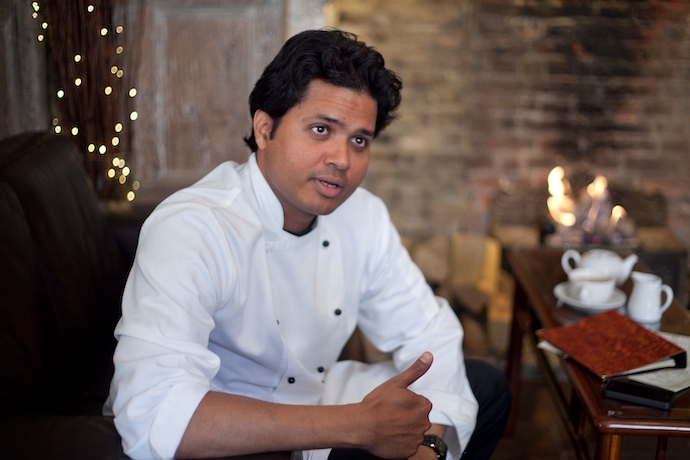
Biswal, the owner of The Cook’s Tale in Canterbury, has become an influential figure in British culinary circles. Raised in Orissa, India, and educated in Calcutta, he moved to London in 2003 at the age of 26. His many distinctions include the Regional Indian Cuisine Championship at the Indian Restaurant Congress & Awards.
During a recent interview, Biswal urged Burnham’s government to develop a “long-term commercial energy strategy” capable of giving hospitality businesses greater certainty.
“Every few years, the hospitality industry returns to the same debate: reduce VAT, cut tax, and save restaurants,” he told me. “A lower rate of VAT would undoubtedly help many businesses, but after operating restaurants every day, I believe we are asking the wrong question.”
The real issue, he argues, is not simply how much tax restaurants pay but whether their underlying business model remains viable.
“It is whether many restaurants are commercially viable before tax is even calculated. That is the elephant in the room. A business that loses money before VAT is added will still struggle after a VAT reduction. Tax relief treats a symptom; it does not cure the disease.”
Hospitality has endured what Biswal describes as a “perfect storm.” Energy prices remain well above historical norms for many commercial users, while food inflation has transformed the economics of menu pricing. Increases in the National Living Wage, higher National Insurance costs, and persistent recruitment pressures have pushed labour costs upward. Many operators are also servicing debts accumulated during and after the pandemic.
Then there is a burden that attracts far less public attention: the rising cost of technology.
“Modern hospitality businesses rely on EPOS systems, online reservation platforms, payment processing, Wi-Fi, accounting software, payroll software, HR systems, delivery platforms, marketing subscriptions, cybersecurity, and digital compliance,” Biswal said.
Each subscription can appear manageable on its own. Together, however, they can add thousands of pounds to a restaurant’s annual overhead before a single customer walks through the door. Technology may have made hospitality more efficient, but it has also created a new layer of unavoidable costs.
“As a restaurant owner, I worry far more about empty tables than VAT,” Biswal said. “A full restaurant can absorb many rising costs. An empty restaurant cannot.”
That distinction matters because a tax cut can improve margins only when customers are already coming through the door. Government policy, Biswal argues, should therefore aim not merely to keep businesses alive but to restore demand: reviving town centres, investing in tourism, improving transport links, and giving people compelling reasons to return to Britain’s high streets.
Energy policy is just as important. “Commercial energy deserves far greater attention,” he said. “Restaurants cannot simply switch equipment off.” Refrigerators, freezers, extraction systems, ovens, dishwashers, and ventilation equipment operate for long hours every day. Hospitality businesses need a commercial energy strategy that offers predictability rather than exposing them to repeated bouts of volatility.
Biswal also wants the government to modernise business rates. Independent restaurants no longer compete only with the establishments next door; they must contend with delivery-only kitchens and multinational digital platforms operating under markedly different cost structures. A tax system designed around physical premises, he argues, should reflect the realities of modern commerce.
The stakes extend well beyond restaurant owners. “Hospitality creates employment, trains young people, supports British farmers, fishermen, food producers, wholesalers, logistics companies, and tourism,” Biswal said.
Every successful restaurant generates economic activity far beyond its own turnover. Helping hospitality prosper is therefore not simply a rescue package for one beleaguered industry. It is an investment in local supply chains, high streets, and regional economies.
Biswal also owns Cafe Marrakech in Canterbury and leads culinary tours in Britain and abroad through his travel company, The Cooks Adventures. His restaurant has been recommended by the country’s leading restaurant guides, and he served as the resident chef on Channel 4’s Superscrimpers, demonstrating how to prepare gourmet meals on a budget.
But his prescription for the sector is more ambitious than a cheaper tax bill. “Rather than asking only, ‘Should VAT be reduced?’ I would encourage the government to ask a bigger question: ‘How do we make hospitality businesses commercially sustainable for the next 20 years?’”
The answer, he believes, includes a long-term commercial energy strategy, comprehensive reform of business rates, policies that increase town-centre footfall, support for British food production, investment in tourism, the sensible adoption of technology, and an economic environment capable of restoring consumer confidence.
“If those fundamentals improve, profitability improves,” Biswal said. “If profitability improves, investment follows. Jobs follow. Tax revenues then follow.”
A VAT reduction might offer struggling restaurants some welcome breathing room. But it cannot, by itself, fill empty tables, lower energy prices, revive depleted high streets, or restore household spending power. Britain’s hospitality industry does not merely need tax relief. It needs a durable strategy for profitability.