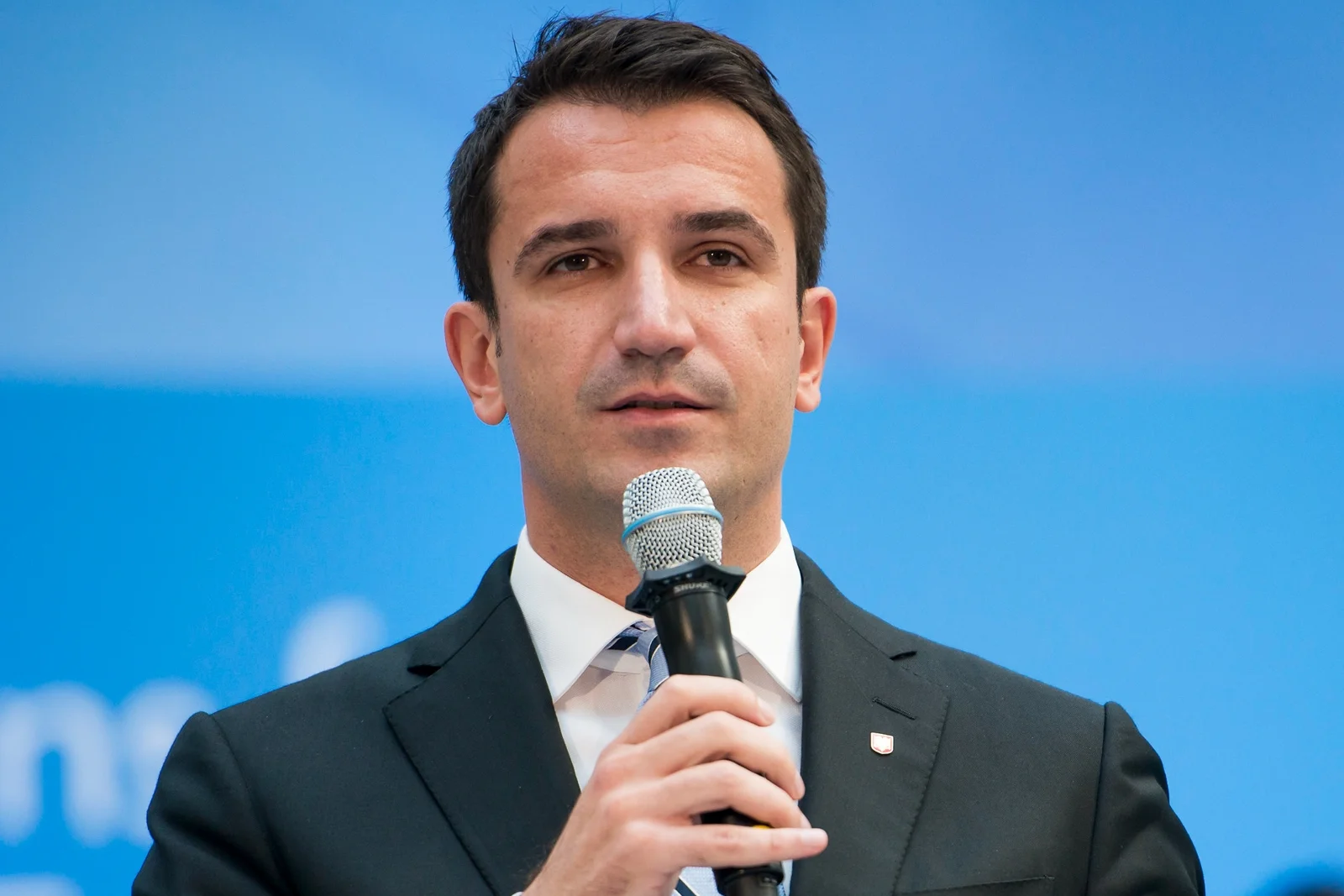

Erion Veliaj’s Detention Tests Albania’s EU Ambitions
He was once regarded as the rising star of Albanian politics, even touted as a future prime minister. Erion Veliaj’s fall from grace has been as swift as it was unexpected.
After winning three terms as mayor of Tirana, Albania’s bustling capital, Erion Veliaj now finds himself behind bars, at the center of an increasingly bitter legal battle and a steady stream of damaging headlines. To his supporters, the case is about far more than one politician. It raises uncomfortable questions about the rule of law in a country hoping to become one of the European Union’s next members.
Veliaj’s legal ordeal began in February 2025, when he was arrested on charges that included passive corruption, money laundering, and abuse of office. He strongly denies the allegations and any wrongdoing.
The case is being led by SPAK, Albania’s Special Prosecution Against Corruption and Organized Crime. The institution has won widespread praise for pursuing high-level corruption and serious crime, an effort considered essential if Albania is to meet the requirements of EU membership.
Yet Veliaj has remained in pretrial detention since his arrest, and his lawyers argue that the measure is grossly disproportionate. In recent weeks, the case has taken several consequential turns.
Most importantly, Albania’s Constitutional Court overturned a Supreme Court decision and ordered a fresh review of his detention. Veliaj has also been granted partial access to his London-based lawyers, although not to those in New York. The reason for that limited reversal is unclear, but it follows pressure from several rights organizations.
The latest hearing in the criminal proceedings against Veliaj took place on Tuesday, July 21, another stage in what has become a protracted and highly publicized saga.
Veliaj, a member of the Socialist Party, won a third consecutive term in the 2023 local elections with nearly 55 percent of the vote. He declined to attend Tuesday’s hearing in person because the court required him to participate from inside a glass enclosure rather than sit beside his lawyers, a practice questioned by the Constitutional Court.
Another hearing is scheduled for July 24. That proceeding was initiated by Veliaj, who is challenging the legality of the appointment of a prosecutor involved in the case and wants the appointment declared null and void.
SPAK’s campaign against entrenched corruption has been widely lauded, and its work remains central to Albania’s ambition of joining the EU by 2030. But the institution has said little publicly about the mayor’s prosecution. Approached for comment, a spokesperson said only, “At this stage, we will not be commenting on this matter.”
Reporting on the case on July 1, the Albanian Daily News cited a concurring opinion written by a judge involved in the proceedings. The judge argued that the lower courts had failed to establish reasonable suspicion supported by adequate evidence and that Veliaj’s continued detention violated protections under the European Convention on Human Rights.
Veliaj’s Tirana-based lawyer, Plarent Ndreca, explained how the case has affected his client’s ability to govern.
“Legally speaking, he remains the elected mayor and, in theory, continues to hold that office,” Ndreca said from Tirana. “In practice, however, it is extremely difficult for him to exercise his responsibilities effectively while being held in isolation.”
He continued: “The wholly disproportionate pretrial detention measure has directly impaired the exercise of his democratic mandate and, in practical terms, has suspended his ability to perform his functions, even though Article 242 of the Albanian Code of Criminal Procedure expressly prohibits a security measure from producing such an effect.”
Ndreca said the Supreme Court should now urgently reconsider the detention order. “Following the Constitutional Court’s judgment, the legal basis for maintaining Mr. Veliaj in detention has fundamentally changed.”
Asked how Veliaj was coping as his confinement approached its 19th month, Ndreca said the mayor was facing imprisonment with “remarkable courage, optimism and confidence.”
“Despite the serious shortcomings that, in our view, continue to exist within the Albanian justice system in terms of compliance with European Convention standards, he remains convinced that his rights will ultimately be vindicated,” Ndreca said.
“He believes that he will soon regain his liberty, enabling him to defend himself as a free citizen while also fulfilling the democratic mandate entrusted to him by the people of Tirana.”
Although the case has been widely covered in Albania, it has received relatively little attention elsewhere. Even so, it lands at a delicate moment for the country’s EU aspirations. Albania is among the leading Western Balkan candidates for membership, possibly by 2030, and has been praised for the pace of its reform program. The rule of law and the independence of the judiciary, however, remain indispensable tests of its readiness.
Erida Skëndaj, executive director of the Albanian Helsinki Committee, a respected human rights organization, said excessive pretrial detention is a systemic problem.
“It is true that in the Albanian judicial system the use of pretrial detention is excessive, and we have expressed our concern, especially about vulnerable groups and for ordinary offences, for example, for the theft of a wallet,” she said.
But Skëndaj also cautioned against using that broader problem to prejudge an individual case. “This is a general concern that cannot be related to specific cases that are subject to appeals or other legal remedies before domestic and international courts.”
Veliaj’s detention is nevertheless beginning to attract more notice abroad. A July 20 article in CNE News, or Christian Network Europe, called the growing international attention “significant.” It said that because Veliaj had been largely cut off from the outside world and limited to visits from immediate family members and his lawyer, “one may only assume that his faith serves as a source of strength.”
The article recalled a speech Veliaj delivered to Christian leaders in Tirana last Christmas. “I believe that God tests us in each of these experiences,” he said. “It tests us in war, it tests us in pandemics, it tests us in earthquakes, it tests us where our limits are, how willing we are to behave as brotherhood and not as customers.”
Albania’s rule-of-law record has also surfaced in debates unrelated to Veliaj. A delegation of Green members of the European Parliament recently visited the country to examine threats to the Vjosa-Narta protected area, the planned Vlora airport, and luxury-tourism developments around Sazan and Zvërnec. The visit had no connection to the mayor’s case, but the delegation’s language underscored how closely democratic standards are tied to Albania’s membership bid.
“This is a crucial moment for Albania’s EU accession path,” the Greens/EFA Group said, adding that “a country moving towards EU membership must align with the EU acquis, respect the rule of law and protect nature.”
Tineke Strik, the Greens/EFA negotiator on the European Parliament’s report on Albania, said public anger extended beyond environmental destruction to “the corruption and organised crime behind it.” Albanians, she said, “want a government that takes care of their interests. They want a democracy like in any other European country.”
Vula Tsetsi, co-chair of the European Green Party, cast the environmental dispute as a broader test of democratic accountability.
“This is not just an environmental issue,” Tsetsi said during the visit. “It is a test of whether the rules that we all live by apply equally to everyone, including the rich, and those in power. The European Commission cannot look away while our fundamental values are breached. It has a responsibility to ensure that countries seeking EU membership fully respect the rule of law, democracy and the principles on which the European Union is built.”
A June 30 article in the U.S.-based Newsmax, focused more directly on Albania’s EU credentials, offered further evidence that Veliaj’s case is gaining attention overseas.
“The contested nature of corruption allegations in Albania becomes particularly evident in the case of Erion Veliaj,” it said. “Despite facing no convictions, his continued imprisonment has prevented him from engaging in the political activities that established him as one of Albania’s most popular politicians.”
The case has also prompted comparisons with that of Istanbul’s elected mayor, Ekrem İmamoğlu, who was suspended from office and has remained in pretrial detention since 2025 on corruption, bribery, and misconduct charges that he strongly denies. The cases are legally unrelated, but both have sharpened concerns about what happens when criminal proceedings effectively remove a popular elected official from public life before a conviction.
Those concerns are magnified by Albania’s unusually heavy reliance on pretrial detention. As of November 2025, the country’s prison population stood at 4,578, with 58 percent of prisoners awaiting trial. The rate—94.6 pretrial detainees per 100,000 people—was reportedly four to five times the EU average.
In January, 76 mayors signed a joint letter issued through the B40 Balkan Cities Network calling for an end to the practice. The letter described the extensive use of pretrial detention as a “dangerous trend” that “threatens” local democracy in the Balkans and beyond.
The Venice Commission, the Council of Europe’s advisory body on constitutional law, has previously warned that using pretrial detention against elected officials can pose a serious threat to democratic governance and the rule of law. Rights groups have voiced similar concerns, arguing that proceedings against elected representatives demand particular vigilance over fair-trial guarantees and judicial independence.
Veliaj has served as mayor of Tirana since 2015 and is now in his third and final term. He says he is considering an appeal to the European Court of Human Rights in Strasbourg.
Daniel J. Fetterman, Veliaj’s lead international counsel in New York, told me in an interview that “personal liberty cannot be restricted without rigorous judicial scrutiny and faithful adherence to constitutional safeguards.”
Fetterman argues that Veliaj’s continued detention “cannot constitutionally be sustained” and hopes the courts will order his “immediate release.”
For now, the politician once tipped as Albania’s next prime minister remains in the Durrës detention center, waiting for the courts to decide not only his liberty but, in practical terms, the fate of the democratic mandate Tirana’s voters handed him. His case will not by itself determine Albania’s European future. But it has become an uncomfortable measure of the country’s ability to fight corruption without allowing detention before trial to become punishment before judgment.