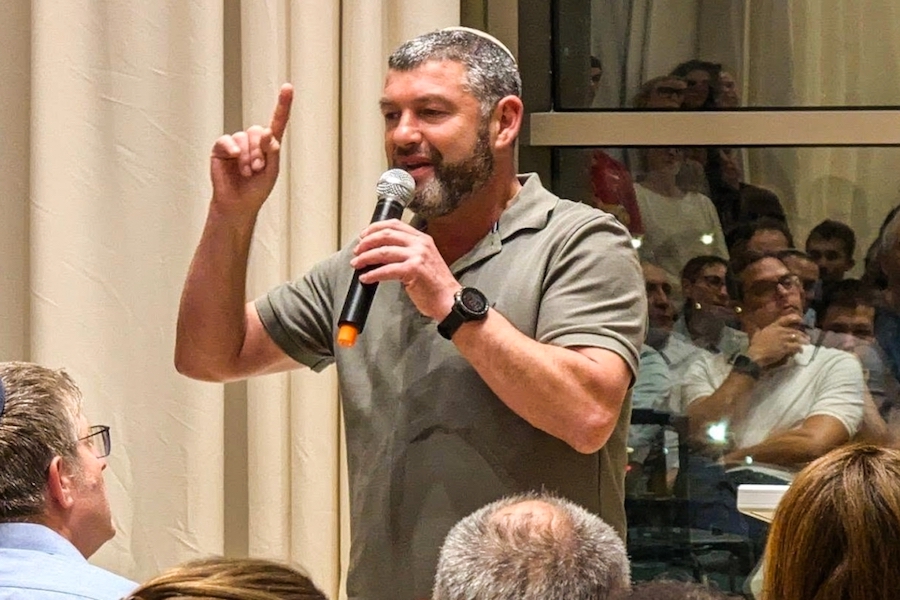

From Battlefield Commander to Political Challenger: The Rise of Ofer Winter
For most of his adult life, Ofer Winter operated within the rigid hierarchy of the Israeli military, where orders were issued, missions executed, and leadership measured by decisions made under pressure. The political arena, however, operates by a different set of rules.
In August 2026, the retired Israeli brigadier general traded military command for electoral politics, launching Amcha Yisrael, a new right-wing party that promised to challenge Israel’s political establishment and redefine its national priorities.
Winter presented himself as something of a political outsider, a figure whose understanding of leadership emerged from decades of military service rather than the compromises and calculations of parliamentary politics.
Born in 1971 in Rechasim and raised in Kiryat Ata, Winter grew up in northern Israel before attending the Or Etzion military boarding school and the Bnei David pre-military academy in Eli.
He enlisted in the Israel Defense Forces in 1990, beginning a career that would take him through some of the country’s most prominent combat units.
View this post on Instagram
Winter served in the elite Sayeret Matkal reconnaissance unit and Maglan before rising through command positions in the Givati Brigade. He later commanded the Duvdevan undercover unit and eventually assumed command of Givati itself.
His most prominent military role came during the 2014 Gaza war, known in Israel as Operation Protective Edge.
As Givati’s commander, Winter led troops during intense fighting, including controversial operations around Rafah. His military leadership brought national recognition, but his conduct and public statements also attracted considerable criticism.
In a letter to his officers, Winter portrayed the conflict in explicitly religious terms, prompting concerns about the place of religious ideology within Israel’s military. The controversy would follow him throughout his career.
He subsequently served as chief of staff of the IDF’s Central Command, military secretary to the defense minister, and commander of the 98th Division.
Despite his extensive operational experience, Winter never attained the rank of major general. His military career ended in 2024 after repeated failures to secure further promotion, leaving unanswered questions about his relationship with the military establishment.
His political ambitions emerged against the backdrop of a national crisis that fundamentally reshaped Israeli debates about security, leadership, and accountability: the Hamas-led attacks of October 7, 2023.
At his party’s launch in Jerusalem on August 25, 2026, Winter argued that Israelis deserved a different generation of leaders, one untainted by the failures that preceded the attacks.
Amcha Yisrael adopted an uncompromising nationalist platform, rejecting Palestinian statehood, advocating the voluntary emigration of Palestinians from Gaza, and proposing changes to military conscription, judicial policy, and national governance.
The party also unveiled an unconventional slate of candidates, including Arab-Israeli activist and IDF veteran Yoseph Haddad, whose inclusion reflected Winter’s efforts to appeal beyond traditional religious and nationalist constituencies.
Winter’s political arrival presented a potential complication for established right-wing parties, particularly Prime Minister Benjamin Netanyahu’s Likud. Yet Winter subsequently pledged to support Netanyahu for prime minister, underscoring the complicated relationship between political competition and ideological loyalty.
His transition from general to politician raises a broader question about the relationship between military authority and democratic leadership.
Military command demands discipline, strategic judgment, and the ability to make consequential decisions. Democratic politics requires a different set of skills: negotiation, compromise, coalition-building, and accountability to an electorate whose interests rarely align.
Winter enters politics with considerable name recognition, an established ideological identity, and a military record that inspires admiration among supporters and skepticism among critics.
But the qualities that define a successful commander do not necessarily produce an effective politician. Winter’s next challenge will be proving that authority earned on the battlefield can translate into legitimacy at the ballot box.