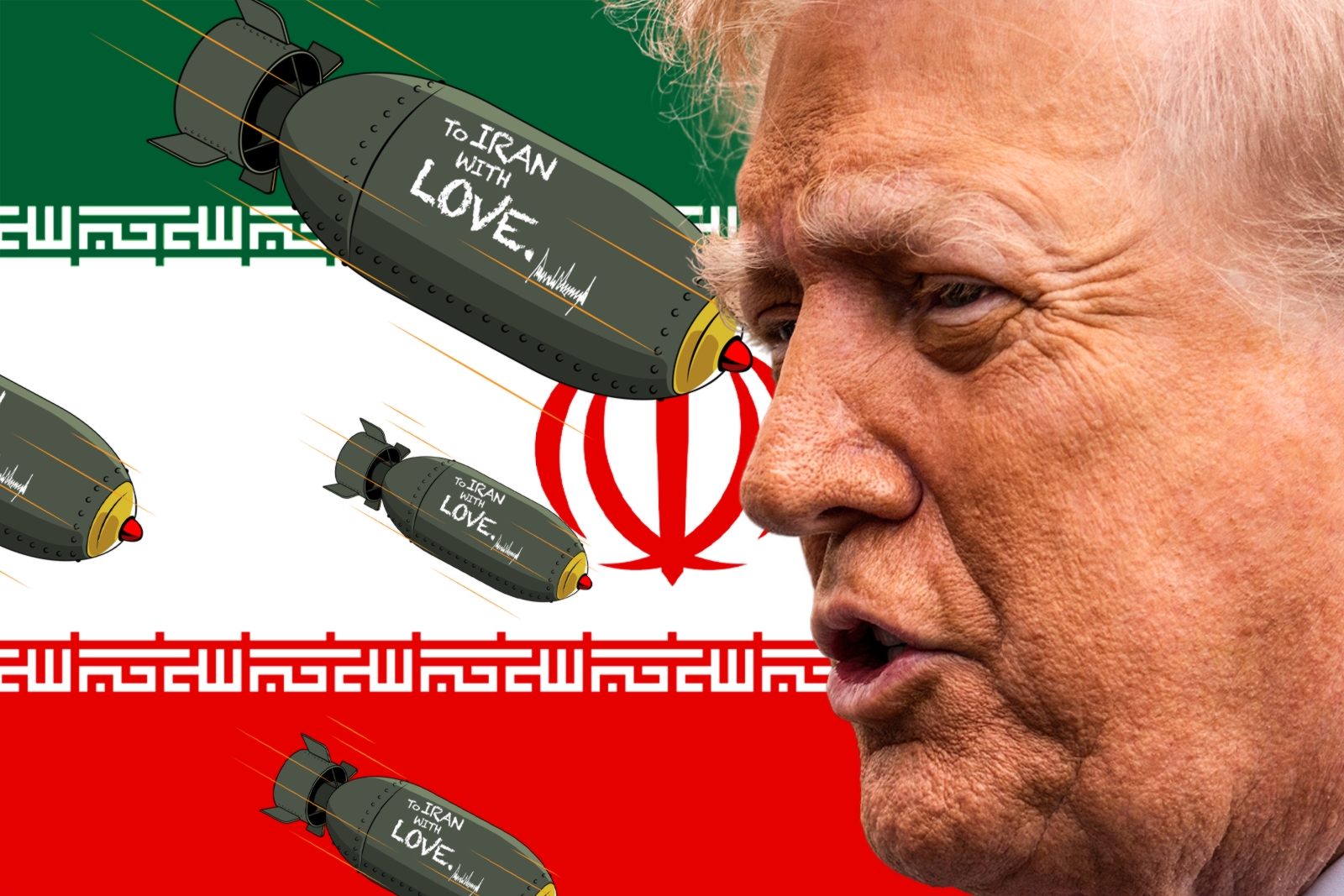

Going Native in the Trump Jungle: How it became Legal to Attack Iran
The allies of the United States have gone native, feral, even, in the jungle of international relations cultivated by President Donald J. Trump. While Western capitals continue to denounce Russia’s war against Ukraine for its shattering of international law and its brazen disregard for the United Nations Charter, the Israeli-U.S. attack on Iran has been met not with outrage but with indulgence. Washington’s client states and loyal supporters have offered, if not applause, then a conspicuous silence.
Countries such as the UK, France, Germany, Australia, and Canada were unequivocal on February 24 in endorsing a UN General Assembly resolution backing Ukraine in the face of Russia’s violation of Article 2(4) of the UN Charter. That provision explicitly “prohibits the threat or use of force,” calling on Member States “to respect the sovereignty, territorial integrity and political independence of other States.” No comparable defense of those principles has been mounted regarding the assault on Iran that began on February 28.
Most pitiful in this repudiation of the Charter are the so-called “middle powers,” a term as flattering as it is evasive—rather like middle management. Australia and Canada stand out here, eager to wish themselves into irrelevance when the stakes involve the integrity of international law. This posture is particularly striking given Canadian Prime Minister Mark Carney’s insistence that like-minded states must band together to rescue the crumbling rules-based international order once cherished under Pax Americana. Speaking at the World Economic Forum’s annual meeting in Davos, Carney extolled the virtues of being principled and pragmatic, which he said included valuing “sovereignty, territorial integrity, the prohibition of the use of force, except when consistent with the UN Charter.” Yet none of this principle was evident in the joint February 28 statement issued by Carney and Foreign Affairs Minister Anita Anand: “Canada supports the United States acting to prevent Iran from obtaining a nuclear weapon, and to prevent its regime from further threatening international peace and security.”
Each craven position has its own stylistic quirks. Australia’s is calibrated to suggest that abstention absolves responsibility. Not participating in the strikes, Canberra implies, spares it from having to consider their legality. “Obviously,” Foreign Minister Penny Wong said on March 1, “Australia did not participate in these strikes.” But the government nevertheless endorsed “action to prevent Iran from obtaining a nuclear weapon and to prevent Iran from continuing to threaten international peace and security.” The distinction is thin enough to be translucent.
The United Kingdom has gone further still, embracing revisionism outright. In a March 1 statement, the government of Sir Keir Starmer explained its commitment to the conflict not by addressing the legality of the initial attack on Iran, but by reframing events around Tehran’s response. The problem, in London’s telling, was not that Iran had been pre-emptively and unlawfully attacked, but that it dared to retaliate against regional powers hosting U.S. military bases and personnel. Britain would therefore undertake “defensive action,” at Washington’s urging, by targeting “missile facilities in Iran which were involved in launching strikes on regional allies.” It would also act “in the collective self-defence of regional allies who have requested support.” Any propaganda minister in history might have admired the elegance of that formulation.
The justificatory rhetoric now circulating could, if adopted as a template, be deployed against a wide array of regimes. Do they violate human rights, crush lawful assembly, fire on protesters? Are they theocracies, governed by martial law, or entrenched police states? Do they meddle in their regions, pose “imminent” threats, destabilize fragile balances? On this logic, the constraints embedded in the UN Charter—respect for territorial integrity, Security Council authorization, self-defense narrowly construed—fade into technicalities. Principles become optional; force becomes discretionary.
With such abandon, one could justify eliminating leaders, commanders, senior officials, provided one remains selective about which theocracies, autocrats, and strategic partners deserve indulgence. That selectivity now resides with Trump, who has personalized international relations with such theatrical force that allies appear cowed into compliance. To condemn the strikes on Iran as illegal risks frostier treatment: punitive tariffs, sanctions, exclusion from intelligence sharing, the quiet severing of cooperative ventures. Be agreeable to Donald, or face the bite. Better yet, be hostile to those he has marked for disfavor.
An important component of the apologias for attacking Iran has been the anecdotal sampling of opinion from segments of the Iranian diaspora in Canada, the United States, Australia, and Europe. Images of flag-waving and, in some quarters, ghoulish celebration over the reported death of Iran’s Supreme Leader, Ayatollah Ali Khamenei, have been offered as moral ballast. The brutality of Iran’s security apparatus in suppressing protests is real and well documented. Yet what tends to go unmentioned are the likely aftershocks: internal fragmentation, intensified factionalism, regional spillover, and the possibility that external attack may strengthen the very hard-liners it seeks to weaken.
The immediate international consequences have already proved combustible. Protests against the killing of Khamenei have erupted in several Islamic states, in some cases, met with lethal force. In Pakistan, security forces reportedly killed 10 in Karachi, eight in Skardu, and two in Islamabad. These deaths barely register in Western corridors of power, perhaps because they complicate the narrative or fall outside the preferred frame of relevance.
History offers warnings that appear, at present, unfashionable. The U.S.-led invasion of Iraq in 2003 and the NATO intervention in Libya in 2011 both stand as cautionary episodes, though they seem to hold little interest for the ahistorical outlaws roaming the Trump Jungle. The aggression against Iraq underscored the utility of inflated threats—most notoriously, Weapons of Mass Destruction that were never found—and the subsequent debacle of occupation and nation-building. Libya provides a particularly sharp analogue, given the aerial character of the current Israeli-U.S. campaign against Iran.
In Libya, a NATO coalition intervened in a civil war ostensibly to protect civilians from the forces of Muammar Qaddafi. “When crisis erupted in Libya,” Sir John Sawers, former chief of Britain’s Secret Intelligence Service, reflected in 2015, “we didn’t feel it right to sit by as Qaddafi crushed decent Libyans demanding an end to dictatorship.” Yet Britain and its partners “didn’t want to get embroiled in Libya’s problems by sending in ground forces.” The operation, initially framed as civilian protection, evolved into overt support for anti-government militias. Qaddafi was overthrown and lynched. Libya fractured among rival factions and remains divided. It became a haven for al-Qaeda and Islamic State elements operating across North Africa. “Libya,” Sawers later acknowledged, “had no institutions. Who or what would take over? The answer? Those with the weapons. Result? Growing chaos, exploited by fanatics.” The parallels are difficult to ignore.
The conduct of European and transatlantic officials has been no less dispiriting. NATO Secretary General Mark Rutte’s conspicuous deference, along with the stance of European Commission leaders Ursula von der Leyen and Kaja Kallas, signals a shift toward a doctrine that privileges force over diplomacy and treats international law as pliable. It is almost embarrassing to read the European Union’s calls for de-escalation when the primary escalators were Israel and the United States, even as Brussels insists that diplomacy still has a role. Iranian officials were, by all accounts, engaged in talks and reassured that further negotiations would follow. The result now looks less like strategy than a confidence trick—one that may further erode Western credibility when addressing future crises, whether actual or perceived. In the Trump Jungle, legality bends to preference, and preference to power.