Science

How Much is the Moon Worth?
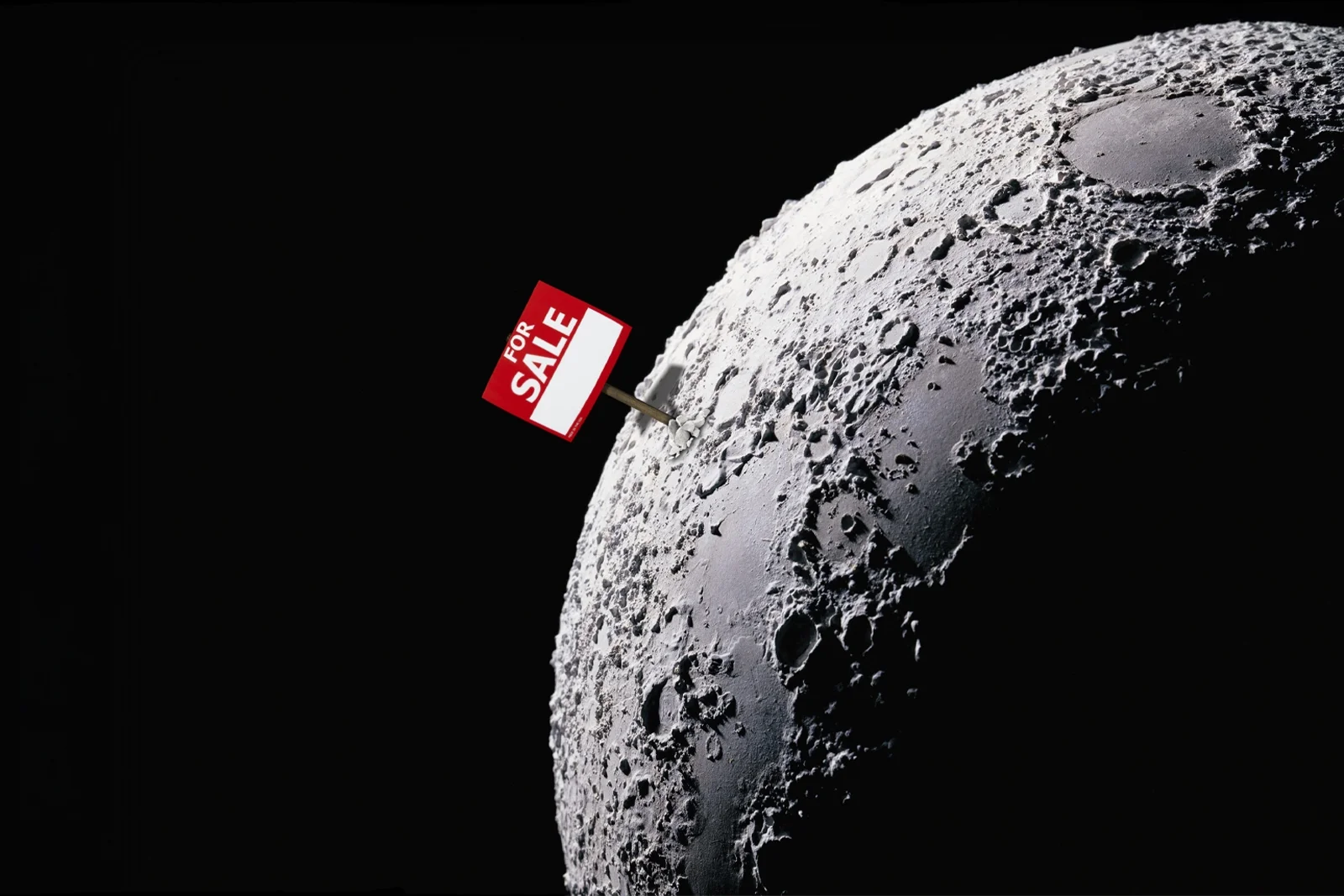
The Moon may be on the verge of becoming the most valuable asset humanity has ever encountered—not in poetry or symbolism, but in the hard arithmetic of economics.
Estimates drawn from its mineral composition—particularly helium-3, rare earth elements, and other strategic metals—place its theoretical value somewhere near $5 quadrillion. The number is almost absurd in scale. For context, the United States produces roughly $27 trillion in annual output, China about $18 trillion, and the global economy as a whole approximately $105 trillion. The Moon, in other words, represents a store of potential wealth that eclipses the entire terrestrial economy many times over.
In practical terms, no state, corporation, or financial system currently in existence could absorb, manage, or meaningfully control an asset of that magnitude without fundamentally transforming the architecture of the global economy itself. And yet, for all the attention such figures command, the most consequential question is not economic. It is legal.
The foundation of modern space law rests on the Outer Space Treaty, a Cold War–era compact designed less to enable commerce than to prevent catastrophe. Drafted in 1967, it sought to keep outer space from becoming another theater of military competition. It established that space is the “province of all mankind,” prohibited national sovereignty over celestial bodies, and mandated that exploration be conducted for peaceful purposes.
At the time, these principles were both ambitious and stabilizing. Today, they are increasingly strained.
The treaty is notably silent on one of the central questions now confronting policymakers: who owns what is taken from space. It does not clearly regulate the ownership of extracted resources, nor does it delineate the legal boundaries of private commercial activity. The result is a structural ambiguity at the heart of the system. While no nation may claim the Moon itself, it remains unresolved whether states—or the corporations they authorize—can claim the materials removed from its surface.
In recent years, governments have begun to test those boundaries. The United States has enacted legislation recognizing the rights of its nationals to own and profit from space resources they extract. Other countries have followed with similar measures. These efforts attempt to fill the gaps left by international law, but they also risk splintering it, creating a patchwork of competing legal regimes rather than a coherent global framework.
What emerges is a growing tension between the principle of non-appropriation and the realities of economic ambition. That tension is no longer theoretical. It is unfolding alongside an accelerating, and increasingly consequential, race back to the Moon.
Major spacefaring powers—including the United States, China, the European Union, and India—are investing heavily in lunar missions, infrastructure, and long-term habitation strategies. NASA’s Artemis program aims explicitly to establish a sustained human presence on the lunar surface. China, in parallel, has outlined plans for a joint international lunar research station, signaling both scientific ambition and geopolitical intent.
At the same time, private industry is reshaping the pace and scale of what is possible. Companies such as SpaceX and Blue Origin are developing launch systems and lunar technologies at a speed that would have seemed implausible even a decade ago. Costs are falling, access is expanding, and the once-distant horizon of lunar resource extraction is drawing closer.
This convergence—state power paired with private innovation—marks a decisive shift. The Moon is no longer merely an object of scientific inquiry. It is becoming an economic frontier.
The principle that outer space constitutes the “common heritage of humankind” remains a powerful normative ideal. But it is just that—an ideal. It lacks any operational mechanism for distributing the benefits of resource extraction. If and when lunar mining becomes viable, access will not be determined by legal equality but by technological capability, financial capital, and geopolitical leverage.
In practice, this suggests that a small number of states and corporations could come to dominate resources whose theoretical value exceeds that of the global economy itself.
That possibility raises a cascade of unresolved questions. Can a common heritage framework function without enforceable systems of redistribution? Can private appropriation coexist with a legal regime that prohibits sovereignty? Who adjudicates disputes that arise beyond Earth’s jurisdiction? At present, international law offers no clear or coherent answers.
History provides a sobering precedent. On Earth, the law has rarely preceded the rush for resources. More often, it has followed in the wake of power. From colonial expansion to deep-sea mining, legal frameworks have tended to emerge only after control has already been established and inequalities entrenched.
The Moon presents a rare opportunity to invert that sequence—to construct a legal order before large-scale exploitation begins. But that window is narrowing.
Absent a coordinated international framework, the extraction of lunar resources risks replicating familiar patterns: concentrated wealth, fragmented regulation, and intensifying geopolitical rivalry. The difference, this time, is scale. The stakes are not regional or even global. They are planetary.
The Moon is no longer simply a distant object of curiosity or a canvas for cultural imagination. It is, increasingly, a potential economic system, a geopolitical arena, and a test case for whether law can keep pace with technological ambition.
Its estimated value, measured in quadrillions, is staggering. But the more pressing question is not how much it is worth. It is whether the rule of law can assert itself before the logic of power does.