
How North Korea Learned to Love Clausewitz
North Korea’s approach toward South Korea, the United States, and Japan is often explained through the familiar concepts of nuclear deterrence, regime survival, or military provocation. While those interpretations are not wrong, they are incomplete. A more useful way to understand Pyongyang’s behavior is through the concept of strategy itself: the coordinated use of political, military, psychological, and diplomatic tools to achieve political objectives without necessarily crossing the threshold into all-out war.
Perhaps Carl von Clausewitz’s most famous observation is that war is not an autonomous military activity but rather “the continuation of politics by other means.” For North Korea, that idea is not an abstract principle confined to military theory. It is a practical guide to statecraft. Missile tests, nuclear signaling, cyber operations, propaganda campaigns, and arms transfers are not isolated actions. They form parts of a single political-military campaign designed to weaken alliance cohesion, manipulate perceptions of risk, and improve North Korea’s bargaining position.
This logic becomes especially dangerous as the prospect of a dual contingency in East Asia grows more plausible. Such a scenario would involve a Chinese invasion or blockade of Taiwan occurring simultaneously with opportunistic North Korean provocations on the Korean Peninsula. Recent analyses have warned that concurrent crises in the Taiwan Strait and the Korean Peninsula would place unprecedented pressure on U.S. and allied planning assumptions. Under those circumstances, North Korea might not need to initiate a full-scale war to achieve meaningful strategic gains. Simply generating enough uncertainty, fear, and military pressure could be sufficient to complicate allied decision-making and produce favorable political outcomes.
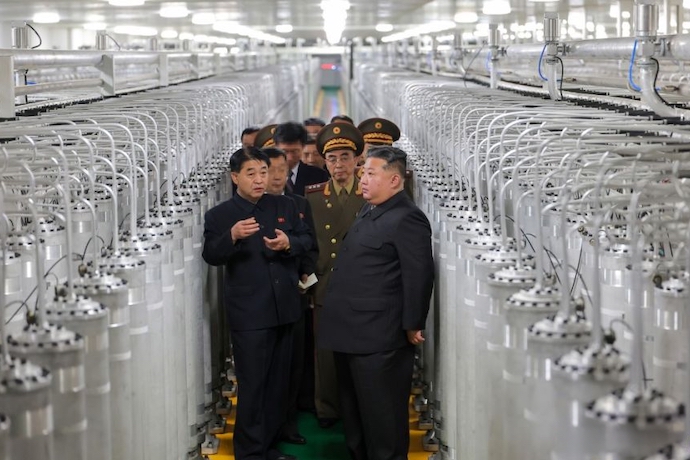
North Korea’s military activities are not primarily about winning battles. They are about shaping political choices in Washington, Seoul, and Tokyo.
Against the United States, Pyongyang seeks to undermine the credibility of extended deterrence. North Korean leaders understand that America’s commitment to defending Japan and South Korea rests not only on military capability but also on political will. By developing the ability to threaten the continental United States and key American bases, North Korea raises a classic decoupling question: would Washington truly risk Los Angeles or Seattle for the sake of Seoul or Tokyo? Unlike the Cold War environment, in which the Soviet Union never fully exploited the decoupling dilemma against Western Europe, the United States and its Northeast Asian allies face a far more immediate and dangerous version of that challenge.
Against South Korea, North Korea aims to weaken confidence in deterrence while increasing doubts about the costs of resistance. Missile launches, artillery threats, drone incursions, cyberattacks, and nuclear rhetoric all serve a broader political purpose. Their objective is to cultivate the perception that any confrontation with the North would impose intolerable costs on South Korean society.
Japan occupies a different but equally important place in North Korea’s strategic calculations. Through missile launches over Japanese territory, maritime threats, and nuclear signaling, Pyongyang seeks to expand the geographic scope of any crisis. Japan is not merely a rear-area supporter. It is a critical staging ground for military operations related to the Korean Peninsula. U.S. bases, missile-defense networks, and maritime logistics in Japan are essential to allied operations. Consequently, North Korea’s pressure campaign against Japan is designed to complicate trilateral cooperation long before a crisis begins.
This approach is fundamentally Clausewitzian. Pyongyang treats war and politics as interchangeable instruments. A missile launch becomes a diplomatic message. A cyberattack serves as a coercive signal. Nuclear doctrine functions as a political weapon. Military actions are valuable not only for their destructive potential but also for their ability to shape political calculations.

A crisis over Taiwan could present North Korea with precisely the kind of strategic opportunity that Clausewitz would have recognized. The enemy’s center of gravity may exist not only on the battlefield but also in alliance cohesion, political resolve, and strategic focus.
If China launches military operations against Taiwan, the United States would immediately require substantial air, naval, intelligence, and missile-defense resources. Japan and South Korea would become indispensable hubs for American operations. In that environment, North Korea could escalate tensions through missile tests, drone infiltrations, maritime confrontations in the Yellow Sea, provocations along the Demilitarized Zone, and renewed nuclear threats.
Such actions would not necessarily be intended to trigger a general war. Rather, they would aim to divide attention, disperse military assets, and create disagreements over priorities. Here, North Korea’s strategy becomes particularly Clausewitzian because political effects may prove more important than military ones.
During a Taiwan contingency, limited North Korean provocations could generate several strategic benefits. They could pressure South Korea to focus on homeland defense rather than supporting Taiwan-related operations. They could force the United States to retain military assets on the Korean Peninsula that might otherwise be redirected elsewhere. They could increase Japan’s vulnerability to missile threats while intensifying domestic political debates about risk and involvement. At the same time, they would indirectly assist China by stretching American decision-making across multiple theaters.
Clausewitz argued that successful strategy requires identifying an adversary’s center of gravity. In a future East Asian crisis, North Korea’s target may not be South Korean military forces themselves. Instead, it may be the cohesion of the alliance linking the United States, Japan, and South Korea.
That reality helps explain why trilateral cooperation has become so important. In recent years, Washington, Tokyo, and Seoul have expanded collaboration in areas such as extended deterrence, missile defense, intelligence sharing, and maritime security. From North Korea’s perspective, these developments are deeply threatening because they reduce opportunities for coercion. If the three countries function as an integrated strategic system, Pyongyang’s ability to exploit divisions among them diminishes significantly.
North Korea’s likely response is therefore relatively predictable. It will attempt to drive wedges between Tokyo and Seoul by amplifying historical grievances and political disputes. It will seek to encourage doubts in South Korea about American reliability. It will promote the perception that Japanese involvement in a Korean contingency would expose Japan to unacceptable missile risks. Most importantly, it will encourage all three governments and their publics to ask a simple but powerful question: is this crisis really worth the cost?
This is not merely propaganda. It is political warfare in the Clausewitzian sense. North Korea understands that military power is most effective when it influences political calculations before combat begins.

First, policymakers should avoid viewing North Korean provocations as isolated incidents. Missile tests, cyberattacks, drone incursions, artillery exercises, and nuclear threats should be assessed as components of an integrated political-military campaign. The key question is not simply what capabilities North Korea has demonstrated, but what political responses it hopes to induce.
Second, allied planning must account for the possibility of simultaneous Taiwan and Korea contingencies. Treating the two scenarios as separate challenges risks overlooking how developments in one theater would immediately influence calculations in the other. Even if South Korea does not directly participate in a Taiwan conflict, such a conflict would almost certainly affect North Korea’s strategic decision-making. Planning must therefore incorporate the possibility of limited North Korean provocations occurring alongside a Taiwan crisis.
Third, Japan and South Korea should continue exploring ways to deepen operational cooperation despite the absence of a formal alliance. North Korea benefits whenever mistrust emerges between Tokyo and Seoul. Enhanced collaboration in missile warning, maritime security, defense coordination, and logistical support is therefore not optional. Both countries should seek innovative ways to strengthen strategic alignment without relying solely on treaty-based mechanisms.
Fourth, the United States must preserve the credibility of extended deterrence under conditions of concurrent crises. Deterrence planning cannot assume that major contingencies will occur sequentially. If Pyongyang concludes that American military resources would be excessively stretched during a Taiwan conflict, it may view limited escalation on the Korean Peninsula as an acceptable risk. Any repositioning of military assets should therefore be conducted carefully, ensuring that adversaries do not interpret such moves as signs of weakening regional deterrence.
Finally, South Korea must strengthen domestic resilience. Clausewitz understood that war is fundamentally a political and social act. North Korea understands this as well. Pyongyang’s pressure campaigns target not only military forces but also public confidence, political unity, and alliance solidarity. Strengthening civil defense, cyber resilience, public communication, drone defenses, and wartime sustainment planning should therefore remain priorities. As discussions surrounding operational control transfer continue, preparation for rear-area disruption deserves particular attention.
North Korea’s strategy is neither irrational nor random. It is a calculated effort to use military power for political effect. In an era defined by the possibility of simultaneous crises, that strategy becomes even more dangerous because Pyongyang does not need to achieve complete military victory to secure meaningful gains. It may only need to slow coordination among allies, increase uncertainty, and raise the political costs of collective action.
Clausewitz warned that war must always be understood as part of politics. North Korea has incorporated that lesson into its strategic practice. The challenge facing the United States, Japan, and South Korea is whether they can do the same before Pyongyang exploits the next regional crisis.