
In Misrata, Libya’s Monarchists Make Their Case
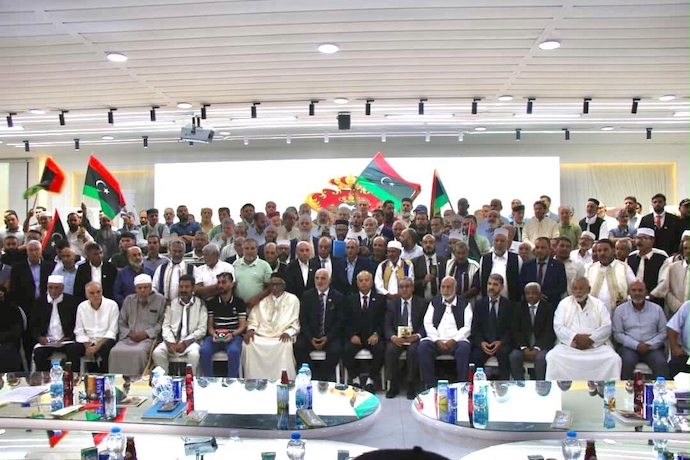
On September 19, more than 500 delegates from Libya’s constitutional monarchy movement gathered in Misrata. In a country whose politics has long been dominated by rival institutions, armed formations, and internationally mediated negotiations, the gathering stood out for its scale. More striking was what its participants had come to do: meet as an organized political constituency.
Ahmed Al Naas, head of the Misrata chapter of the Higher Coordination Council of the Royal Movement, said the city was proud to host the conference. “Our city is honoured to host the inaugural conference,” he said, describing it as an opportunity to reflect on the generation that established Libya’s constitutional monarchy at independence. He also called it a step toward “a credible national framework” and transparent, fair elections.
That ambition matters because Libya has not held a national election since June 2014, when roughly 630,000 people voted for a House of Representatives whose candidates had to stand as individuals rather than on party lists. The presidential election scheduled for December 24, 2021, was called off two days beforehand. Since then, political life has revolved around armed formations, municipal and tribal councils, rival governments, their foreign patrons, and a succession of United Nations envoys. What has been harder to find is an organized group of citizens choosing delegates and gathering to decide what it stands for. The novelty in Misrata was less the size of the crowd than the form it took.
That form did not emerge overnight. For two years, Crown Prince Mohammed El Senussi has pursued a deliberately patient round of national dialogue, meeting tribal sheiks from the east, political figures from the west and south, and members of Libya’s social and ethnic communities. His argument has been consistent: The 1951 Independence Constitution offers a foundation Libyans once agreed upon; it can be updated; and a constitutional monarch might serve as a head of state whose legitimacy does not depend on which brigade controls a particular neighborhood.
 In August 2024, 75 members of the High Council of State wrote to the UN secretary-general endorsing that path. Last November, the National Forum for Unity and Peace, a body affiliated with the movement, brought political figures together in Tripoli under the banner “constitutional monarchy: the path to resolving the Libyan crisis.” The deputy chairman of the High Council of State attended. Even Abdulhamid Dbeibah, the prime minister in Tripoli, has described the kingdom as the only experiment in Libya’s history “that had some bright spots.” Such remarks suggest an opening for debate, though they do not amount to an endorsement of restoration.
The dialogue produced the High Coordination Council of the Constitutional Royal Movement, formed by community leaders from across Libya. The council then announced local chapters, roughly one a month, beginning in February. A Tripoli chapter opened in July. Misrata brought those chapters into the same room.
Al Naas called the conference “a significant step toward the national foundation to which the Libyan people have long aspired.” That framework, he added, should enable elections that give “genuine expression to the will of the Libyan people.” Whether the movement can deliver such a framework remains an open question. Its choice of venue, however, was significant.
Misrata withstood Gaddafi’s siege in 2011, played a prominent role in the campaign against Islamic State in Sirte, and remains home to powerful armed formations. It is also Dbeibah’s hometown. For years, critics have depicted the monarchy as a Cyrenaican project, rooted in an eastern religious order with little purchase in Tripolitania. A conference in Misrata, after the opening of a chapter in Tripoli, challenges that perception. It gives the movement a visible presence in western centers of power as well as in the east, where its history began. The symbolism goes further: The flag revolutionaries raised in Misrata in 2011 was the kingdom’s flag.
The timing gives the gathering another dimension. On August 30, delegations linked to Libya’s rival camps signed an agreement under UN auspices that promised a single executive and elections “within a period not exceeding 24 months.” It offered yet another two-year horizon, thirteen months after the UN’s own roadmap had envisioned elections within twelve to eighteen months.
The High Council of State refused to attend and expelled the two members who did. The House of Representatives endorsed the deal on September 14, but 68 of its members say the session lacked a quorum; they have threatened to elect a rival speaker. Four days earlier, the heads of both chambers had met in Ankara to revive a different track. Meanwhile, the movement to restore the Gaddafi family lost its most prominent figure when Saif al-Islam was killed in Zintan in February. Each development underscores how contested the route to a political settlement remains.
The conference’s response was measured. It welcomed the efforts of the UN and the international community while insisting that Libyans were ready to take the initiative themselves. It rejected any bargain that would extend the present disorder and deny Libyans a say in their future. That language echoed what Misrata’s civic and military leaders told U.S. envoy Massad Boulos in July: They opposed “any political settlement that reproduces Libya’s crisis.” The Security Council, too, reaffirmed this month that the process should be “Libyan-led and Libyan-owned.” The monarchists are trying to give those words a political structure, presenting their platform as open to Libyans of every creed and conviction.
The word “monarchy” can obscure what the movement says it wants to restore. The 1951 constitution provided for an elected House of Representatives, ministers collectively answerable to that House and removable through a vote of no confidence, a king who acted through those ministers, and a bill of rights. It vested sovereignty in the nation. Supporters argue that an institution above regional and factional competition could provide a shared national identity while an elected government exercises political authority. That is an argument for a constitutional system, not a substitute for proving that Libyans want one today.
Nor does a conference establish a majority. The prince lives abroad, the movement commands no brigades, and no reliable polling establishes its national support. Its lack of an armed wing is central to how it presents itself: as an effort to organize across regions around a constitutional framework, rather than around control of territory, oil revenue, or a foreign sponsor. But it still has to turn dialogue and local chapters into a durable constituency capable of surviving the pressures that have defeated other political initiatives.
Misrata did not settle the question of Libya’s future. It showed that an organized constituency inside the country is prepared to argue for a constitutional alternative—and to test whether that argument can reach beyond the conference hall.