

Is Zuckerberg the World’s Most Successful Wildlife Trafficker?
Rhino horn, elephant ivory, tiger teeth, and live exotic animals are being advertised in the same digital ecosystem where billions of people communicate, shop, and entertain themselves. For years, social media companies have promised to police illegal wildlife sales. Yet researchers continue to find a thriving marketplace on platforms owned by Meta, raising uncomfortable questions about whether the company’s enforcement efforts can keep pace with the business its technology helps create.
In 2023, New Mexico Attorney General Raúl Torrez sued Meta, alleging that Facebook and Instagram exposed children to sexual exploitation, grooming, and other dangers while violating the state’s Unfair Practices Act. In August 2026, Judge Bryan Biedscheid ordered the company to pay $567 million toward addressing harm to young people, on top of $375 million in civil penalties imposed by a jury. Meta has said it will appeal. The case concerned children, not wildlife, but it sharpened a larger question: What happens when platforms built to maximize engagement fail to control the harms that flourish within their networks?
The wildlife trade presents another test. Research published in 2026 by the Global Initiative Against Transnational Organized Crime suggests that Facebook is not merely a passive venue for illegal wildlife advertising. Its groups, feeds, and recommendation systems can also help connect sellers and potential buyers. That finding matters because wildlife trafficking is both a major contributor to biodiversity loss and a lucrative form of transnational organized crime.
Researchers have struggled to measure the industry’s value, in part because the trade is designed to escape detection. One recent estimate, drawing on seizures catalogued in TRAFFIC’s Wildlife Trade Portal between 2016 and 2021 and adjusting for underreporting, placed the average annual value at approximately $34 billion, with a margin of uncertainty of $3.42 billion. No estimate can capture every transaction. Even a conservative assessment, however, reveals an industry of formidable scale.
The commodities vary, but most fall into two broad categories: live animals and wildlife derivatives. Live animals feed the exotic-pet trade and, in some instances, collections and zoological facilities. Horns, tusks, bones, teeth, claws, and other parts are sold for ornaments, cultural objects, specialty foods, or traditional medicines. The same species can supply both markets, sometimes at different stages of its life. Young big cats, for example, may be traded alive, while their bones, teeth, or claws enter a separate commercial chain.
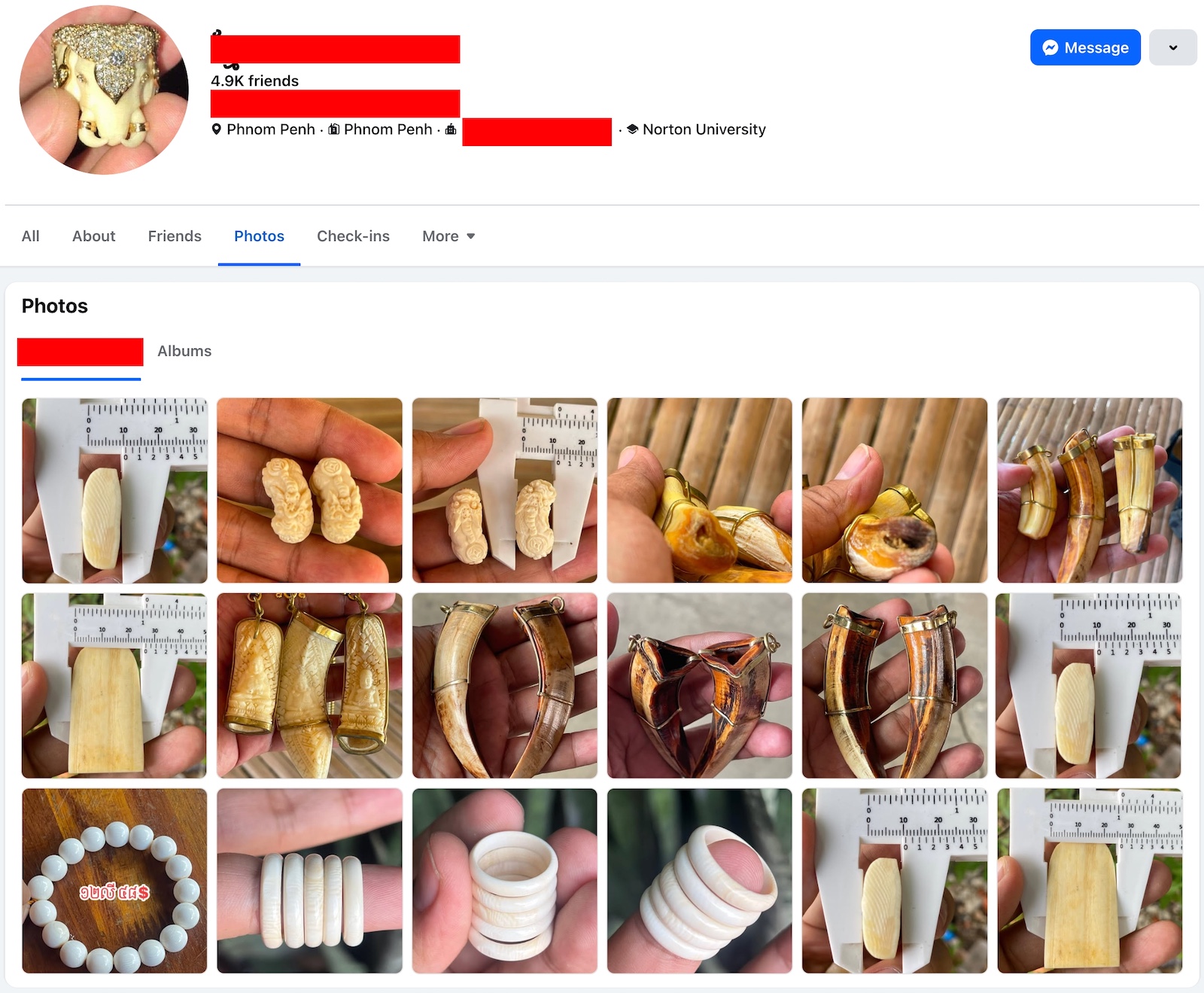
These markets do not always share the same customers, intermediaries, or destinations. They can, however, overlap at the source, with traffickers drawing from the same populations of threatened animals. For conservationists, that means protecting wildlife requires attention not only to poaching but also to the commercial networks that turn animals into products.
Before the Internet transformed retail, much of the illegal wildlife trade passed through physical marketplaces and comparatively visible distribution chains. Poachers and trafficking networks supplied brokers, who moved animals or their parts across borders. Importers sold to middlemen, processors, merchants, or consumers. Ivory might reach a carving workshop; an animal captured in the wild might end up in a private home or a wildlife facility. Transactions could be clandestine, but the infrastructure was recognizably physical.
E-commerce changed the geography of that trade. A 2008 investigation by the International Fund for Animal Welfare identified 7,122 wildlife advertisements on 126 websites across eight countries during just six weeks of monitoring. Buyers no longer needed to travel to particular markets to browse available products. Sellers could reach customers in distant countries, and transactions increasingly generated smaller, dispersed shipments rather than relying exclusively on established bulk-trafficking routes.
Conventional e-commerce sites also had a vulnerability from the traffickers’ perspective: listings could be searched, documented, and reported. Conservation groups began systematically monitoring major platforms and publicizing evidence of prohibited sales. Companies responded with restrictions on certain wildlife advertisements. Those policies did not end the trade. Instead, some traders migrated to an environment that offered greater reach and a more complicated landscape for enforcement: social media.
Facebook became widely available in 2006. Meta later acquired Instagram and WhatsApp, bringing an expanding collection of social and messaging services under one corporate umbrella. As online marketplaces tightened their rules in the 2010s, Facebook and Instagram became attractive alternatives for wildlife sellers. Public posts could advertise goods, private groups could cultivate repeat customers, and messaging services could move discussions of price, payment, and delivery out of public view.
That combination made the distinction between advertising and transacting particularly important. A photograph of ivory or a live parrot posted in a group does not, by itself, prove a completed illegal sale. But a platform that allows sellers to display goods, build credibility, contact buyers, and arrange delivery can provide much of the infrastructure on which trafficking depends.
Meta’s systems are designed to help people discover content, communities, and others with shared interests. Those same features can work in favor of illicit sellers. Researchers monitoring wildlife commerce have documented instances in which prohibited goods or wildlife-trading groups surfaced through ordinary browsing or recommendations, rather than through deliberate searches for contraband. The concern is therefore not simply that some posts evade moderators. It is that the architecture of engagement can make illegal commerce easier to find.
Other services, including TikTok, Telegram, regional marketplaces, and messaging applications, have also appeared in monitoring of wildlife trafficking. Some traders advertise across several platforms. Yet Facebook remains disproportionately prominent in the data gathered by the Global Initiative Against Transnational Organized Crime’s ECO-SOLVE project.
According to figures cited in its Global Monitoring System, investigators detected 25,350 suspected illegal wildlife advertisements from April 14, 2024, through April 30, 2026. The records covered 11 monitoring hubs, 66 platforms, and 23 languages. Together, the advertisements listed 280,237 animals, specimens, products, or other wildlife items. Parts, derivatives, and extracts accounted for 217,264 of those items, approximately 77.5 percent, while live animals accounted for 62,973, or 22.5 percent.
Facebook represented 71.5 percent of detected advertisements in that dataset, far more than any other single platform. WhatsApp appeared next, with Instagram and several other social, retail, and classified-advertising services also represented. These percentages describe what researchers detected across the platforms they monitored; they should not be mistaken for a definitive measurement of every illegal wildlife transaction taking place online.
The reported financial figures are equally striking, though they require similar caution. Researchers found that about 60 percent of detected advertisements displayed prices. The total advertised value associated with those listings was approximately $66 million, nearly $65 million of it attributed to Facebook. Those are asking prices, not verified receipts, and the listed inventory may not have been sold. Even so, the concentration demonstrates how central Facebook was to the activity investigators could observe.
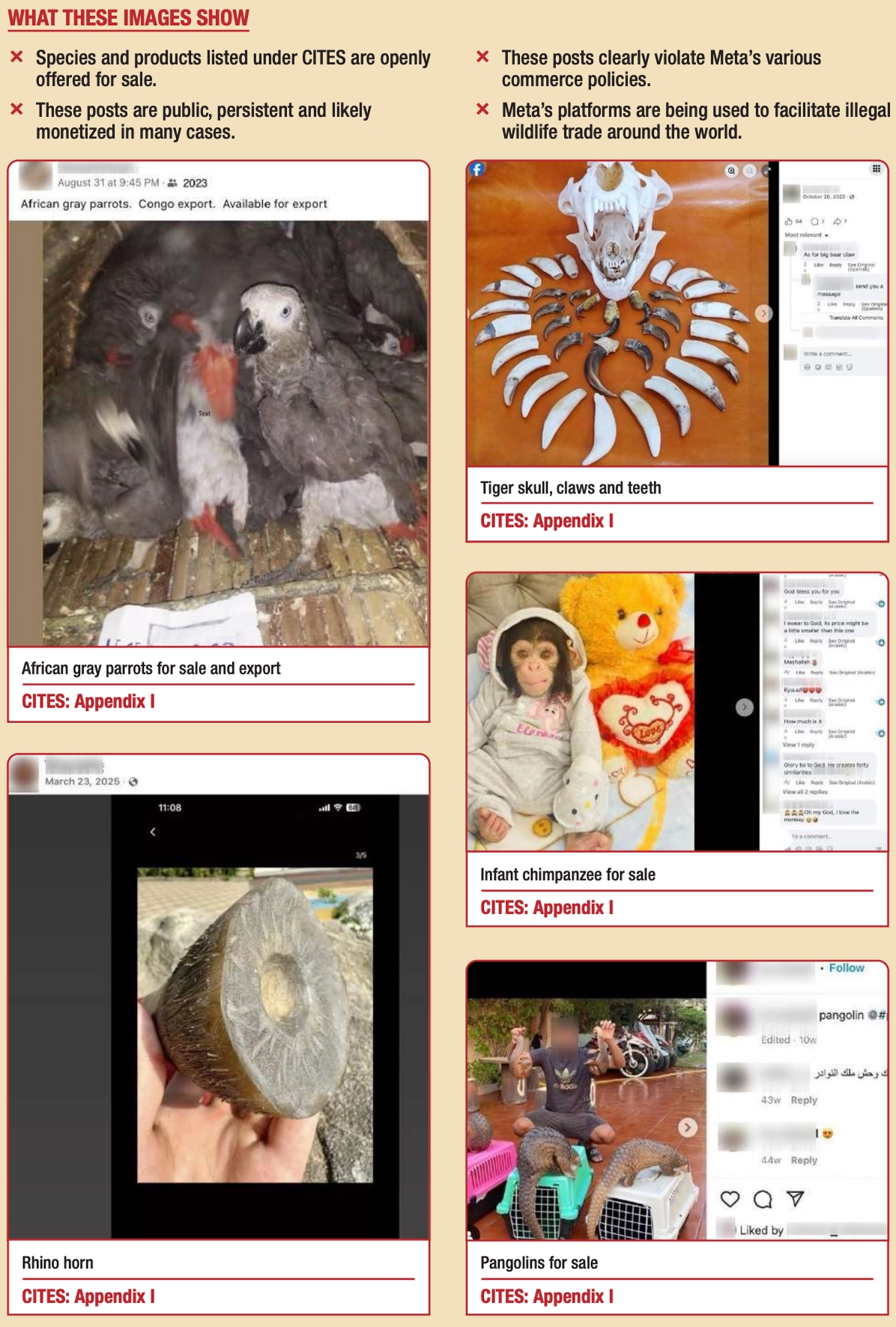
The scale of this advertising creates difficult practical questions for investigators. A seller’s photograph may be recycled, a listing may use code words, and a public price may be only an opening bid. A live animal offered in one country could be held elsewhere, while the person posting the advertisement may be a broker rather than the poacher. Researchers therefore need to distinguish individual listings from unique animals, identify repeated advertisements, and document what evidence supports a judgment that a sale would violate the law. Without those distinctions, raw counts can create a misleading impression of either the marketplace’s size or the success of a crackdown.
The mechanisms of trust and fulfillment are familiar to anyone who has shopped online. Sellers reportedly display evidence of previous payments to reassure potential buyers. Advertisements and conversations describe delivery through courier services, public buses, or direct handoffs. Such details reveal how illegal commerce borrows the ordinary conventions of legitimate retail, adapting them to products that may have been taken from protected populations thousands of miles away.
The same features that make social media attractive to ordinary users complicate enforcement. A group can change its name, an account can be replaced, and a buyer who encounters an advertisement on a public feed can continue the conversation in an encrypted messaging service. Removing the original listing may erase an obvious advertisement without disrupting the relationship behind it. This is why researchers increasingly look at discovery, recommendations, connected accounts, and patterns of repeated posting, rather than assessing moderation solely through the number of takedowns a company announces. It is also why cooperation among platforms, conservation groups, customs authorities, and national investigators matters: no single organization sees the entire chain from poaching to payment and delivery.
The protected status of many advertised species deepens the concern. The monitoring findings described 84 percent of Facebook advertisements as involving species listed in Appendix I of the Convention on International Trade in Endangered Species, or CITES, and another 14.6 percent as involving Appendix II species. Appendix I generally prohibits commercial international trade in wild-sourced specimens, subject to exceptions; Appendix II regulates international trade rather than banning it outright. A CITES listing alone does not establish that every advertisement is illegal, because origin, permits, and domestic laws also matter. It does establish the conservation significance of the species appearing in these listings.
The growth of online advertising has coincided with an increasingly complex international trafficking network. A study tracing illegal wildlife trade from 2000 to 2022 reported an expansion from 49 participating countries in 2000 to 110 in 2018, alongside a marked increase in trade connections. The network proved resilient during the COVID-19 pandemic, even as lockdowns disrupted travel and physical marketplaces.
Northern Vietnam’s Nhi Khe village illustrates the distinction. Before the pandemic, it attracted visitors, including buyers from China, seeking wildlife products. Restrictions on movement severely curtailed the village’s in-person commerce. Online channels, however, allowed the underlying trade to persist even when customers could not arrive in person. A shuttered market did not necessarily mean demand had disappeared; it could mean the market had moved.
Reports from law enforcement agencies, including Interpol, and international bodies such as the United Nations Office on Drugs and Crime have documented extensive trafficking in live animals and wildlife parts. The rise of exotic-pet demand is particularly troubling. Yet the similarity between the proportions of live animals and derivatives detected online and in seizure records cannot, on its own, prove that most confiscated shipments originated in social media purchases. That is an important distinction: parallel trends may indicate connected markets without identifying the transaction behind a particular seizure.
Christian Plowman, a former British law enforcement officer and an International Fund for Animal Welfare specialist in wildlife cybercrime, has described Ethiopia as a transit point for illicit wildlife cargo rather than simply a destination for consumers. Rhino horn, ivory, and live animals, including lions, cheetahs, and exotic birds, can move through Addis Ababa toward markets elsewhere. He has also warned that policymakers underestimate the scale of the problem. “It is not a small problem,” Plowman noted, placing wildlife crime on the same tier as narcotics, firearms, and human trafficking.
What begins as a transaction involving an animal or a body part ultimately reaches far beyond that individual specimen. Wildlife trafficking can reduce already vulnerable populations, damage ecological relationships, and undermine conservation efforts. Its consequences extend into livelihoods, food systems, public health, and, potentially, national security. A species removed from its habitat is not simply a commodity removed from nature; it may be a missing participant in the ecosystem that sustains a much wider community of life.
Scientists have repeatedly warned that accelerating biodiversity loss threatens the systems on which human societies depend. Addressing the United Nations in 2022, Secretary-General António Guterres said that “humanity has become a weapon of mass extinction.” He described international efforts to reverse environmental destruction as “our chance to stop this orgy of destruction.” The rhetoric was forceful, but the underlying danger is increasingly quantifiable.
A 2023 study, “Trading species to extinction: evidence of extinction linked to the wildlife trade,” identified 511 reported cases of extinction at different geographic scales associated with trade-related factors. They included 294 reports of global extinction, 25 of extinction in the wild, and 192 local, regional, or population-level extinctions. These categories should not be conflated: the loss of a local population is devastating, but it is not the same as the disappearance of a species everywhere on Earth.
Other studies have examined the ecological changes that follow when larger animals decline. In parts of sub-Saharan Africa, the disappearance or depletion of large-bodied species can change how ecosystems function, leaving smaller animals to perform roles once distributed across a broader range of species. Poaching and trafficking are among the pressures contributing to these shifts, although habitat destruction, land use, and climate change also play substantial roles.
The exotic-pet trade adds another dimension. A 2025 report from Nature Needs More estimated that between 10,000 and 13,000 species are traded as exotic pets, including nearly 4,000 reptile species, or roughly 35 percent of those known. Many species are traded legally, and the existence of an exotic-pet market does not automatically mean every animal was illegally captured. The report’s central criticism, however, was that the industry’s fragmented supply chains, weak oversight, and inconsistent enforcement make sustainability difficult to establish.
Its authors were particularly skeptical of relying on online platforms to regulate themselves. Businesses gain commercial benefits from attention, transactions, and advertising, while policing wildlife commerce requires sustained investment and a willingness to remove content that attracts engagement. The incentives are not naturally aligned. The report argued that restrictions can also be circumvented when sellers move into closed groups and private conversations.
The Coalition to End Wildlife Trafficking Online, launched in 2018, was intended to address precisely that problem. Its early ambition was to reduce online wildlife trafficking by 80 percent by 2020. Subsequent progress statements emphasized the number of listings and accounts blocked, including a cumulative figure of 24.1 million by a later update. Those removals may represent meaningful enforcement activity. But a count of blocked accounts or advertisements cannot independently demonstrate an 80 percent reduction in the underlying trade. Measuring success requires a credible baseline, consistent monitoring, and evidence that sellers have not simply migrated to other accounts or platforms.
There is also a policy dilemma. Sweeping bans on all wildlife-related imagery or discussion would threaten legitimate conservation work, scientific exchange, rescue efforts, and lawful commerce. Yet allowing every post to remain until an investigator demonstrates a completed illegal transaction would leave authorities responding only after the damage has been done. The more defensible approach combines risk-based detection, species identification, clear rules for permissible trade, meaningful review of suspicious listings, and accessible channels for researchers to report repeat offenders. The test of such a system would not be whether prohibited content ever appears; at this scale, some will. It would be whether the company can detect patterns early, prevent its own recommendation tools from amplifying them, and provide credible evidence that interventions reduce illicit activity rather than merely pushing it out of view.
The stakes are not restricted to conservation organizations. A British government assessment published in 2026 examined how biodiversity loss and ecosystem collapse might threaten food and water security, human health, supply chains, and geopolitical stability. It identified six ecosystems of strategic concern to the United Kingdom and considered the cascading effects of their deterioration. Although framed around British national security, the underlying vulnerabilities cross borders. Food markets, migration pressures, financial systems, and ecological dependencies rarely remain confined to one country.
Economic research has also attempted to put a price on ecological breakdown. One 2026 analysis modeled higher sovereign borrowing costs under a scenario of partial ecosystem collapse. It projected additional annual debt-servicing costs of $49 billion for India and $70 billion for China, with increases across countries potentially totaling $162 billion. These are scenario-based estimates, not costs already incurred, but they illustrate how damage to nature can find its way into bond markets and national budgets.
The same research warned that vulnerable economies, including Angola, Bangladesh, the Democratic Republic of the Congo, and Madagascar, could experience severe output losses under adverse environmental scenarios. Financial markets, the researchers suggested, may be underpricing risks associated with nature’s decline. When ecosystems weaken, productive capacity, creditworthiness, and public finances can suffer together.
The connection between biodiversity and human health is equally consequential. Deforestation and the disruption of wildlife habitats can increase certain opportunities for diseases to move between animals and people. The precise pathways vary, and no single pandemic can be attributed to wildlife trafficking alone. Yet the broader lesson is clear: ecological disturbance can create risks that spill across public-health systems and national borders.
Nature’s economic contribution is often invisible until it fails. Wild pollinators support food production. Fisheries sustain nutrition and employment. Forests regulate water and store carbon. Soil organisms maintain agricultural productivity.
The loss of species changes these functions in ways that can be difficult and expensive to reverse. Studies examining pollination, fisheries, and tropical forests have projected enormous economic losses under scenarios of continued ecosystem degradation.
Wildlife also helps regulate the climate. A coalition of 287 researchers across six continents endorsed a Scientific Consensus on Wildlife and Climate urging governments to integrate wild animals more fully into climate policy. Animals shape vegetation, distribute nutrients and seeds, affect food webs, and participate in processes that influence carbon storage. Their role is not identical across species or ecosystems, but it is significant enough that climate strategies focused only on emissions and vegetation risk overlooking important ecological relationships.
Matt Collis, a senior policy director at the International Fund for Animal Welfare, captured the argument succinctly: “Wild animals are some of our greatest allies in protecting the planet from climate catastrophe, yet their role has been overlooked for far too long,” he said. From forest-shaping elephants to marine animals involved in ocean carbon cycles, conserving wildlife can help sustain ecological resilience. The relationship is complicated, but it reinforces a simple point: species protection and climate protection are not separate concerns.
The World Wildlife Fund’s Living Planet Report 2026 provides a grim measure of what is at stake. Released in October under the subtitle The Science of Hope, it found a 73 percent average decline in the size of monitored vertebrate wildlife populations between 1970 and 2022. In Africa, the average decline was 80 percent. Those figures do not mean that 73 percent of all animals have vanished, nor that 73 percent of species are extinct. They describe an average proportional change among monitored populations. Properly understood, the findings are alarming enough without exaggeration.
The report also offers a qualification that matters. Conservation can work. Some monitored populations are stable or increasing, and recoveries among selected tiger, turtle, tuna, and elephant populations show that determined protection can produce results. That is the hope in the report’s title: not reassurance that biodiversity loss is under control, but evidence that decline is not always irreversible.
For Meta, this distinction makes the question of responsibility more urgent, not less. The company cannot be held accountable for every act of poaching, every buyer’s decision, or every failure of national law enforcement. But it can be asked to explain whether its own systems make illegal wildlife advertising easier to discover, why prohibited listings remain accessible, and how it measures the effectiveness of efforts to remove them.
The evidence from wildlife-monitoring projects points to a substantial enforcement challenge on Meta’s platforms. It does not prove that Meta accounts for most completed illegal wildlife sales worldwide, nor that every recommendation or advertisement results in a transaction. It does show that a large share of the suspicious listings researchers encounter are concentrated within an exceptionally powerful digital network.
That network can connect families and communities across continents. It can also connect traffickers with customers searching for animals and products that should never enter commerce. The challenge is not simply to count the posts Meta removes. It is to establish whether its systems are reducing the market for illegal wildlife, or helping that market find its next buyer.