
Pro-Democracy Venezuelans Must Resist Rodríguez and Trump
Operation Absolute Resolve marked the return of the United States as a coercive power in its own hemisphere, acting in ways sharply at odds with the international norms Washington once claimed to defend. On January 3, U.S. armed forces, acting on orders from President Donald Trump, abducted Venezuelan President Nicolás Maduro and his wife, Cilia Flores, transporting them to New York to stand trial. The operation itself was swift. Within a few hours, American bombardment suppressed Venezuelan air defenses while Delta Force troops stormed past Maduro’s bodyguards and seized both the president and the first lady.
Maduro’s detention was greeted with jubilation among Venezuelans inside the country and across the global diaspora who had long opposed his rule. Nowhere were the celebrations louder than in South Florida. Members of the Venezuelan diaspora waved national flags and chanted “Liberty! Liberty! Liberty!” as they hailed what they believed to be the end of the Chavista era.
For a brief moment, hopes of democratic transition surged. One demonstrator told journalists, “There’s fears. There’s excitement. There’s so many years that we’ve been waiting for this. Something had to happen in Venezuela. We all need the freedom.” Venezuelan immigrant and Manhattan Institute fellow Daniel DiMartino likewise celebrated Maduro’s removal in an interview with NewsNation, expressing hope that the country might now transition peacefully to liberal democracy under the leadership of opposition activist María Corina Machado.
The raid also boosted Trump’s standing among Latino voters. Polling suggested that a majority of Latin American voters supported the military operation. The sudden improvement in Trump’s political fortunes came after months of declining approval among Hispanic Americans, many of whom had felt alienated by the administration’s sweeping deportation policies. Those plans included the industrial-scale detention of immigrants in camps across the country, an initiative that Cato Institute analyst David Bier bluntly described as “ethnic cleansing.”
Yet the diaspora’s celebration proved fleeting. There was no triumphant moment in which María Corina Machado was ushered into power. Instead, the Trump administration quietly abandoned the pro-democracy movement it had once courted in its campaign to destabilize the Maduro regime.
Rather than embracing democratic transition, Trump negotiated a backroom arrangement with Maduro’s vice president, Delcy Rodríguez. Under the terms of this agreement, Rodríguez would grant the United States access to Venezuela’s vast oil reserves. In return, the White House would ensure the continuity of the Chavista state while providing a steady economic lifeline in the form of U.S. dollars flowing into the country.
The agreement carried the appearance of consent, but its underlying coercion was impossible to ignore. Looming behind the negotiations was the threat of a U.S. naval blockade or even further decapitation strikes against Venezuelan leadership. The message was unmistakable: compliance would bring survival, while resistance could bring destruction. In that moment, the United States appeared to have shifted from a benevolent hegemon to a far more predatory one.
As Venezuelan oil once again began flowing toward American markets, the Trump administration moved to formalize relations with Caracas. Washington restored diplomatic ties with the Chavista regime, effectively granting it renewed legitimacy. María Corina Machado, who had demanded elections and democratic reform, found herself abruptly sidelined, like a former partner watching her replacement welcomed into the relationship.
A White House adviser captured the administration’s view of Machado with striking bluntness in comments to POLITICO: “All María Corina Machado does is try to negate all of this. None of this is ‘Operation María Corina Machado.’ It’s ‘Operation U.S. national security,’ which is not tied to her in any way. She’s a spoiler, and she’s working against U.S. national security goals.”
For many Venezuelans, the moment was a bitter awakening. The removal of Maduro had been celebrated as liberation, yet the country now risked becoming something else entirely: a site of economic extraction. Rodríguez appeared poised to rule for the foreseeable future so long as she continued delivering resources to Washington. Machado and the broader pro-democracy movement watched their aspirations pushed aside.
History offers an instructive parallel. Under the British Raj, India was not always governed directly from London. Instead, British authorities relied on a network of local intermediaries—maharajas, landlords, and bureaucrats—whose privileges depended on their cooperation with imperial extraction. On paper, Indians appeared to govern India. In reality, Britain dictated the terms.
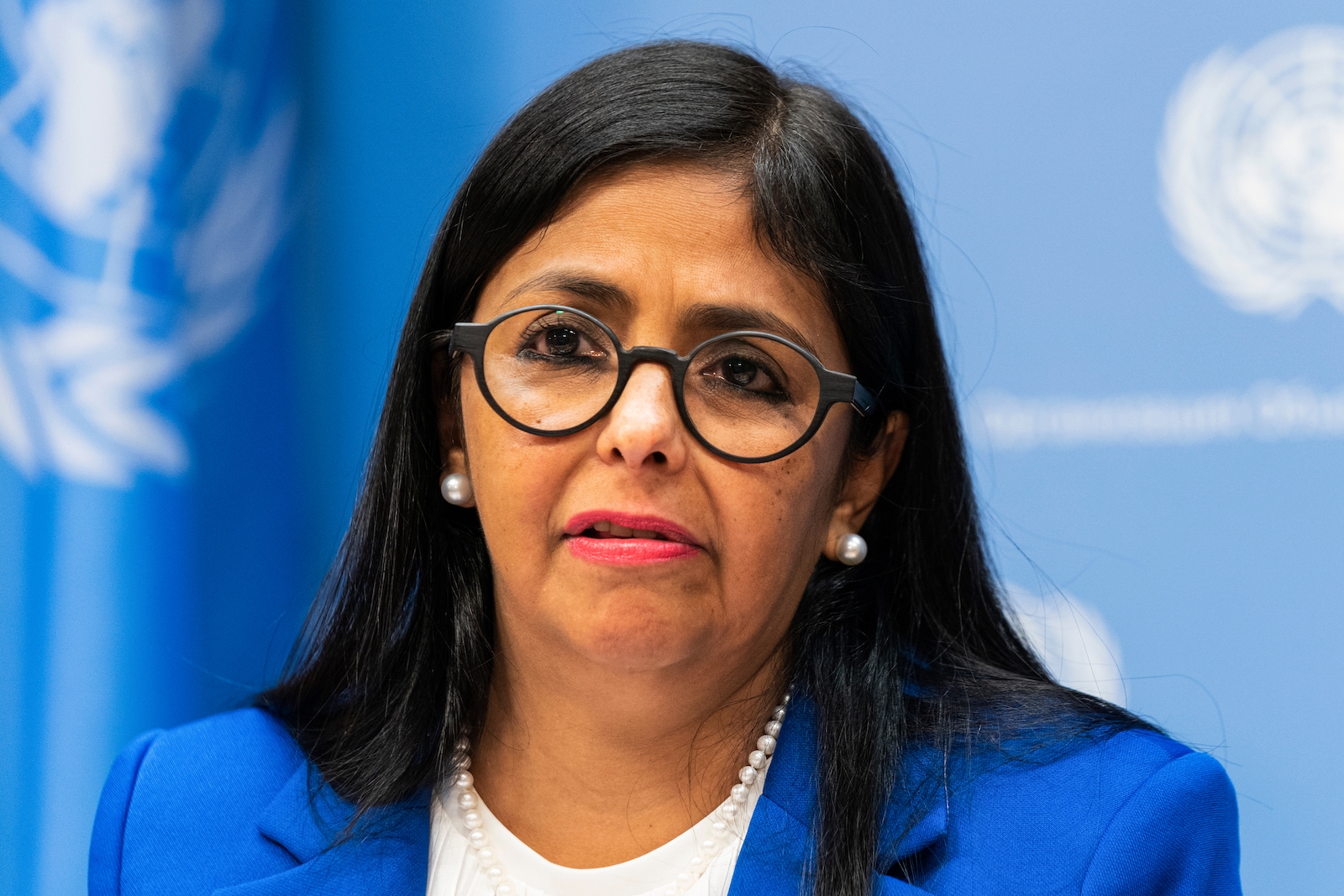
Today, Delcy Rodríguez occupies a role eerily similar to that of those imperial intermediaries. Secretary of State Marco Rubio functions as Washington’s regional viceroy. Rodríguez sits in Miraflores Palace not because Venezuelans elected her or because the Chavista base rallied behind her, but because she is useful to Donald Trump’s strategic objectives.
Her government’s new Hydrocarbons Law makes the arrangement clear. State royalties are capped at just 30 percent. Foreign firms—many of them with connections to American political interests—gain sweeping control over production and sales. Legal disputes are routed to courts outside Venezuela.
The logic of this system was articulated with striking candor by U.S. Vice President J.D. Vance, who told Fox News: “We control the energy resources, and we tell the regime you’re allowed to sell the oil so long as you serve America’s national interest. You’re not allowed to sell it if you can’t serve America’s national interest.”
In other words, the metropole sets the rules, and the peripheral state complies.
For Venezuela’s pro-democracy movement, this moment demands a fundamental reassessment. For years, its energies were directed almost exclusively toward opposing Maduro. Now the challenge is broader. Venezuelans must resist not only Rodríguez’s opportunism but also the emerging structure of foreign domination that sustains her rule.
Such resistance should not be confused with anti-Americanism. The United States as a nation—with its civic traditions and democratic institutions—is not the enemy. But Trumpism represents something different. It treats sovereign states less as partners than as assets to be acquired, managed, and stripped for resources.
Under this worldview, Venezuela becomes less a nation than a foreclosure property.
True patriotism, therefore, requires Venezuelans to demand equality in their dealings with Washington. No future Venezuelan leader should face abduction or deposition simply for prioritizing national interests over American ones. What is now being done to Rodríguez could easily be done to a democratically elected president tomorrow.
Alongside their demands for free elections, Venezuelans must also challenge the Hydrocarbons Law itself. Agreements extracted under threat of military force cannot be considered legitimate. Venezuela should exercise full sovereignty over its oil industry rather than accepting a system in which it receives only a fraction of the profits while foreign corporations control production schedules and export routes.
Companies working in Venezuela should be chosen through transparent and meritocratic processes, not through foreign pressure to favor specific firms. Venezuelans should oversee extraction, refining, and sales. They should determine their own trading partners—whether Cuba, China, India, Brazil, or any country willing to offer fair terms and market prices.
The profits from Venezuelan crude should fund schools, hospitals, and infrastructure within Venezuela. Those revenues should be managed by Venezuelan institutions accountable to Venezuelan citizens.
The notion that the country must surrender control of its primary resource because a foreign power installed its last leader is colonial logic. It deserves rejection.
History again offers a guide. India’s independence movement confronted British rule through mass civil disobedience. Strikes, protests, and nonviolent resistance gradually undermined the economic foundations of imperial control.
Venezuelans could adopt similar tactics. Oil workers could refuse to operate fields governed by contracts written in Washington under military threat. Dockworkers could decline to load tankers bound for refineries whose terms were negotiated without Venezuelan representation.
Such actions would represent more than protest. They would be declarations of sovereignty.
Every colonial system ultimately depends on the compliance of the colonized. If Venezuelans withdraw that compliance, the arrangement collapses. Contracts become worthless pieces of paper when no one is willing to enforce them.
The White House would then face a simple choice: negotiate a more equitable agreement or watch its extraction project grind to a halt.
María Corina Machado, however, cannot lead this struggle. Her credibility has been damaged by her misplaced trust in the Trump administration. By aligning herself with Washington’s strategy, she encouraged Venezuelans to believe that collaboration with Trump would advance democratic goals.
Events have shown otherwise.
Nor can leadership come from the diaspora in South Florida. Many expatriates understandably fled Venezuela for painful and legitimate reasons, but their circumstances now differ profoundly from those still living under Rodríguez’s security apparatus.
From the suburbs of Doral or Weston, it is easy to urge patience. It is easy to claim that Trump’s plan will eventually deliver free and fair elections. It is easy to argue that the current arrangement is preferable to Maduro’s dictatorship.
But the cost of being wrong will be paid by Venezuelans inside Venezuela.
Those who have left the country do not work in the oil fields whose profits now flow abroad. They do not confront the security forces tasked with enforcing the new order. They do not bear the daily consequences of foreign control over the nation’s resources.
No American would accept a foreign government dictating how its oil revenues are distributed. Venezuelans should not accept it either. And those urging them to do so from abroad cannot claim to be defending Venezuelan sovereignty.
The country’s struggle for freedom did not end with Maduro’s removal. It has simply entered a new phase: the day after.
Part of that day after involves resisting the colonial impulses now visible within the Trump administration. The path ahead will be difficult, but national dignity is secured only through its assertion.
This argument does not arise from communist sympathies. On the contrary, I consider myself a classical liberal. Yet genuine liberalism—centered on liberty and self-determination—cannot exist without a rejection of imperial domination.
For Venezuela, freedom requires nothing less than anti-imperialism.