Culture

Rock Music as an Allegory for Poland’s Post-Communist Development
In an influential Foreign Affairs article assessing the development of the former Eastern Bloc a quarter century after the fall of the Berlin Wall, Andrei Shleifer and Daniel Treisman argued that Poland, unlike most of its post-communist neighbors, had become a “normal” country. In their assessment, the authors relied primarily on economic indicators of normalcy.
In the abnormal 1980s, Polish families applying for an apartment could expect to wait up to 30 years, while inflation climbed to a record 640 percent. Then, between 1990 and 2011, Poland made substantial strides in its economic development. During this period, GDP per capita grew by 119 percent, outpacing Asian Tigers such as Hong Kong and Singapore. Household consumption grew by 146 percent, a rise comparable to that of South Korea. Car ownership in Poland reached levels at which there were more cars per capita than in the United Kingdom.
Since Shleifer and Treisman published their study in 2014, Poland has made further advances. While in the 1980s Poland remained a Soviet satellite state within the Warsaw Pact, by 2025 it was contributing a greater share of its GDP to the NATO defense budget than any other member, including the United States. With a gross GDP now exceeding $1 trillion, Poland has been invited to participate as a guest at the upcoming G20 summit and is expected to appeal for permanent membership.
Important as it may be, however, economic progress is not the only measure of a country’s “normalcy.” In addition to undermining economic growth, Poland’s communist regime also stifled the country’s cultural development, leaving Polish society trailing cultural trends in Western Europe and the United States. To highlight this often-overlooked aspect of Poland’s post-communist transformation, this essay uses rock music as an allegory for Poland’s progress in the realm of popular culture.
Rock Music Behind the Iron Curtain
In the so-called swinging sixties, when Elvis Presley was competing for chart positions with The Beatles and other groups associated with the emerging British Invasion, and when Andy Warhol was colorfully immortalizing pop culture icons like Marilyn Monroe and designing album covers for avant-garde groups such as The Velvet Underground, the Polish People’s Republic was still emerging from the bleakness of post-war devastation and Stalinist totalitarianism. Ever wary of subversive counterculture movements, authorities in Poland officially banned the term “rock and roll” in association with local artists or concerts. To circumvent Communist Party censorship, Polish bands interested in Western musical styles such as jazz or rhythm and blues adopted the label “bigbit” (read in Polish as “big-beat”).
The façade was finally broken in 1967, when The Rolling Stones were permitted to give two concerts in Warsaw, becoming the first major Western rock band to perform anywhere in the Eastern Bloc. However, in a move that underscored the regime’s contradictions, concert tickets were almost exclusively reserved for Party members and their families, prompting protests by fans outside the concert hall. Bassist Bill Wyman later recalled Warsaw as a “gloomy, grey and overwhelmingly depressing” city filled with riot police and undercover agents.
Following the Rolling Stones episode, the Party was finally forced to permit public references to “rock and roll,” but communist authorities soon faced a new challenge. By the late 1970s, echoes of Western punk and heavy metal could be heard on the airwaves of pirate radio stations and in the homes of fans who had the means and connections to obtain smuggled bootleg recordings. Once again, punk and heavy metal were publicly referred to as “young generation music,” another façade that proved no more effective than “bigbit.”
In 1980, Polish authorities permitted the All-Polish Review of Music of the Young Generation in Jarocin, which grew into one of the most important punk festivals in the Eastern Bloc. Another milestone came in 1984, when Iron Maiden were permitted to film the documentary Behind the Iron Curtain, chronicling the band’s experiences performing and traveling in Poland, Hungary, and Yugoslavia.
Although the footage depicted airports and cities that remained gloomy and grey, it also revealed thousands of fans longing to live in a normal country that respected personal liberties such as freedom of expression. In many respects, Iron Maiden’s tour helped pave the way for other Western artists like Queen, whose Hungarian Rhapsody concert brought British rock to more than 80,000 fans inside Budapest’s Népstadion in 1986.
Rock Music in a Normal Country
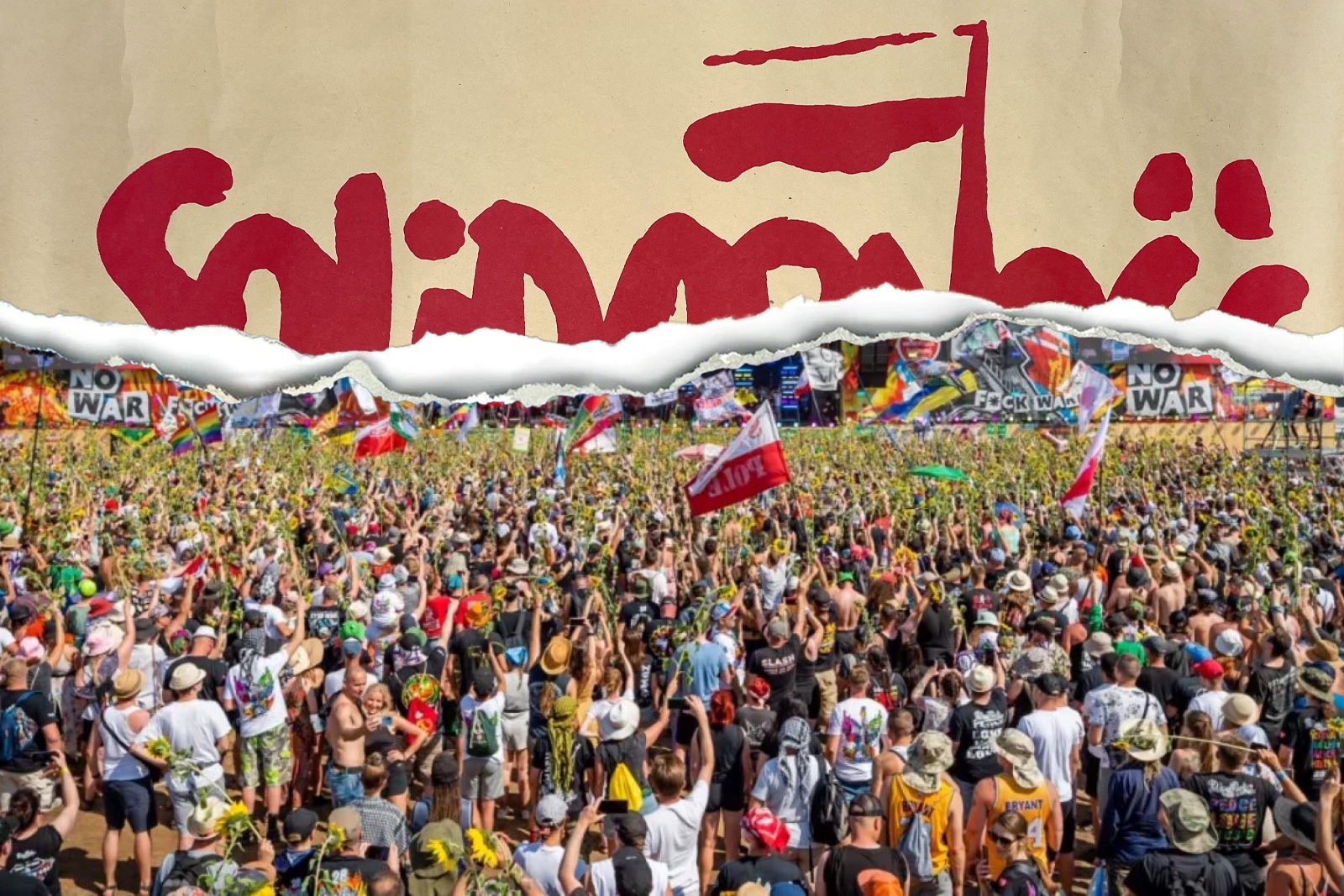
When Poland finally emerged from behind the Iron Curtain, it took quick and decisive steps to rejoin the Western world. In 1995, the first Woodstock Festival Poland was organized by Jerzy Owsiak, founder of the country’s largest non-profit charity organization, as a gesture of appreciation for his volunteers. Taking inspiration from the spirit of the original Woodstock Festival of 1969, the Polish spin-off was freely open to the public and featured primarily national artists.
Rebranded as Pol’and’Rock Festival in 2018, the event has remained free to attend but now features both legendary headliners and rising stars from around the world. With an annual attendance of approximately 750,000 fans, Pol’and’Rock has grown into one of the largest music festivals not only in Europe but anywhere in the world. The year of its rebranding, the headlining act was Judas Priest, supported by a young Polish group called Nocny Kochanek.
When the opening act’s performance from that night was later released as a live album, festival organizer Owsiak included liner notes recounting an anecdote: that Ozzy Osbourne had reportedly listened to the material several times, struck by the fact that someone was still playing music as compelling as his own. This spring, Nocny Kochanek are touring across Great Britain, no small feat for a band whose lyrics are exclusively in Polish. What makes the achievement even more remarkable is that the band members’ parents, who grew up in the 1970s and 1980s, could scarcely have imagined that their children would one day have the means—or even the permission—to travel to Britain as tourists, much less as professional musicians.
From Behind the Iron Curtain to Center Stage?
Poland welcomed 2026 with a series of televised New Year’s Eve concerts across the country. Even in relatively smaller cities such as Toruń, the state-of-the-art stages on which public performances were organized placed Poland on equal footing with countries hosting similar celebrations in Western Europe. Perhaps this highly visible start to the year was intended as an optimistic signal of what lies ahead.
This summer, concertgoers in Poland—who are now as affluent as those in Spain by GDP per capita—will have the opportunity to see such stars as Guns N’ Roses, Metallica, as well as artists from other genres such as Pitbull, Bad Bunny, and gypsy punk legends Gogol Bordello. Still, there remain voices within the country that condemn events like Pol’and’Rock Festival and the liberal leanings of its organizer. These same voices are often quick to criticize Poland’s integration into the European Union and wary of immigrants from beyond its borders.
While some of these critiques may warrant discussion and some of the concerns deserve acknowledgment, it should not be forgotten that behind the Iron Curtain, Poland was an isolated and constrained country. If it has regained a measure of normalcy in recent decades, it is because it has opened itself to the wider world. More importantly, if Poland is to take center stage among its post-communist peers in the years ahead, it must remain open—not only economically, but culturally as well.