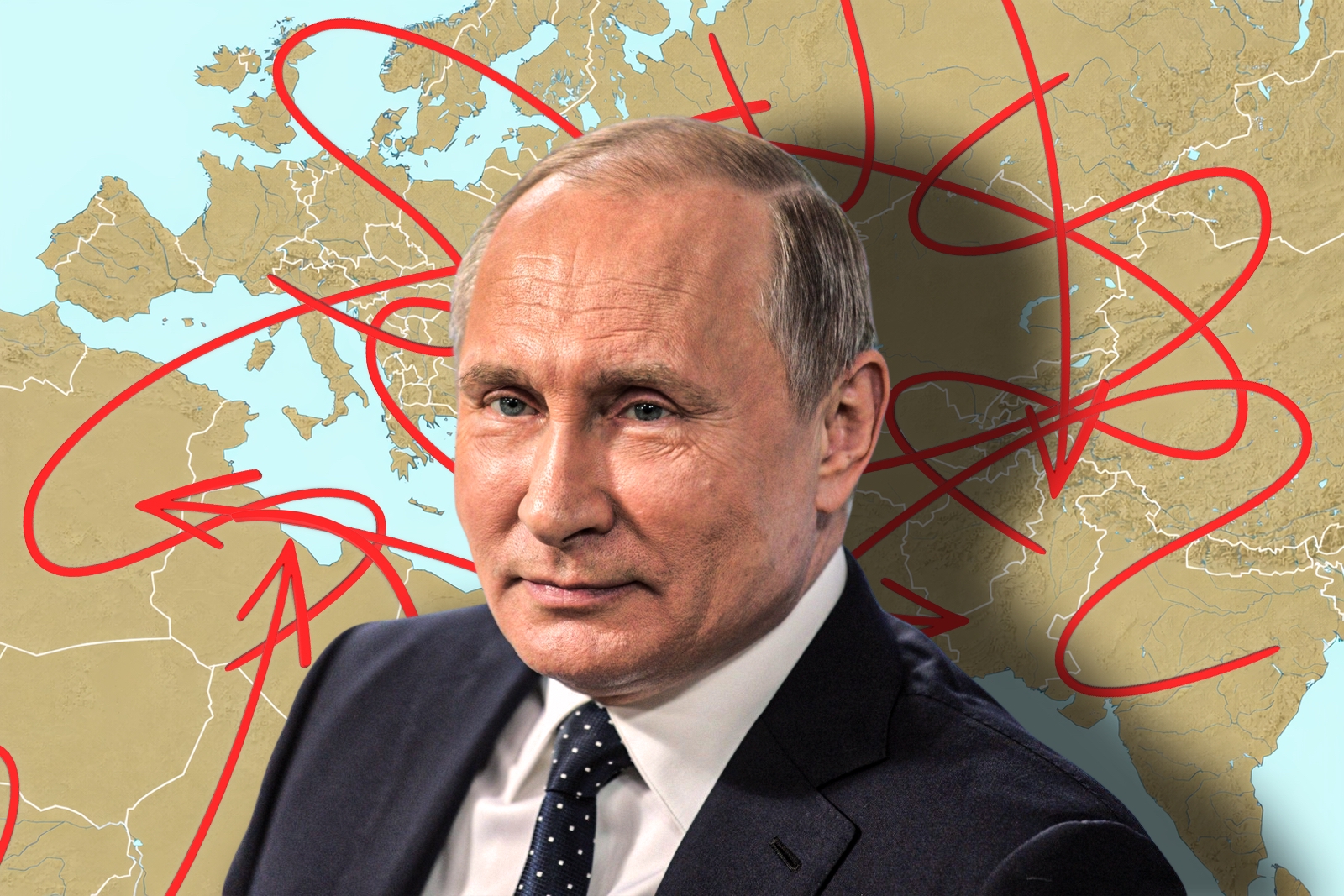

Russia’s Bid to Bypass the West
The International North–South Transport Corridor (INSTC) has emerged as one of Russia’s most consequential geopolitical infrastructure projects over the past quarter-century. Spanning roughly 7,200 kilometers, the multimodal network of rail, road, and maritime routes links St. Petersburg with Mumbai via Iran and Azerbaijan, offering a faster and potentially cheaper alternative to the traditional route through the Suez Canal.
First envisioned in 2000 by Russia, Iran, and India, the corridor languished for decades. Chronic funding shortfalls, international sanctions on Tehran, and shifting political priorities repeatedly stalled progress. Today, however, the INSTC has acquired new urgency. Vladimir Putin has elevated the project to a strategic priority, casting it as a linchpin in Russia’s economic and geopolitical reorientation toward Asia and the Global South.
At the core of Putin’s push lies a clear objective: to construct a reliable, sanctions-resistant overland trade artery that reduces Russia’s exposure to vulnerable maritime chokepoints. If completed as planned, the INSTC could slash transit times from the 40 to 60 days required via Suez to roughly 25 days, while cutting shipping costs by as much as 30 to 40 percent. Central to this promise is the long-delayed 163-kilometer Rasht–Astara railway in northern Iran—the missing link that would allow uninterrupted rail transport from Russia’s Caspian ports to Iran’s terminals on the Persian Gulf.
Recent diplomatic exchanges underscore how seriously Moscow now views the corridor. In December 2025, Iranian President Masoud Pezeshkian assured Putin that land acquisition for the Rasht–Astara segment would be completed by the end of the year, paving the way for accelerated construction. Russian financing and technical expertise are driving the effort, building on agreements finalized earlier in the year.
The transformation of the INSTC from a dormant concept into a strategic imperative is inseparable from geopolitical shifts since 2022. Western sanctions imposed after Russia’s invasion of Ukraine abruptly severed long-standing trade links with Europe, forcing Moscow into what it has framed as a “pivot to the East and South.” Exports of oil, grain, fertilizers, and metals have increasingly been redirected toward India, the Gulf states, and other non-Western markets.
Maritime instability has only reinforced this logic. Houthi attacks in the Red Sea, alongside disruptions linked to the war in Ukraine affecting Black Sea shipping, have exposed the fragility of global sea lanes. Rising insurance costs and delays have made overland alternatives more attractive. By bypassing contested waterways, the largely terrestrial INSTC offers a degree of insulation from these mounting risks.
At the same time, political alignment among non-Western partners has deepened. Russia and Iran, both under heavy sanctions, have found common cause in expanding economic cooperation. India, a BRICS member long interested in diversifying its connectivity options while bypassing Pakistan, has remained committed to the corridor. Recent summits between Prime Minister Narendra Modi and Putin have reaffirmed support for the INSTC alongside complementary routes such as the Chennai–Vladivostok maritime corridor.
For the Kremlin, the anticipated benefits are substantial. Economically, the corridor is projected to handle 30 to 35 million tons of freight annually by 2030, generating revenue not only from exports but also from transit fees. More broadly, it promises to reduce Russia’s dependence on energy shipments vulnerable to naval interdiction, offering access to high-growth Asian markets through diversified logistics.
The geopolitical dividends may be just as significant. By tightening ties with Iran, India, Central Asia, and potentially Gulf states, the INSTC helps counter Russia’s diplomatic isolation. Framed as a Eurasian transit hub, Moscow can enhance its leverage in an increasingly multipolar world, complementing initiatives such as the Northern Sea Route in the Arctic.
Strategically, the corridor represents a form of resilience planning. U.S. and European officials have watched its development with growing unease, warning that deeper Russian-Iranian cooperation could complicate sanctions enforcement. From Moscow’s perspective, however, the INSTC exemplifies adaptation: a concrete response to prolonged confrontation with the West.
Significant obstacles remain—financing gaps, coordination challenges, and regional instability chief among them. Yet the current momentum suggests a project that has crossed a political threshold. No longer merely an infrastructure proposal, the International North–South Transport Corridor has become a central element of Putin’s blueprint for sustaining Russian influence in a world defined by fragmentation, sanctions, and shifting power centers.