Women, War, and Witness: Anna Vlasenko on Reporting Ukraine
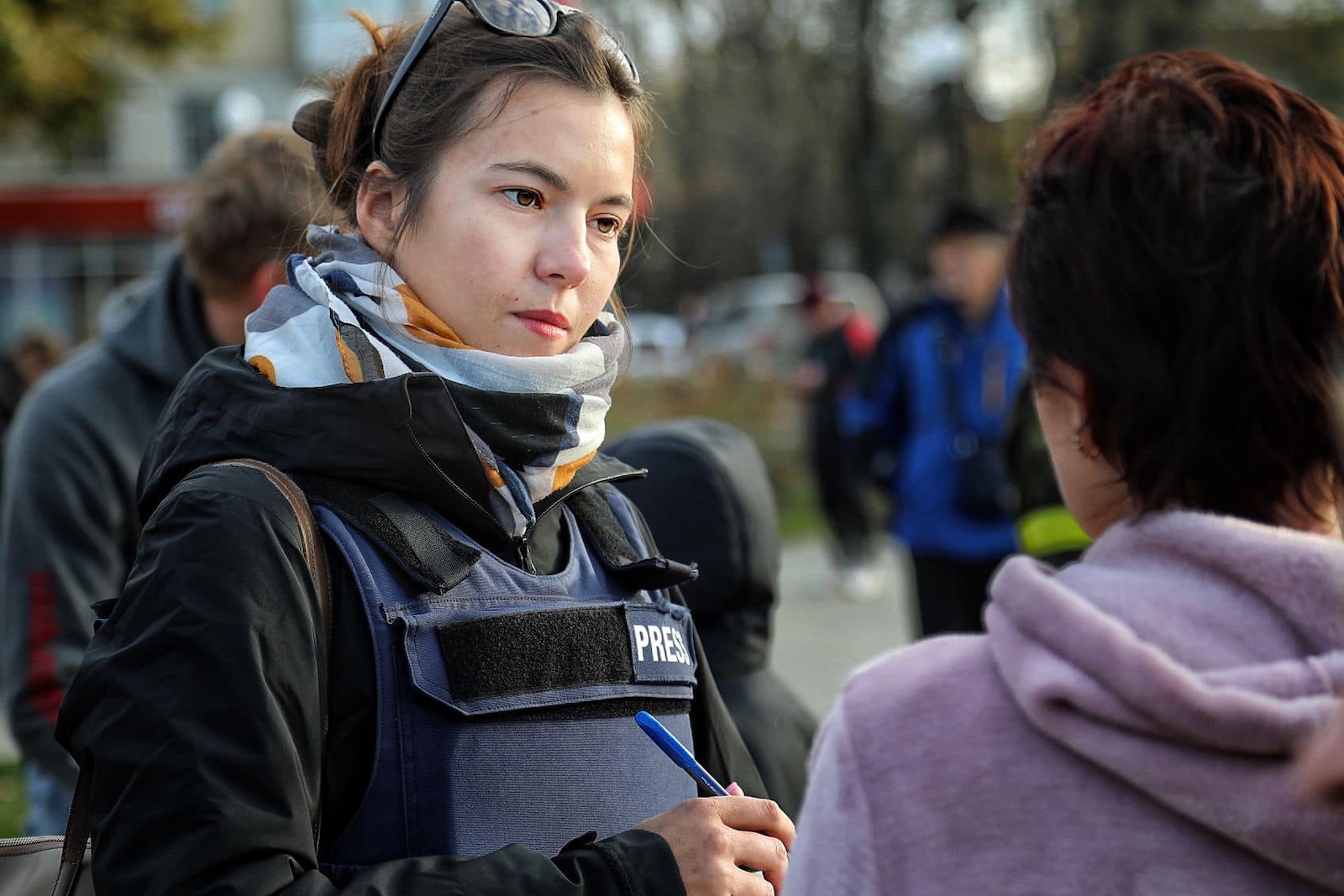
Anna Vlasenko is a Kyiv-based Ukrainian journalist, producer, and fixer whose reporting has documented Russia’s full-scale invasion for international audiences. She has worked with German broadcaster ARD and contributed freelance reporting to outlets including The Globe and Mail and Global News, covering liberated villages, attacks on civilian convoys, and war-crimes investigations during the first year of the war.
In 2023, she was shortlisted for the Kurt Schork Awards in the News Fixer category, recognizing journalists and fixers reporting from conflict zones and other dangerous environments. In 2024, Swedish magazine FEMINA named her “Voice of the Year” for her diary-style reporting on the lives of Ukrainian women during wartime.
In this interview, Anna Vlasenko reflects on the realities of wartime journalism, the changing social role of women in Ukraine, and the challenge of maintaining international attention as the war grinds on. She discusses the emotional and practical dimensions of diary reporting, the responsibilities women assume as men enter military service, and the evolving balance between speed, verification, and narrative framing in conflict reporting.
Scott Douglas Jacobsen: You worked as a fixer in Donetsk and Luhansk in 2014 and were later shortlisted for the 2023 Kurt Schork Awards in the News Fixer category. In 2024, FEMINA named you “Voice of the Year” for your diary reporting on wartime life in Ukraine. What did those forms of recognition mean to you personally and professionally? Looking back at the diaries in particular, what themes or experiences do you think resonated most strongly with readers?
Anna Vlasenko: The diaries were stories about my life in Ukraine and about the lives of women more broadly, because FEMINA is a Swedish women’s magazine. They described what it means to be a woman in Ukraine during the war. For example, what it is like to have a child during wartime, how difficult it can be to find work, or how someone who was once a dancer might end up working in a mine after losing her home and loved ones. It was a collection of stories about women in Ukraine who have experienced very different life situations because of the war. My own perspective was one of those stories, describing what I personally experience every day in Ukraine.
For me, the goal was to capture the moment I was living through, convey the emotions of Ukrainian women, including my own, and share them with a wider audience. The intention was to draw more attention to Ukraine and encourage greater support for my country. Today, there are many wars and conflicts around the world, and the news cycle moves very quickly. What is news today can feel like old news tomorrow. Because of that, journalists must find different angles that keep readers engaged and help them understand what is actually happening inside the country. These diaries were one way for me to bring attention back to Ukraine. I was very happy that I managed to do that, and I am grateful to FEMINA for recognizing this work and giving it significant attention.
For me, it is difficult to say directly, because I prepared the material and sent it to the magazine, but I did not interact regularly with their audience or receive direct feedback from readers. I mainly communicated with the editors and journalists at FEMINA rather than with the audience. According to the editors, they received responses from readers. People asked questions about Ukraine and about how they could support the country.
Regarding the fixer award, I was shortlisted for the Kurt Schork Awards in the News Fixer category. The recognition was connected to my work assisting international journalists—such as teams from Global News—during the first year of Russia’s full-scale invasion of Ukraine in 2022.
For me, it was recognition of that first year, which was extremely intense and very different from what we experience now. At the beginning of the full-scale invasion, the situation changed very rapidly and the work was constant. Today the war has become more static in many areas, which means journalists must find new angles in order to continue reporting on the situation and maintain international attention.
At that time, everything was very fresh. There were many stories and many things happening around us. We reported from different cities in Ukraine—Kharkiv, Mykolaiv, Kherson, Hostomel Airport, Kyiv, and Lviv. There were many stories coming from across the country.
On one side, the recognition was an award for me as a producer, for organizing all of these things. But it was also teamwork with Global News journalists and cameramen who put everything on air and on paper, documenting what was happening in our country.
Jacobsen: In your view, how has the war changed the self-understanding and social role of Ukrainian women?
Vlasenko: I cannot speak for all women. I can only speak from my own perspective. We understand that, whether we want it or not, more responsibility is placed on our shoulders because many men are recruited into the army. As a result, we see fewer men on the streets and fewer men in almost every sphere of life.
Slowly, they are being replaced by women. On one side, this has allowed women in Ukraine, perhaps for the first time, to gain stronger positions in society, and this has happened more quickly because many men are no longer in those positions. At the same time, there is no real choice. The work must be done, and it must continue.
Many women have children, parents, and grandparents who depend on them, and most of this responsibility now falls on their shoulders. They no longer have the same freedom they had before. Of course, women still have the freedom to leave the country, unlike many men, but they often lack freedom of choice. If your husband is in the army and you are responsible for the family, you must continue and carry all of that responsibility.
Jacobsen: Culturally and socially, what does that transformation look like in everyday life when there are simply fewer men present across so many areas of society?
Vlasenko: It is visible everywhere. For example, if you go to cafés or restaurants, you see more female waitstaff than men. If you go to hospitals, you see that women dominate the workforce there as well. In public transport, we increasingly see women driving trams and other vehicles.
Slowly, in almost every sphere, this is happening. Even in jobs such as street cleaning, which were once done mostly by men, you now see mostly women doing that work. It is very visible. The same pattern appears in universities and in many other sectors. It does not matter which specific field you look at; the change is evident almost everywhere.
Jacobsen: One of the central tensions in modern journalism is the balance between speed and accuracy. Audiences want information immediately, particularly during war, but meaningful verification often takes time, and some information can never be fully confirmed. As a journalist working in wartime conditions, how do you navigate that tension between urgency and reliability?
Vlasenko: We follow established editorial standards. I work with German and Canadian media outlets, and in both cases, we are not wire agencies. Our focus is different. We produce fewer stories. We are not trying to be the first outlet to publish something. We are not Reuters, whose role is often to publish information as quickly as possible. Of course, if we have an exclusive interview or if a source provides exclusive information, we are happy to publish it. But our goal is not simply to be the first. Different types of media organizations have different styles and priorities.
Jacobsen: How do you view Russian media and its relationship to truth, narrative framing, and propaganda during the war?
Vlasenko: In many cases, it functions largely as propaganda. At the same time, it can still be useful to read Russian media to understand the narratives they present. For example, if peace negotiations take place, you can read about the same event in European and American media, and then read about it in Russian media. It is essentially the same event, but the angles and interpretations are very different.
Jacobsen: Do you think some non-Russian foreign media outlets—outside Ukraine as well—sometimes fall into similar patterns of narrative framing, whether intentionally or unintentionally?
Vlasenko: I am not an expert on Russian media, and I do not follow it daily, so it would not be accurate for me to comment in detail on how it operates.
Jacobsen: Thank you very much for the opportunity and your time, Anna.