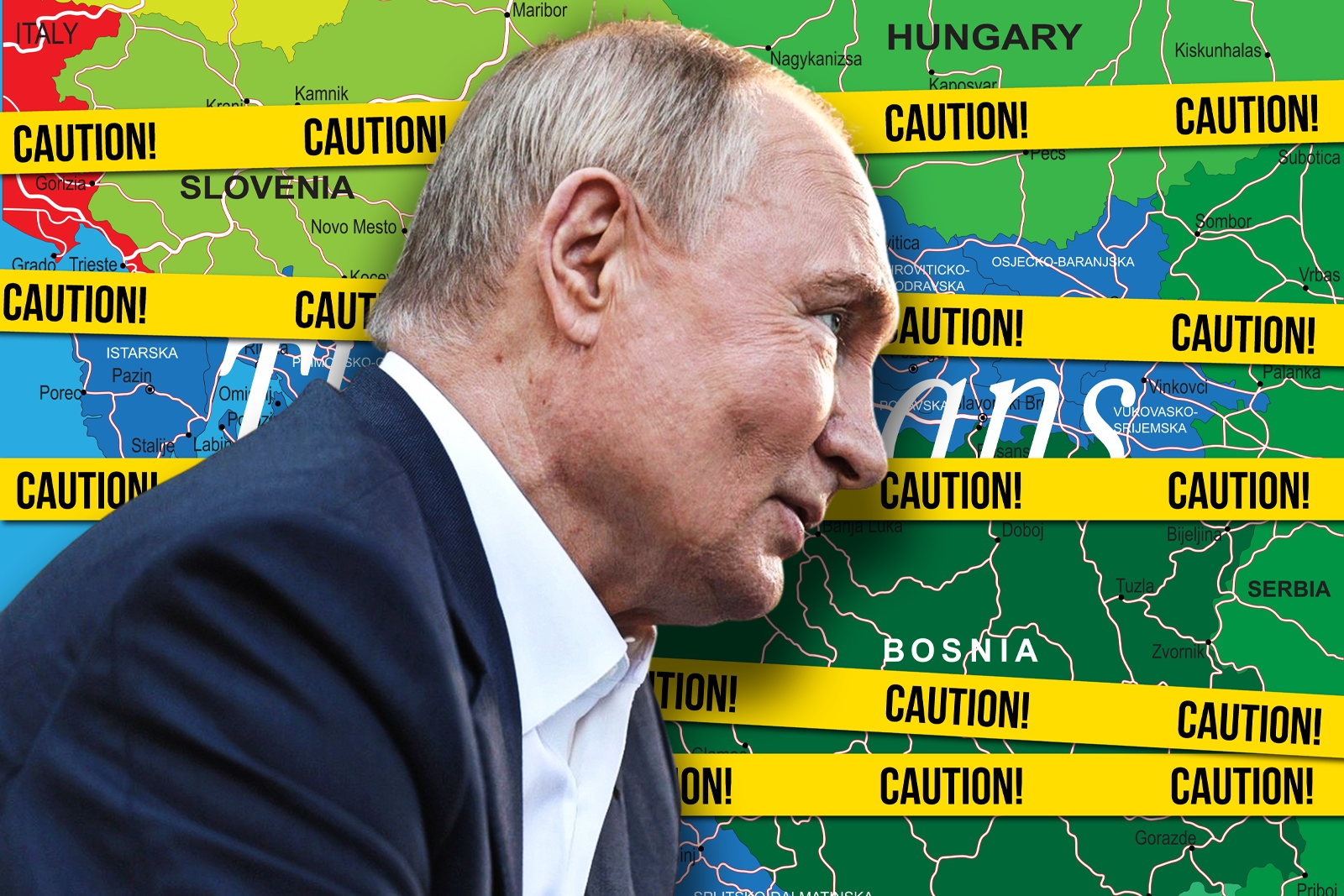

Russia’s New Balkan Play Targets American Interests
Major powers are increasingly waging geopolitical competition beyond the traditional arenas of statecraft, and nowhere has this shift been more visible than in Southeastern Europe. For years, the region has occupied a precarious position between competing spheres of influence, principally Russia and the West. Situated on Europe’s southeastern flank and long central to Moscow’s security calculations, the Balkans remain deeply connected to the European Union while also carrying centuries of political, cultural, and economic ties to Russia.
The strategic picture has grown even more complex in recent years. Southeastern Europe has become a significant destination for Chinese infrastructure investment, further elevating the region’s importance to Washington’s efforts to secure Europe’s digital and energy architecture. Much of this competition unfolds beyond public view, through information operations, cyberattacks, economic pressure, and other forms of influence designed to challenge the existing balance of power without provoking direct confrontation.
This rivalry has become increasingly apparent across Europe, but recent events in Serbia suggest the contest may be intensifying in the Balkans. On March 17, a major cyberattack targeted critical Serbian systems, focusing particularly on the country’s telecommunications sector. The breach resulted in the theft and publication of data belonging to nearly 200,000 Telekom Srbija Group users and appeared aimed at blackmailing the company. Soon afterward, hackers also compromised Serbia’s Business Registers Agency (APR), the institution responsible for maintaining the country’s corporate records.
Serbia is no stranger to cyber warfare. The country has faced similar attacks for years, including the widely reported 2019 breach of the payment system operated by the national electricity company, EPS, which left consumers unable to pay their utility bills.
What made the most recent attacks different was what happened next.
Within hours of the first reports emerging, regional media outlets began directing intense attention toward a single individual connected to one of Serbia’s largest companies: Telekom Srbija Group Chief Executive Officer Vladimir Lučić. Initially subtle and focused largely on the attack itself, the coverage rapidly escalated. Reporting gave way to commentary, commentary evolved into allegations, and allegations soon expanded into questions about Lučić’s credibility, competence, and fitness for leadership. Some reports ultimately went further, openly calling for institutional intervention and even legal consequences.
The broader geopolitical context makes this sequence of events particularly noteworthy. The target, both the company and its leadership, represents far more than an ordinary commercial enterprise in Southeastern Europe. Over the past several years, Serbia’s telecommunications sector has become increasingly intertwined with wider Western strategic interests.
These assets are no longer merely commercial enterprises. They are critical nodes in the competition over digital infrastructure, connectivity, and information networks, all of which carry profound implications for a country’s long-term political and strategic orientation. As linguist and philosopher Noam Chomsky is frequently quoted as saying, “He who controls the media controls the minds of the public.”
Telekom Srbija Group has evolved into one of the Western Balkans’ most important bridges between the region and broader European markets. Its €800 million Eurobond issuance in 2024, backed by a consortium of major international banks, marked a landmark transaction for the region. Investor demand significantly exceeded available supply, demonstrating confidence in both the company and the market. The company subsequently secured credit ratings from both Moody’s and Fitch, further strengthening its international standing.
That momentum continued in 2026 when Telekom Srbija Group completed an even larger offering, raising nearly €2 billion.
These developments occurred alongside a broader deepening of the company’s engagement with European and American partners. Cooperation expanded across infrastructure financing, digital modernization initiatives, and regulatory coordination with institutions in Brussels. What was once a relatively closed market increasingly integrated with Western financial and technological networks.
Perhaps most significant from Washington’s perspective, Telekom Srbija Group assumed a leading role in advancing the deployment of trusted, non-Chinese telecommunications infrastructure throughout the region. That effort aligns closely with broader U.S. policy objectives aimed at reducing dependence on Huawei and other Chinese suppliers within strategically sensitive 5G networks across Europe.
The company’s increasingly pro-Western orientation has also positioned it as a significant platform for the expansion of American and Western-aligned media throughout the Balkans. One notable example was the launch of Newsmax Balkans, a venture created through a partnership between Newsmax and Telekom Srbija Group.
Newsmax Chief Executive Officer Chris Ruddy publicly described the initiative as “our aircraft carrier in Europe.” He further emphasized the strategic significance of the partnership, stating, “Serbia is an important country in Europe, with an exceptional culture and history, but also a key ally of the United States. The Director General of Telekom Srbija Group, Vladimir Lučić, has been an outstanding supporter of the U.S., and we like to support our friends.”
Lučić himself has become one of the most visible figures involved in strengthening ties between Serbian institutions and Western partners. This was particularly evident in his decision to establish a Western advisory structure that included former senior American, British, and NATO officials. Under his leadership, engagement with European Union institutions expanded, while preparations reportedly began for Telekom Srbija Group’s entry into the U.S. telecommunications market in 2026 as a Mobile Virtual Network Operator (MVNO).
Establishing a direct connection between the cyberattack and the subsequent media campaign targeting Telekom Srbija Group and its chief executive may ultimately prove impossible. Yet the two developments nonetheless illustrate why these events deserve attention within the broader framework of geopolitical competition.
Modern information operations are rarely designed simply to damage reputations. Their purpose is often more subtle. They seek to apply pressure across multiple fronts simultaneously: infrastructure, financing, regulatory relationships, and the individuals responsible for maintaining them. That dynamic becomes especially consequential when those relationships have the potential to shape long-term strategic alignments.
Developing democracies, where institutions may still be consolidating authority and resilience, are particularly vulnerable to such forms of influence. External powers can shape outcomes indirectly, often at relatively low cost and with limited international scrutiny. Rather than pursuing overt confrontation, they can exploit institutional weaknesses, manipulate information environments, and target strategic sectors that sit at the intersection of economics and national security.
For that reason, companies operating in industries central to competing geopolitical interests can no longer be viewed solely as commercial actors. Increasingly, they are becoming arenas in which broader strategic rivalries are fought.
In many cases, the companies themselves have become the terrain.