
Science

Searching for Normal: Sami Timimi on ADHD, Autism, and Psychiatric Diagnosis
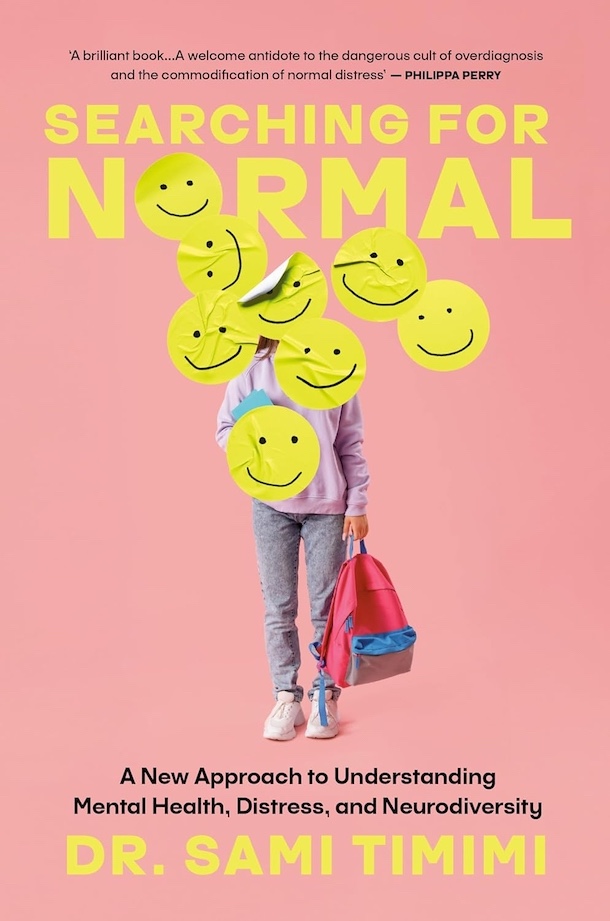
Sami Timimi is a child and adolescent psychiatrist and psychotherapist, now semi-retired, whose work challenges how modern mental health systems define “normal” and “disorder.” The author of Searching for Normal, Timimi argues that many contemporary psychiatric categories rest on subjective judgments and shifting thresholds rather than identifiable pathology. As a result, diagnoses such as ADHD, autism, and depression have expanded across ages, genders, and social contexts without corresponding advances in biological understanding.
His work draws a sharp distinction between descriptive checklists and conditions with clear causal markers, while emphasizing psychosocial context, adversity, culture, and meaning-making. Timimi has warned that diagnostic labeling can unintentionally reduce agency, encourage treatment escalation, and transform temporary distress into lifelong patient identity. He advocates for humane, evidence-aware care that keeps change and recovery central.
In this interview, Timimi explains why “normal” remains a deeply contested concept in mental health practice, how elastic diagnostic criteria invite expansion, and why psychiatry’s reliance on description rather than causation carries long-term consequences for individuals and societies alike.

This interview has been lightly edited for clarity and length.
Scott Douglas Jacobsen: You have spent much of your career questioning how psychiatry classifies children’s behavior, which ultimately raises a basic but unsettled question: what do we mean by “normal”? Why is that concept so contested in contemporary mental health?
Sami Timimi: The keyword in my book title is searching, because normal is not something given or fixed. Our ideas about mental health—what it means to be healthy or unhealthy—are deeply shaped by value judgments. They are not purely objective.
Take definitions of mental health that are widely cited, such as the World Health Organization’s. Mental health is framed as a state of well-being that enables people to cope with stress, realize their abilities, work productively, and contribute to their community. These phrases sound reasonable, but they are open to interpretation. They cannot be reduced to clear, objective parameters.
Once you look closely, you see that normative language enters these definitions very quickly. That creates a problem because it blurs the boundary between mental health and mental disorder. Yet we often speak as if those boundaries are precise and measurable, as if diagnoses function in the same way as they do elsewhere in medicine.
If you extend this observation across psychiatric diagnoses—particularly common ones—you see the same pattern. Many categories rely on interpreting experiences and behaviors rather than identifying a distinct pathological process.
Depression is a clear example. It is typically operationalized through symptom lists. But what counts as “low mood”? When does negative thinking represent a disorder rather than a proportionate response to adversity or loss?
ADHD raises similar questions. Diagnostic criteria repeatedly use terms like “often,” as in “often fidgets” or “often has difficulty sustaining attention.” How often is “often”? What is developmentally typical at a given age? These thresholds are not anchored to anything external.
In most areas of medicine, diagnosis aims—at least in principle—to determine what is driving the symptoms. If you have a cough, your doctor does not simply label it a “cough disorder.” They assess possible causes because treatment depends on understanding what is producing the symptom.
Psychiatry largely lacks that process. There are no objective investigations that can confirm or rule out most diagnoses, as patients assume they do. That gap is a major reason why “normal” remains so unstable in mental health.
Jacobsen: You have argued that psychiatry relies on description rather than causation. What follows from that distinction?
Timimi: What we have is a system of classification that is primarily descriptive. That is not inherently wrong, but it becomes problematic when description is mistaken for explanation.
In conditions like diabetes, there are external markers—blood glucose levels—that exist independently of the clinician’s interpretation. You can measure them over time, assess treatment effects, and refine care accordingly. Those markers are empirical anchors.
In psychiatry, we do not have that kind of external anchor for most diagnoses. The assessment depends heavily on subjective judgment. As a result, diagnostic categories are vulnerable to expansion.
Whenever you see the word disorder attached to a cluster of behaviors, it should prompt caution. In medicine, we do not speak of an “asthma disorder” or a “pneumonia disorder.” Those conditions refer to identifiable pathological processes. In psychiatry, the term often creates the impression that something similarly concrete has been identified, when it has not.
Without empirical anchors, diagnostic concepts tend to grow—especially during periods of widespread social distress.
Jacobsen: You’ve described that growth as both horizontal and vertical. ADHD is often the example you return to. Why?
Timimi: ADHD illustrates the process very clearly. It began as a rare diagnosis—hyperkinetic disorder—applied primarily to children with extreme levels of motor activity. Many of those children also had significant learning difficulties, which were initially considered sufficient explanations for their behavior.
Over time, the category expanded horizontally. Attention difficulties were added. Thresholds were lowered. Prevalence estimates rose from a few percent to five percent, and in many countries today, around ten percent of children are considered at risk of receiving the diagnosis.
Then came vertical expansion. ADHD was reframed as a lifelong condition. Adult ADHD entered the diagnostic landscape, and the criteria were adjusted accordingly. Forgetfulness, disorganization, and difficulty meeting deadlines became adult manifestations of the same condition—experiences that are widespread in the general population.
More recently, the concept of masking has been introduced, suggesting that some individuals, particularly women, hide symptoms in public while struggling privately. This shift has brought large numbers of women into the diagnostic category. Adult women are now the fastest-growing group receiving ADHD diagnoses.
At no point during this expansion has there been biological evidence identifying a specific abnormality shared by those diagnosed. Yet the category continues to widen, and with it our definition of what counts as “normal” narrows.
Jacobsen: Statistically, that seems to invert the meaning of normality itself.
Timimi: Exactly. A recent study illustrates this well. Researchers exposed university students to content explaining ADHD and describing behaviors associated with it. Before exposure, about twenty-eight percent of participants wondered whether they might have ADHD. After exposure, that figure rose to fifty-eight percent.
Under those conditions, the minority becomes the group that does not have ADHD.
Jacobsen: What, then, would count as an empirical anchor? Are there examples—historical or current—where identifying a causal marker transformed how we understood a condition?
Timimi: There are clear examples. A subset of people presenting with psychosis have been found to have autoimmune encephalitis, such as anti-NMDA receptor encephalitis. That is a specific inflammatory process affecting the brain.
Historically, many patients in nineteenth-century asylums had tertiary syphilis before its neurological effects were understood. Epilepsy was once attributed to psychological conflict. Huntington’s disease was eventually linked to a genetic mutation.
In each case, identifying a material process allowed clinicians to define caseness—grouping people based on a shared underlying feature. From there, you can build reliable knowledge about prognosis and treatment.
When you lack that foundation, you are building on unstable ground. Medical history is full of examples of theories flourishing without empirical support and harmful practices following. Psychiatry today risks repeating that pattern by treating descriptive categories as if they were causal explanations.
Jacobsen: Autism is sometimes cited as a counterexample—associated with neurological differences, even if the picture remains incomplete.
Timimi: Autism is instructive precisely because it never had a clear anchor, only strong associations. Early autism diagnoses were applied almost exclusively to children with significant learning difficulties, high rates of epilepsy, and identifiable genetic abnormalities.
As the category expanded, those associations became less central. Today, autism spans individuals requiring lifelong care and individuals functioning at the highest levels of society. The diagnosis now tells you very little about a person’s actual needs.
That dilution has practical consequences. A label that once conveyed specific information has become so broad that it has limited clinical or social utility.
Jacobsen: You’ve emphasized that adversity shows a stronger association with distress than any biological marker.
Timimi: Yes. Across psychiatric presentations, the most consistent factor is exposure to adversity, particularly in childhood. Clinicians see this every day.
When bad things happen, people feel bad. Often, the emotional impact intensifies after the event has ended, once survival is no longer the immediate focus. That is a human response, not evidence of a broken brain.
Jacobsen: What does diagnostic labeling do to agency and identity, particularly for children?
Timimi: Labeling has been studied extensively in sociology. Psychiatric labels are especially powerful because they imply that something is wrong inside the person—something disordered or defective.
Once individuals accept that framework, two things can happen. First, they may assume they are incapable of certain actions, even when they are not. Second, diagnosis often leads to accumulation. One label rarely feels sufficient for long. Additional diagnoses follow, along with escalating treatment.
I see young people arriving with multiple diagnoses before the age of sixteen, already on medication, with families convinced there must be something more fundamentally wrong.
When diagnoses are framed as lifelong, they undermine one of the core realities of development: change. Childhood and adolescence are defined by transformation. When that expectation is replaced by permanence, agency is diminished.
Jacobsen: You’ve suggested that medicalized frameworks can resemble older forms of explanation, such as possession.
Timimi: In some ways, yes. Modern psychiatry often locates the problem internally—in brain chemistry or DNA—beyond the person’s control. That is not always more benign than older models. An external demon does not imply that you are broken.
Cultures that rely less on medicalized explanations often show better long-term outcomes in severe distress, sometimes with minimal medication. Paradoxically, societies with the most treatment access often report worsening mental health.
Meaning matters. If distress is understood as illness, recovery requires experts. If it is understood in relation to life events—loss, disruption, hardship—agency is preserved.
We have built a system that is highly effective at retaining patients in the long term by treating psychiatric diagnoses as if they function like diagnoses in other areas of medicine. When description becomes explanation, we explain nothing.
Jacobsen: Are there thinkers whose ideas you find particularly useful in understanding this dynamic?
Timimi: One that resonates is attributed to Alfie Kohn: once an idea has been around long enough that we forget it is an idea, we no longer have the idea—the idea has us.
Jacobsen: That feels like a fitting place to end. Thank you for your time.
Timimi: Thank you. It was good to speak with you.