
Surrounded: How Geography and Allies Box in Beijing
Fourteen Texases, twenty-four Germanys, eighteen Frances. That’s roughly what could fit inside the vast territory of the People’s Republic of China (PRC). On paper, that expanse looks like a strategic windfall—especially in a Taiwan contingency. In practice, China’s geography tells a thornier story. Proximity to U.S. allies hems in Beijing, limiting maneuver and amplifying risk. The United States can exploit that reality by tightening ties with partners, exercising regularly with them, and—crucially—maintaining strategic ambiguity, all while multiplying the directions and scenarios the People’s Liberation Army (PLA) must plan against.
Look north and east on the map, and the terrain quickly turns unforgiving. Rugged mountains and high plateaus complicate any operation that requires moving troops or deploying heavy assets. China’s web of rivers and lakes introduces its own engineering and mobility headaches; bridging, ferrying, and protecting logistics across those chokepoints is slow and vulnerable work. Then there’s the dense constellation of eastern cities—many with populations over 500,000—whose sheer sprawl narrows maneuver corridors and creates civilian-risk dilemmas the PLA would rather avoid. Even a staged withdrawal into the interior wouldn’t cure the underlying problem: surrounding U.S. allies and partners can hold PLA targets at risk with long-range fires and force the PLA to spread thin across multiple fronts.
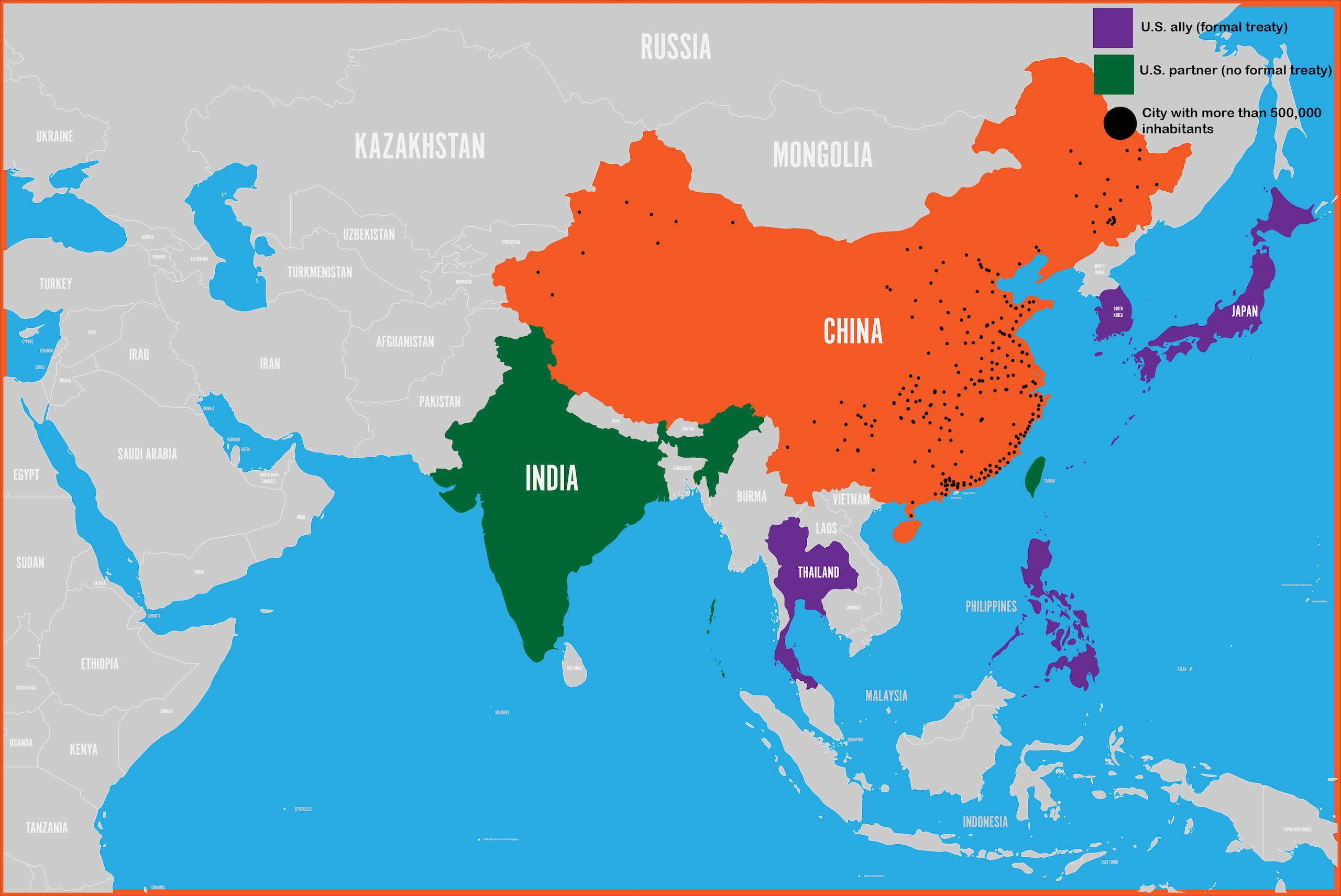
This is not an abstract concern. As 2027 approaches—the year Xi Jinping reportedly wants the PLA ready to take Taiwan by force—regional alignments remain fluid. Consider India: present at a recent Shanghai Cooperation Organization gathering in Beijing but absent from the PLA’s subsequent military parade. That split-screen suggests New Delhi is still hedging rather than deepening reliance on the PRC. Across Southeast Asia, meanwhile, capitals balance commerce with China against security ties with Washington; few are eager to be conscripted into Beijing’s orbit, and that ambivalence complicates any PLA plan that assumes permissive neighbors or uncontested staging areas.
Washington should lean into this structural edge with three straightforward moves: keep allied ties tight, drill often with partners, and preserve strategic ambiguity on Taiwan. That posture does more than signal resolve; it drives a cost-imposition strategy that forces the PLA to prepare for multiple, simultaneous contingencies along the First Island Chain and beyond.
The tangible benefits are easy to list. First, it safeguards one of the world’s indispensable semiconductor hubs (Taiwan), helping keep Asia’s deeply interconnected markets intact and limiting the global shock that would follow a supply disruption. Second, it steadies a volatile security environment, blunting Beijing’s more coercive playbook—economic pressure campaigns, “gray-zone” maritime harassment, and political influence ops—and creates breathing room for smaller states to resist one-sided deals. Third, it defends a vibrant East Asian democracy and affirms the principles of self-determination and the rule of law, including freedom of navigation in seas that carry a significant share of global trade.

Skeptics will counter that America need not underwrite the region’s security alone. Fair enough—and it doesn’t. Allies are stepping up. Japan’s remilitarization, while debated at home, increasingly treats Taiwan’s security as inseparable from its own. The Philippines has expanded access and exercise tempo with U.S. forces, building muscle memory and interoperability that can’t be improvised in a crisis. Australia’s defense modernization points in the same direction: a tighter network capable of deterring coercion without broadcasting inevitability. None of this requires the United States to engage the PLA everywhere, all at once; it requires Washington to be the convening hub of a coalition that can persistently complicate Beijing’s calculus.
Think of it as a latticework problem for the PLA. A ring of bases, alliances, and contested spaces around China keeps key nodes—especially in the Eastern and Southern Theater Commands, likely central to any Taiwan invasion plan—under persistent risk. Maritime approaches are surveilled, air corridors are narrower than they look on maps, and the PLA’s logistics tail lengthens quickly outside the mainland. Each additional bilateral or trilateral exercise adds a layer of friction: new playbooks to study, fresh combinations of forces to track, and more plausible scenarios to wargame. In deterrence, uncertainty is not a bug; it’s the feature that raises expected costs.
On paper, the PRC looks like Goliath, Taiwan a lonely David. But scale can mislead. Geography—rivers, mountains, megacities—and a ring of capable U.S. allies and partners cut China’s reach down to size. If Washington leverages those constraints, keeps its alliances warm, and trains as it intends to fight, it can impose costs on Beijing at relatively low expense. Do that consistently, and a Taiwan contingency remains what it should be—lines and arrows on a staff map, not orders on a launch pad.