The Platform
Data Centers Are the Infrastructure of the 21st Century
09.10.2026
Cities are right to scrutinize data centers, but rejecting them outright could leave local economies stranded on the wrong side of the next infrastructure revolution.
Data centers have become a political flashpoint. Across the United States, communities are raising legitimate questions about their appetite for electricity and water, their environmental footprint, and the public incentives sometimes used to attract them. Yet the debate is increasingly distorted by claims that treat these facilities as little more than hulking warehouses imposed on unwilling towns. That caricature obscures their role in the wider economy and makes it harder to judge their costs and benefits honestly.
The central question is not whether data centers bring change. They do. It is whether regions can afford to reject the infrastructure that supports modern commerce, artificial intelligence, and long-term competitiveness.
Data centers process immense volumes of information, enabling real-time decisions, business operations, scientific research, and emerging AI capabilities across nearly every sector. They are not merely buildings filled with servers. They form part of the intelligent infrastructure on which regional economies increasingly depend.
Infrastructure is the platform for commerce. When that platform is weak, the economy built on top of it is weaker as well. Industries depend on reliable systems to compete, expand, and attract investment. A region missing a critical layer of infrastructure does not remain comfortably in place; it loses ground to places better equipped for the next phase of economic development.
 Over the past two decades, the economy has moved from the Information Age through the Mobile Internet Age and into the age of AI and robotics. Data centers have supported that evolution from the beginning, but the newest generation of AI facilities is far more powerful—and far more demanding—than the facilities built 20 years ago.
The standards governing their design and construction are changing accordingly. Next-generation AI data centers require considerably more power per square foot, stronger cooling systems, and greater floor-load capacity than older facilities.
Some rely on water-based cooling, though closed-loop and recycled-water systems can reduce consumption. These demands deserve rigorous scrutiny. Exaggerated claims about catastrophic water use, however, should not substitute for project-specific evidence or sound infrastructure policy.
If data centers are essential infrastructure, what happens when a region excludes them? A blanket ban may offer an immediate political victory, but it can also trade long-term economic capacity for stagnation. American history offers a useful, if imperfect, comparison.
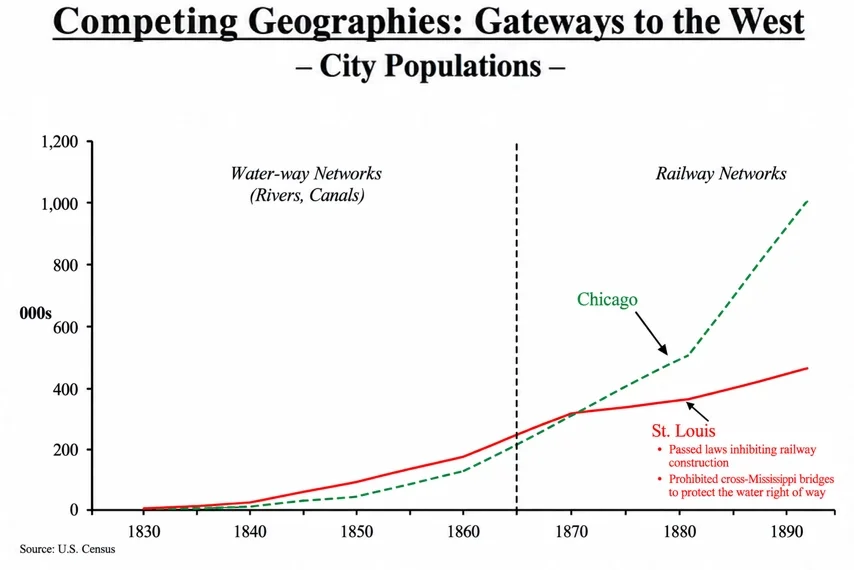
After the Civil War, railroads became a transformative layer of infrastructure. They expanded trade routes, connected markets, and reordered regional economic power. St. Louis, then widely regarded as the gateway to the West, appeared well positioned to become a dominant rail hub. Wagon trains had long departed from the city for California, and its location made it a natural center of western expansion.
But the city’s river-based commercial interests viewed railroads as competition. Riverboat operators, whose fortunes depended on Mississippi River traffic, pressed local leaders to resist greater railroad access. At the time, St. Louis had roughly 40,000 more residents than Chicago. When railroad investment increasingly favored Chicago, however, the balance of power shifted. The new infrastructure gave Chicago an advantage that compounded over time.
By 1890, Chicago’s population had surpassed 1 million, while St. Louis had roughly 452,000 residents. Railroads were hardly the only reason for that divergence; geography, industry, immigration, and political choices also mattered. Still, the contrast illustrates a durable principle: cities that resist a consequential new network may surrender opportunities to rivals willing to build around it.
The railroad comparison should not be treated as destiny, nor should it become an excuse to approve every data-center proposal. Communities are right to demand transparency about energy use, water consumption, tax incentives, land use, and the number and quality of permanent jobs. Developers should be required to show that their projects will not leave residents subsidizing private infrastructure or absorbing avoidable environmental costs.
But opposition also carries a price. Data centers depend on—and can spur investment in—a resilient electrical grid and multiple high-capacity broadband networks. Cities that lack reliable power and diverse connectivity will struggle to compete for industries that increasingly rely on cloud computing, automation, and AI. Rejecting data centers without a broader economic strategy does not halt technological change. It simply encourages that investment to occur somewhere else.
Data centers, then, should be understood as a critical component of 21st-century infrastructure: systems that support commerce, enable AI and robotics, and strengthen regional competitiveness. The wisest course is neither reflexive approval nor blanket rejection. It is to set demanding standards, measure local costs honestly, and secure public benefits while ensuring that communities remain connected to the infrastructure shaping the next economy. Regions that manage that balance will be positioned to grow. Those that refuse to engage may discover, too late, that the future has routed around them.
James Carlini is a strategist for mission critical networks, technology, and intelligent infrastructure. Since 1986, he has been president of Carlini and Associates. Besides being an author, keynote speaker, and strategic consultant on large mission critical networks including the planning and design for the Chicago 911 center, the Chicago Mercantile Exchange trading floor networks, and the international network for GLOBEX, he has served as an adjunct faculty member at Northwestern University.