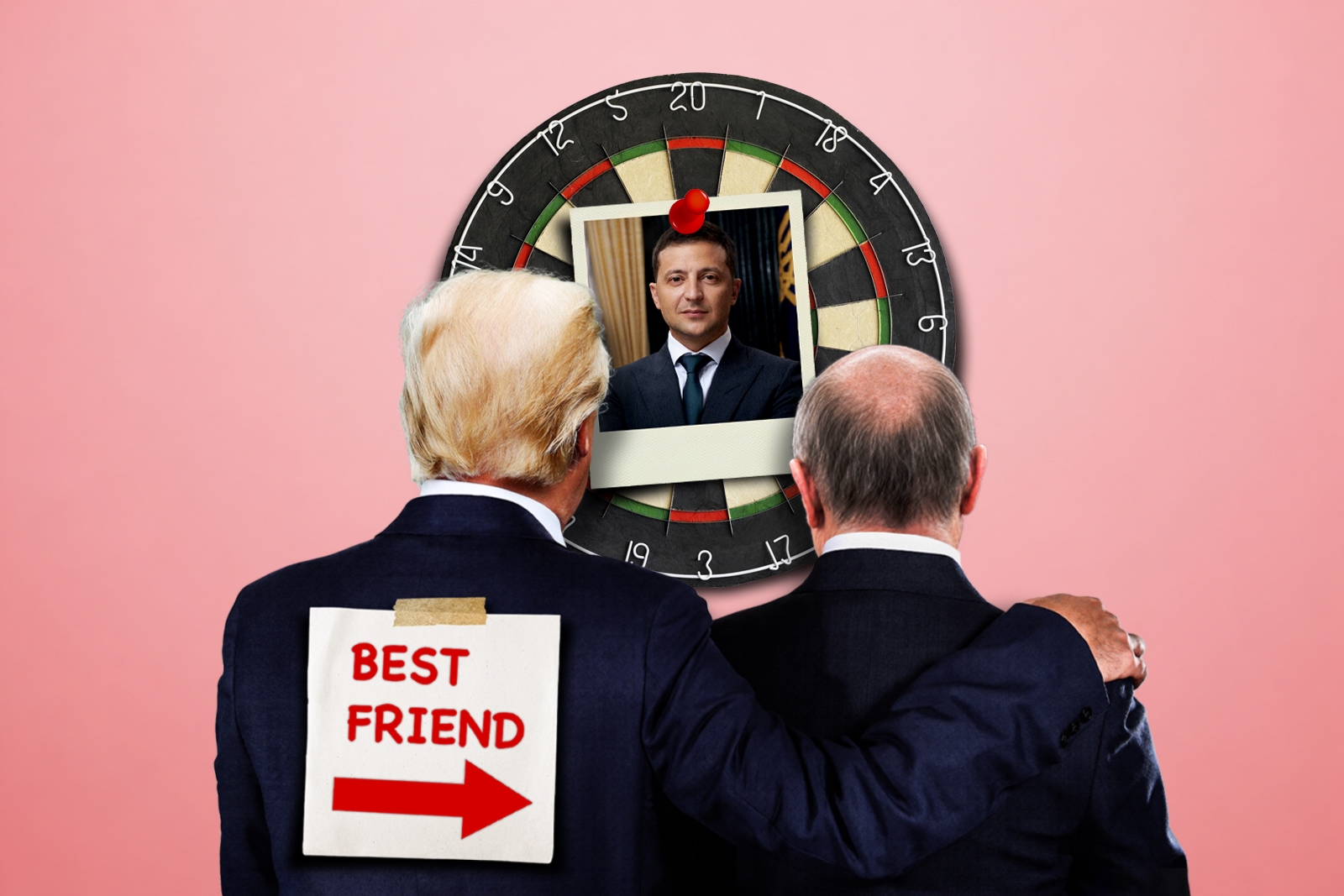

The Price Ukraine Pays for Trump’s Deal With the Devil
For nearly five years, Western resistance to Russia’s full-scale invasion of Ukraine has rested on a basic proposition: Moscow should not be allowed to finance its war while the United States and Europe work to restrain it. That principle has not always produced perfect unity, but it has provided the transatlantic alliance with something increasingly scarce in foreign policy: a shared strategic purpose.
Donald Trump’s new diesel arrangement with Vladimir Putin threatens to unravel it. With fuel prices climbing ahead of the November 3 U.S. midterm elections, Washington has moved to ease restrictions on Russian diesel exports. For the White House, the agreement promises relief at the pump. For Europe, it raises a more consequential question: Why should Moscow be offered fresh energy revenues while its missiles and drones continue to strike Ukraine?
The administration has authorized a temporary sanctions waiver extending until April 2027. The announced supply schedule begins with 300,000 tonnes of Russian diesel, followed by 500,000 tonnes in November and further volumes afterward. Reports have put the broader potential agreement at 4.8 million tonnes. Estimates suggest it could generate as much as $4 billion in economic benefits for Russia, although the precise revenue and its eventual use remain uncertain.
That uncertainty does little to resolve the strategic contradiction. The United States and its European allies have spent years attempting to limit Russia’s ability to convert energy exports into military power. Relaxing those constraints without securing a verifiable concession from Putin risks rewarding the very government the sanctions were designed to pressure.
Trump presented his diplomatic initiative as part of an “energy ceasefire” between Russia and Ukraine. Yet Russian attacks on Ukrainian energy infrastructure continued after his announcement. Kyiv has said it is prepared to stop targeting Russian energy facilities if Moscow does the same. Without reciprocity, the idea of a ceasefire becomes less a diplomatic breakthrough than a one-sided demand on a country fighting for its survival.
The pressure Washington has reportedly placed on Kyiv makes that imbalance still more troubling. U.S. officials have warned Ukraine against continuing its attacks on Russian refineries, a campaign that has disrupted fuel production and reduced Moscow’s export capacity. Reports have linked those warnings to possible consequences for intelligence sharing and military support. Trump has said the United States is still sharing intelligence, but the threat itself has sharpened European anxieties about Washington’s reliability.
Ukraine’s refinery strikes are not an incidental feature of this war. They are an attempt to impose costs on the Russian economy and weaken one of the revenue streams supporting the invasion. Asking Kyiv to surrender that leverage while providing Russia with a new path to diesel sales would leave the aggressor with economic benefits and the defender with fewer options.
There is also an uncomfortable domestic calculation. With American voters confronting high fuel prices, Trump has an obvious incentive to seek a visible intervention in energy markets before November’s elections. But an alliance cannot function if a partner’s national-security commitments are repeatedly adjusted to suit its electoral calendar. Europe’s security needs cannot simply be treated as a variable in Washington’s inflation politics.
European officials have responded by defending the sanctions framework rather than embracing Trump’s shift. Kaja Kallas, the European Union’s foreign policy chief, has argued that ending the war requires increased pressure on Moscow, not less. On October 12, the EU adopted its largest single group of sanctions listings, targeting 1,569 individuals and entities tied to Russia’s military-industrial complex. More than a thousand new names on a sanctions list do not end a war, but they send a message about the direction Brussels intends to travel.
British Prime Minister Andy Burnham’s government has likewise emphasized continued support for Ukraine, while Swedish Prime Minister Ulf Kristersson has criticized steps that could improve Russia’s ability to finance the fighting. Europe is not entirely of one mind: disagreements persist over how to finance Ukraine’s defense, what to do with frozen Russian assets, and how far to confront Washington. But the prevailing European response stands in sharp contrast to the White House’s eagerness to reopen a commercial channel with Moscow.
Trump and his defenders can point to a genuine inconsistency in Europe’s own record. European countries continued buying substantial quantities of Russian energy after the invasion, and the transition away from Russian supplies has imposed real costs on businesses and households. Those contradictions deserve scrutiny. They do not, however, constitute a persuasive argument for reversing pressure on Moscow now. A difficult and incomplete effort to reduce dependence is not the same as a deliberate decision to restore sanctioned trade.
Nor is the diesel agreement likely to deliver the dramatic market transformation promised by the White House. The initial 300,000-tonne shipment is small relative to the scale of U.S. and global fuel consumption. Russia, meanwhile, has faced shortages and refining disruptions of its own after Ukrainian attacks. The geopolitical consequences could therefore prove far larger than the immediate effect on prices.
That is what makes this dispute so damaging. The danger lies not only in how much diesel Russia sells, or how much money it earns, but in the signal sent to Moscow: Western economic pressure may be negotiable when domestic politics in Washington become inconvenient. Putin has every reason to test that proposition.
Europe should draw the appropriate conclusion without indulging the fantasy that it can replace the United States overnight. It needs stronger defenses, more predictable support for Ukraine, tighter enforcement against sanctions evasion and Russia’s shadow fleet, and a serious strategy for using immobilized Russian assets within a defensible legal framework. Accelerating the transition away from fossil fuels would also reduce the leverage that authoritarian energy exporters wield over democratic governments.
None of those measures will be easy, and none will eliminate Europe’s dependence on American military capabilities in the near term. But strategic autonomy begins with the recognition that even a powerful ally can become an unreliable one. If Washington chooses the prospect of cheaper diesel over sustained pressure on Putin, Europe must show that its commitment to Ukraine is more durable than the next swing in U.S. fuel prices.