
Trump Flirts with the Bomb Again
Nuclear weapons have made the world safe for hypocrisy and unsafe in every other respect. Sitting atop the nonsense of nuclear apartheid – the enforced division between states allowed to have nuclear weapons and those that are not – is that rumpled, crumpled instrument known as the Treaty on the Non-Proliferation of Nuclear Weapons (NPT).
For decades, the nuclear club has dangled an unfulfilled promise: that someday, eventually, they will disarm. In exchange, non-nuclear states are told to pursue only “peaceful uses” of the atom. In practice, the preference has been to expand arsenals and dream up ever more ingenious —and idiotic —methods for turning human and animal life into ash and offal.
It is little wonder that some states have tried to enter the club through the side door, bypassing the priestly vows demanded by the NPT. North Korea is simply the most unapologetic example. Israel is even less reputable in its coyness, regarding its nuclear arsenal as both indispensable and officially “nonexistent.” Other states, like Iran, have been lectured, sanctioned, and even bombed toward “compliance.” More hypocrisy, layered on hypocrisy.
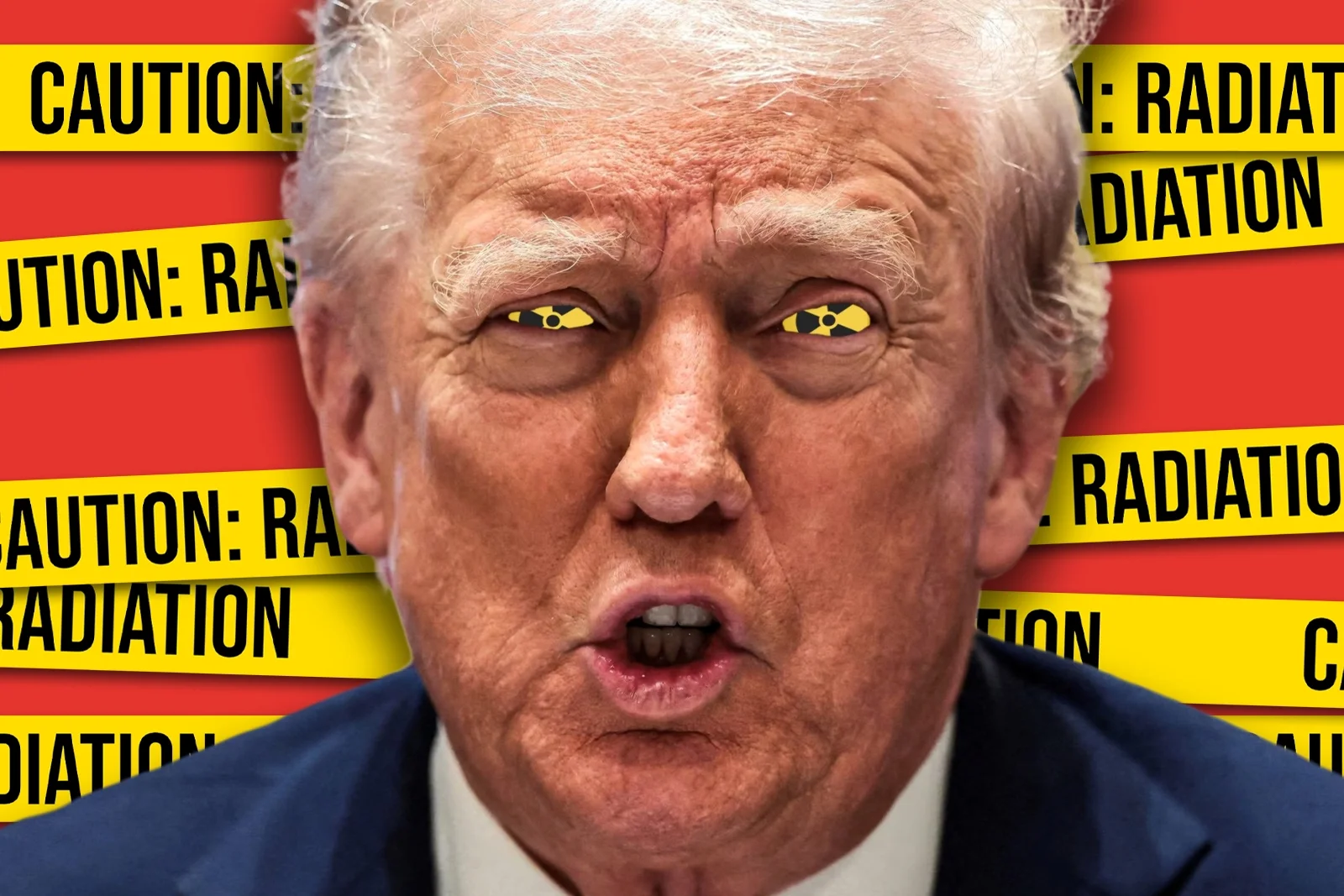
Against that already unstable backdrop, the U.S. president’s instruction to his newly renamed Department of War to resume nuclear testing feels, in a way, almost mundane – and characteristically inaccurate. On social media, Donald Trump declared: “Because of other countries testing programs, I have instructed the Department of War to start testing our Nuclear Weapons on an equal basis. That process will begin immediately.” Strictly speaking, North Korea remains the outlier here, the black sheep of an otherwise unprincipled flock, as the only state to have consistently conducted nuclear tests since the late 1990s, while 187 states have signed the Comprehensive Test Ban Treaty (CTBT).
Other loose claims came bundled with the announcement. Trump asserted that the United States now possesses a nuclear inventory larger than that of any other state, supposedly “accomplished” through “a complete update and renovation of existing weapons” during his first term.
The declaration triggered instant chatter in the nuclear policy world. “For both technical and political reasons,” said Heather Williams, Director of the Project on Nuclear Issues and a Senior Fellow in the Defense and Security Program at the Center for Strategic and International Studies, “the United States is unlikely to return to nuclear explosive testing any time soon.” She did concede that the post reflects “increasing nuclear competition between the United States, Russia, and China,” and that, despite the bluster and periodic bipartisan calls to expand capability, the administration “has been slow to seriously invest in this nuclear competition.”
Williams’ point is revealing. The concern, for her, is not that explosive, high-yield nuclear testing might resume. It’s that the president is not taking the nuclear competition seriously enough. “Nuclear testing is not the best step forward in that competition,” she argues, but it “should raise alarm within the administration about the state of the United States’ nuclear enterprise and the urgency of investing in nuclear modernization.” There it is. The real complaint is not moral but budgetary.
Rebeccah L. Heinrichs of the Hudson Institute indulges in a bit of interpretive landscaping around Trump’s announcement and reaches a similar conclusion. Perhaps Trump was talking about “conducting flight tests of delivery systems,” she suggests in the Wall Street Journal. Perhaps he meant actual explosive yield-producing tests. Either way, she says, Russia and China are certainly not keeping their arsenals politely inert.
With the familiar, hawkish fatalism that dominates this corner of the policy world, Heinrichs is unambiguous about what should happen next: “Whatever Mr. Trump means by ‘testing,’ the U.S. should work urgently to improve and adapt its nuclear deterrent.” Her prescription is to let the last arms control treaty between Washington and Moscow – the New Strategic Arms Reduction Treaty, New START – expire in February. This, in her telling, qualifies as strategic wisdom.
Others chose a more literal reading of the president’s words. In that camp, there is no room for metaphor, symbolism, or off-the-cuff flourish. Tilman Ruff, affiliated with International Physicians for the Prevention of Nuclear War, is blunt. “If Trump is referring to the resumption of explosive nuclear testing, this would be an extremely unfortunate, regrettable step by the United States,” he writes in The Conversation. Such a move, he warns, would “almost inevitably be followed by tit-for-tat reciprocal announcements by other nuclear-armed states, particularly Russia and China,” locking in an accelerating arms race that puts the rest of us in obvious danger.
Ruff walks through the physical dangers of renewed explosive testing: global radioactive fallout; the risk, even in underground tests, of “the possible release and venting of radioactive materials”; and long-term contamination of groundwater. Grim, familiar, and not hypothetical.
And then there were those who took the more ceremonial step of fact-checking the president in public, a habit that, in Trump’s case, has always felt both inevitable and largely pointless. “Nothing [in the announcement] is correct,” complained Tom Nichols in The Atlantic. Trump did not “create a larger stockpile” by updating weapons in his first term, and “no nation except North Korea has tested nuclear weapons since the 1990s.”
At The New York Times, W.J. Hennigan pointed out another factual snag: nuclear testing authority falls to the Department of Energy, not the Pentagon (or any improvised “Department of War”). But his critique carried a deeper anxiety. “The president’s ambiguity is worrisome not only because America’s public can’t know what he means, but because America’s adversaries don’t.”
That anxiety is not unfounded. As Hennigan notes, the idea of breaking the U.S. moratorium on nuclear testing is never entirely buried; it’s always lingering at the edge of the policy conversation. The United States has already been investing in the capability to conduct “subcritical” nuclear tests – underground experiments that probe components of a warhead without triggering a self-sustaining chain reaction, and therefore fall short of a full explosive test. The infrastructure for the next step is being built in plain sight.
Even if the president’s announcement were to be taken at face value – and there is good reason to treat it as a moment of loose improvisation delivered in the twilight between impulse and policy – a return to full-scale explosive testing would only marginally increase the danger in which the planet already sits. The nuclear club, with its Armageddon fanciers and Doomsday hobbyists, remains determined to keep the world in a state of permanent, structured risk. The arms race never actually stopped; it just learned to describe itself in euphemism.