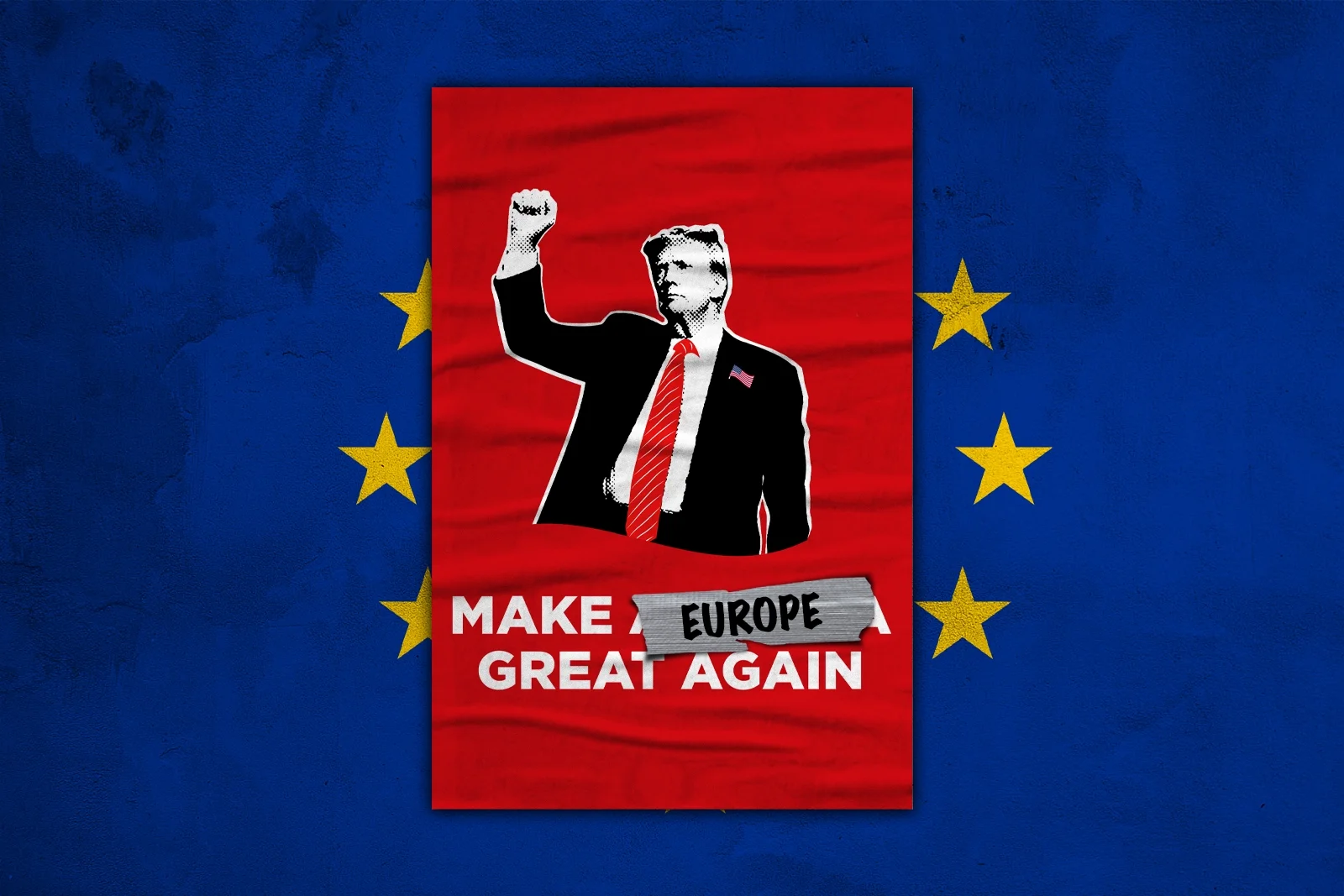

Trump’s War on Europe is Tearing Washington Apart
In American foreign policy, the bond with Europe—above all through the European Union and NATO—has long functioned as a structural beam rather than a decorative flourish. Since the end of World War II, that partnership has weathered crises, trade disputes, and strategic disagreements. Yet the underlying premise endured: the United States and Europe were bound together by shared interests and a shared vision of global order.
That premise began to fray with the arrival of President Donald Trump. His confrontational approach toward Europe did more than disrupt diplomatic etiquette; it undermined the foundations of the European Union. It sharpened a partisan divide that now cuts through the center of Washington’s foreign policy establishment.
For decades, disagreements over Europe tended to revolve around burden-sharing formulas or tactical adjustments. Today, they reflect something more fundamental. On one side stands a transactional nationalism that treats alliances as contingent bargains. On the other is a belief in collective security and durable institutions as expressions of American purpose. The dispute is no longer about how to manage the transatlantic relationship. It is about whether that relationship should anchor American strategy at all.
From the outset, Trump pressed NATO members to raise defense spending, imposed tariffs on European goods, and addressed European leaders with a bluntness that often veered into public scolding. Supporters saw overdue candor. Critics saw a rupture with the diplomatic habits that had underwritten the postwar order. Over time, these differences hardened into a defining political cleavage. Many Republicans aligned with Trump’s outlook argue that Europe has relied too comfortably on U.S. protection while resisting economic concessions. Democrats, by contrast, continue to view Europe as indispensable to sustaining the liberal international system built after 1945.
The contrast was on display at the most recent Munich Security Conference, the annual gathering that has long served as a barometer of transatlantic health. With Trump back in office and his hard-edged posture still shaping policy, prominent Democrats traveled to Munich in visible numbers. Among them were figures such as Gavin Newsom and Alexandria Ocasio-Cortez, both frequently mentioned as potential future presidential contenders. Their message was unmistakable: Trump occupies the Oval Office, but the alliance endures.
On the surface, their presence offered reassurance to anxious European officials. Beneath that reassurance lay a striking admission. When leading members of one party cross the Atlantic to signal that their own president’s foreign policy may be temporary, it reveals how thoroughly domestic consensus has eroded. During the Cold War and even in the turbulent years that followed, partisan conflict rarely targeted the transatlantic alliance itself. Today, that alliance has become a proxy battlefield in a broader struggle over national identity.
Trump’s impact on this divide stems less from incremental change than from inversion. Rather than adjusting the existing framework, he has challenged its premises. By questioning NATO’s strategic purpose and openly criticizing the European Union, he set aside assumptions that once enjoyed bipartisan support. Democrats have responded by elevating the defense of European ties into a test of America’s global character. Europe, in effect, has become the terrain on which two visions of the country compete: one that prizes autonomy and leverage, and another that sees alliances as force multipliers rooted in shared values.
Tone has magnified substance. In diplomacy, language can signal continuity or rupture as powerfully as policy. Trump’s dismissive remarks toward long-standing allies carried symbolic weight in European capitals. For Democrats, such rhetoric erodes American credibility and weakens the moral authority that has long accompanied U.S. leadership. Rebuilding trust, in this view, is not only about restoring military cooperation. It is about reaffirming a narrative of reliability that has shaped global expectations for generations.
These tensions unfold against a fraught strategic backdrop. Russia’s war in Ukraine grinds on, reshaping Europe’s security architecture and testing Western unity. China’s expanding influence adds another layer of pressure. In such a climate, Europe’s importance to American strategy is difficult to overstate. Democrats argue that wavering commitment risks emboldening adversaries and destabilizing NATO. Trump’s supporters counter that warnings of collapse are overstated and that European governments must assume greater responsibility for their own defense. For them, recalibration is not abandonment but overdue correction.
The debate over Europe thus folds neatly into the broader “America First” framework. Should alliances be judged primarily by immediate returns, or by their cumulative stabilizing effect? Is leadership measured by leverage or by stewardship? Each side claims realism, but they define it differently. One emphasizes cost-sharing and sovereignty. The other emphasizes deterrence and institutional continuity.
Seen in this light, the Democratic delegation’s presence in Munich was more than a symbolic gesture. It was an effort to project an alternative narrative of American steadiness. By appearing on Europe’s most prominent security stage, they sought to demonstrate that institutional memory and historical commitment remain embedded in the U.S. political system. Yet the very need for such reassurance underscores how much confidence has eroded. If bipartisan consensus still held, reassurance would not require partisan choreography.
The effects are intertwined. Abroad, European officials confront uncertainty about the durability of U.S. commitments. At home, partisan rhetoric intensifies as each side interprets European reactions through its own lens. The more doubts surface overseas, the more Democrats warn of reputational damage. The sharper those warnings become, the more Republicans frame them as alarmism designed to undermine a sitting president. A feedback loop takes shape, reinforcing suspicion on both sides of the Atlantic.
At its core, the dispute is not about tariffs or summit etiquette. It is about the meaning of American leadership. Should the United States continue to anchor the transatlantic system as it has since 1945, accepting the burdens that accompany influence? Or should it treat Europe as one partner among many, subject to renegotiation as circumstances change? The answers now align closely with party affiliation, and the gap shows little sign of narrowing.
Trump’s tough line toward Europe and the European Union is therefore more than a chapter in diplomatic history. It has illuminated a deeper fracture in American political life. The image of senior Democrats in Munich insisting that Trump is temporary while the alliance is permanent captures the paradox. The alliance may indeed endure, but the consensus that once sustained it no longer feels assured. If this trajectory continues, the consequences will extend beyond Brussels or Berlin. They will shape the coherence of American foreign policy for years to come.